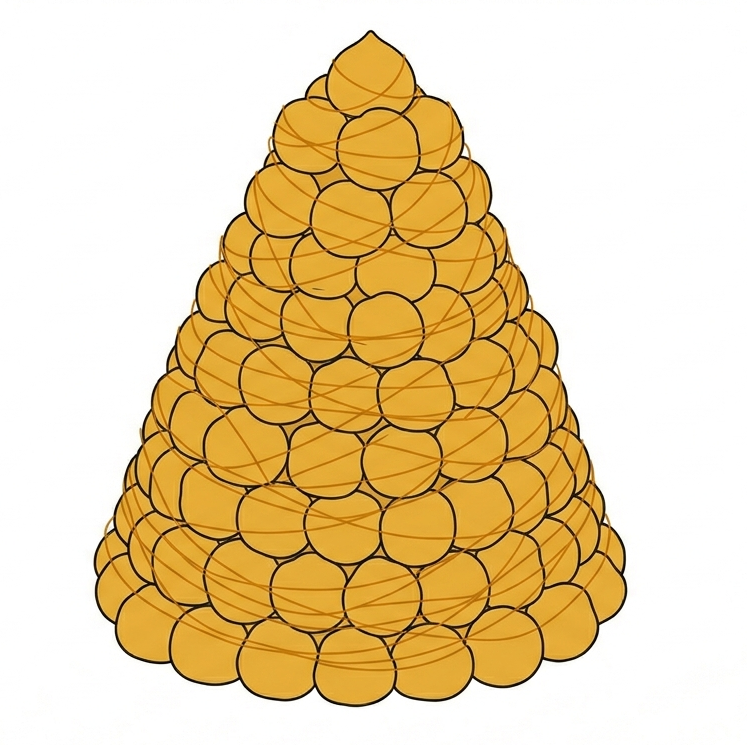
Croquembouche is a conical tower of choux pastry puffs filled with pastry cream and held together with threads of pulled caramel. It is the traditional centerpiece dessert for weddings, baptisms, and first communions in France, served in place of wedding cake at formal celebrations. The name translates literally to “crunches in the mouth,” a reference to the hardened caramel shell that shatters when a puff is pulled free.
The structure is assembled to order, typically by a professional pastry chef, and can reach considerable height — anywhere from a foot tall for a small gathering to several feet for a large reception. Individual puffs are dipped in hot caramel and stacked in a tight spiral around a cone mold, then decorated with spun caramel, sugared almonds, dragées, or fresh flowers. The caramel acts as both adhesive and glaze, setting into a rigid amber lattice as it cools.
Choux pastry — the base of the puffs — was introduced to France from Italy in the sixteenth century, credited to cooks brought over by Catherine de Medici. The French pastry tradition absorbed and formalized it over the following two centuries. Catholic monastic kitchens played a significant role in the development of French confectionery broadly, including the refined custards and cream fillings that became standard for filled pastries. The assembled tower format was codified by Marie-Antoine Carême in the early nineteenth century, who treated pièces montées — elaborate architectural pastry constructions — as a central expression of French haute cuisine. His written instructions established croquembouche as a discipline with specific technique, not just a festive improvisation.
The pastry cream filling is typically vanilla, though chocolate and praline variations are common. Regional and contemporary versions may incorporate liqueur-flavored creams or fruit. Some bakeries offer individual choux puffs as an accessible approximation, but the assembled tower is the form the dessert is known for — the spectacle is inseparable from the tradition.
Croquembouche declined in French home cooking as the twentieth century progressed, requiring skill and timing that made it largely the domain of professional pâtisseries. It has seen renewed visibility internationally through cooking competitions and food media, which has increased demand outside France, particularly in Australia and the United States, where it is sometimes offered as an alternative to tiered wedding cake. In France, it remains conventional for Catholic sacramental celebrations, where it is still expected in much of the country.
This content was created with the assistance of AI. Sources are currently being reviewed.