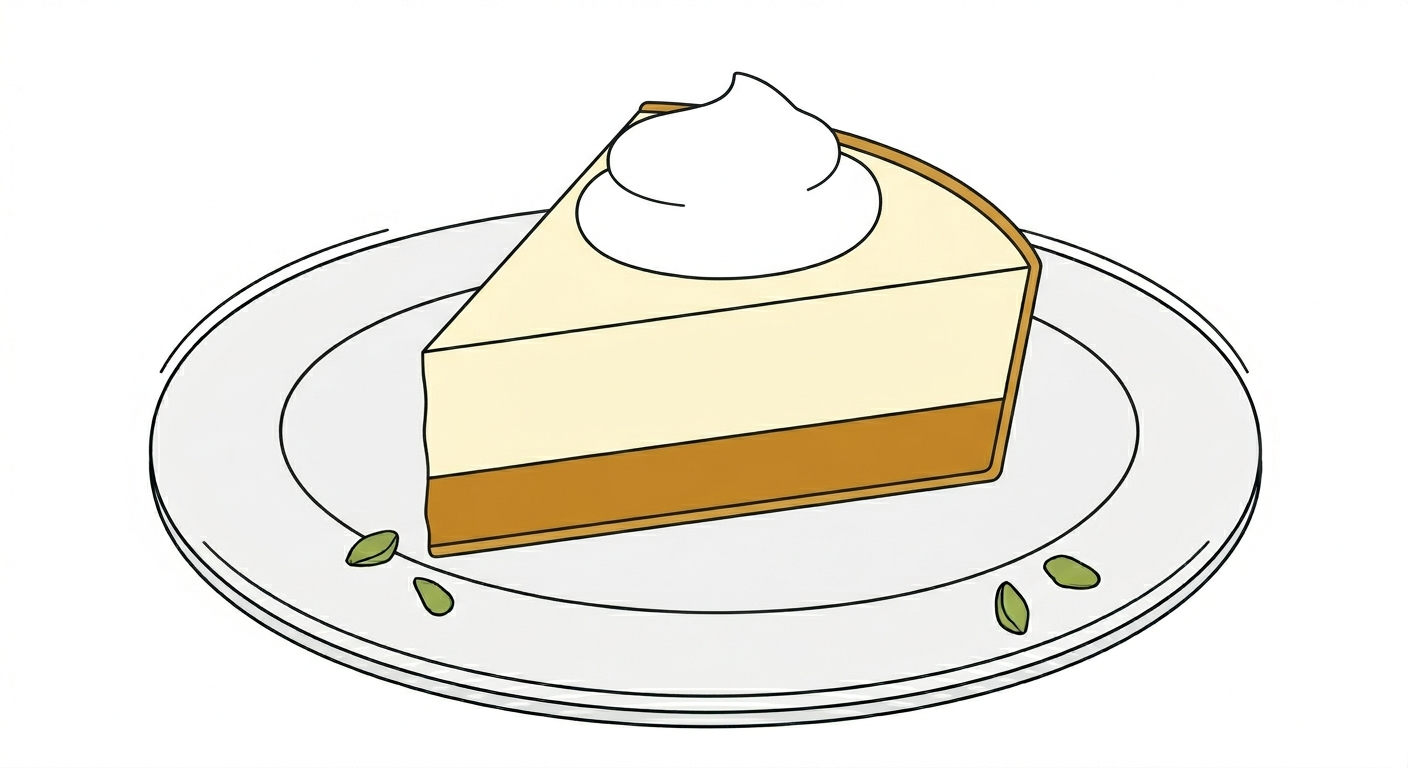
Chiffon pie is a single-crust pie filled with a mousse made from egg yolks, sugar, gelatin, and beaten egg whites or whipped cream folded together to create an airy, set filling. It is served cold and sliced cleanly, holding its structure without being dense. The crust is typically a standard pastry shell or graham cracker base. Flavor variations are wide — lemon, lime, chocolate, pumpkin, eggnog, and strawberry are all common — but the defining characteristic is the method, not the flavor.
The filling is cooked on the stovetop, bloomed gelatin is incorporated while hot, and the mixture is cooled until it begins to set before whipped whites or cream are folded in. The result is a filling that is lighter than a custard pie and more stable than a cream pie, slicing without collapsing. It was a practical solution for home bakers who wanted an impressive cold dessert that could be made ahead and refrigerated.
The pie is credited to Monroe Boston Strause, a Los Angeles-based professional baker who developed and named it around 1926, drawing an explicit comparison to chiffon fabric — light, airy, and delicate. He promoted it actively through industry publications and demonstrations, and it spread quickly through home economics networks and newspaper recipe columns. By the 1930s and 1940s it was a fixture in American home baking, appearing regularly in community cookbooks and women’s magazine food sections. Knox gelatin and similar brands amplified its reach through recipe pamphlets distributed nationally.
Chiffon pie belongs to a distinctly American category of cold, gelatin-structured desserts that peaked mid-century. It requires no special equipment beyond a stovetop and a mixer, and it tolerates a wide range of flavor profiles without changing the core technique, which contributed to its adaptability across regions. Lemon chiffon became particularly associated with spring and summer entertaining. Pumpkin chiffon offered a lighter alternative to dense pumpkin custard pie at Thanksgiving.
Its visibility declined alongside the broader retreat of gelatin-based cooking from American mainstream food culture in the latter decades of the twentieth century. It remains in active use in regional American baking, particularly in the Midwest and South, and appears consistently in community and church cookbook traditions where mid-century American recipes have stayed in circulation.
This content was created with the assistance of AI. Sources are currently being reviewed.