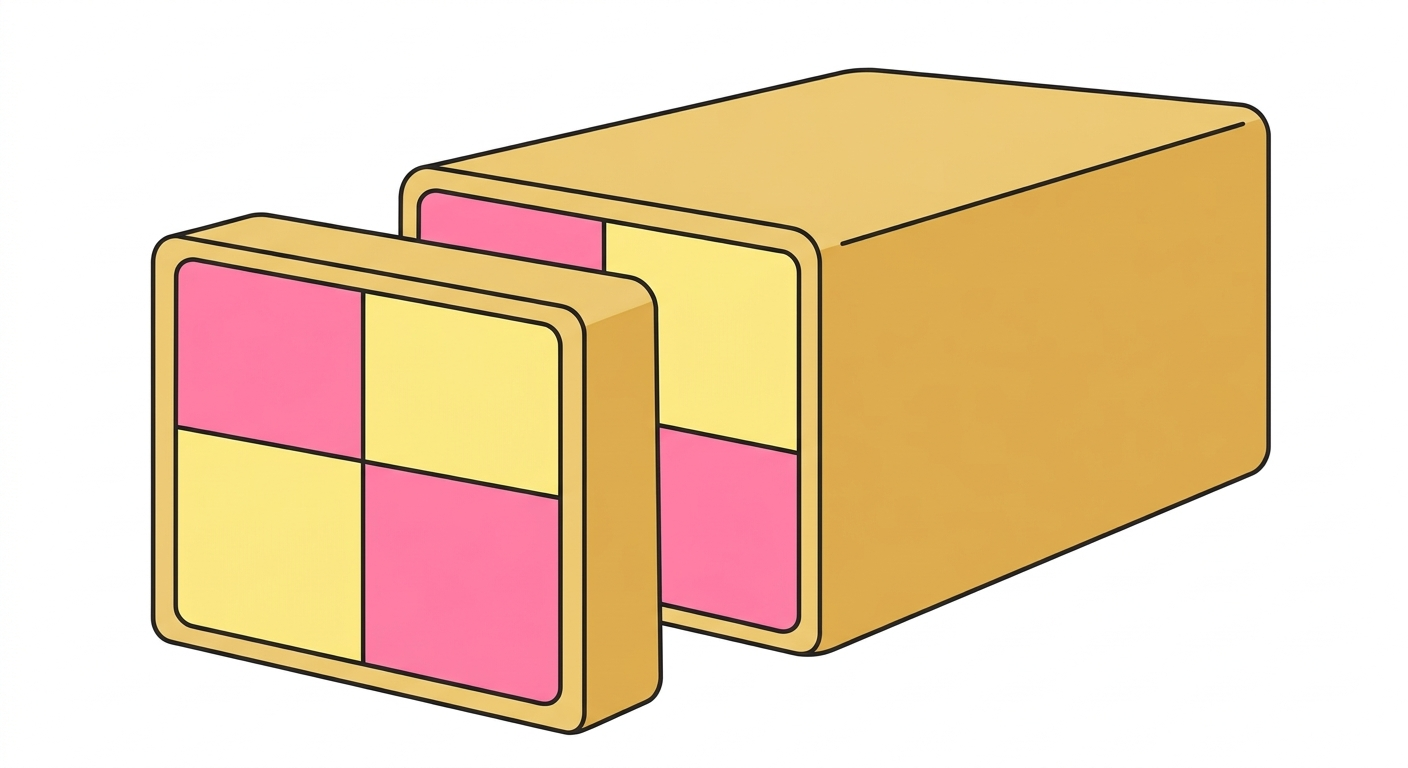
Battenberg cake is a rectangular sponge cake made from two separately baked loaves — one plain, one tinted pink — cut into strips, reassembled in a two-by-two checkerboard pattern using apricot jam as adhesive, and wrapped entirely in a sheet of rolled marzipan. The cross-section, revealed when sliced, shows the alternating pink and yellow squares enclosed in the pale almond exterior. The sponge is light and almond-flavored; the apricot jam is tart enough to cut through the sweetness; the marzipan adds a dense, confectionery finish. It is served at afternoon tea, bought in supermarkets in the individually wrapped form, and appears reliably at any occasion that calls for something both traditional and visually distinctive.
The cake is associated with the 1884 marriage of Princess Victoria, granddaughter of Queen Victoria, to Prince Louis of Battenberg — a German nobleman whose family name the cake takes. The story holds that British pastry chefs, drawing on German confectionery traditions including the use of marzipan, created the cake for the occasion, with the four squares said to represent Prince Louis and his three brothers. That detail is almost certainly retrofitted: the earliest published recipe, from Frederick Vine in 1898, specifies nine squares, not four. The same year, Agnes Bertha Marshall published a version calling it Domino Cake; Robert Wells published another under the name Church Window Cake. The four-square format, which is the one now universally used, appears to have become standard during the early twentieth century when commercial production simplified the construction to its minimum viable checkerboard.
Prince Louis later anglicized his surname to Mountbatten during World War I, under pressure to distance the British royal family from German associations. The cake kept its original name. It remains a fixture of British baking — one of the signature challenges on the Great British Bake Off and a tea room staple — and its checkerboard pattern has traveled beyond food: the alternating blue-and-yellow squares used on British emergency vehicles are officially called Battenburg markings for the resemblance to the cake’s cross-section.
This content was created with the assistance of AI. Sources are currently being reviewed.