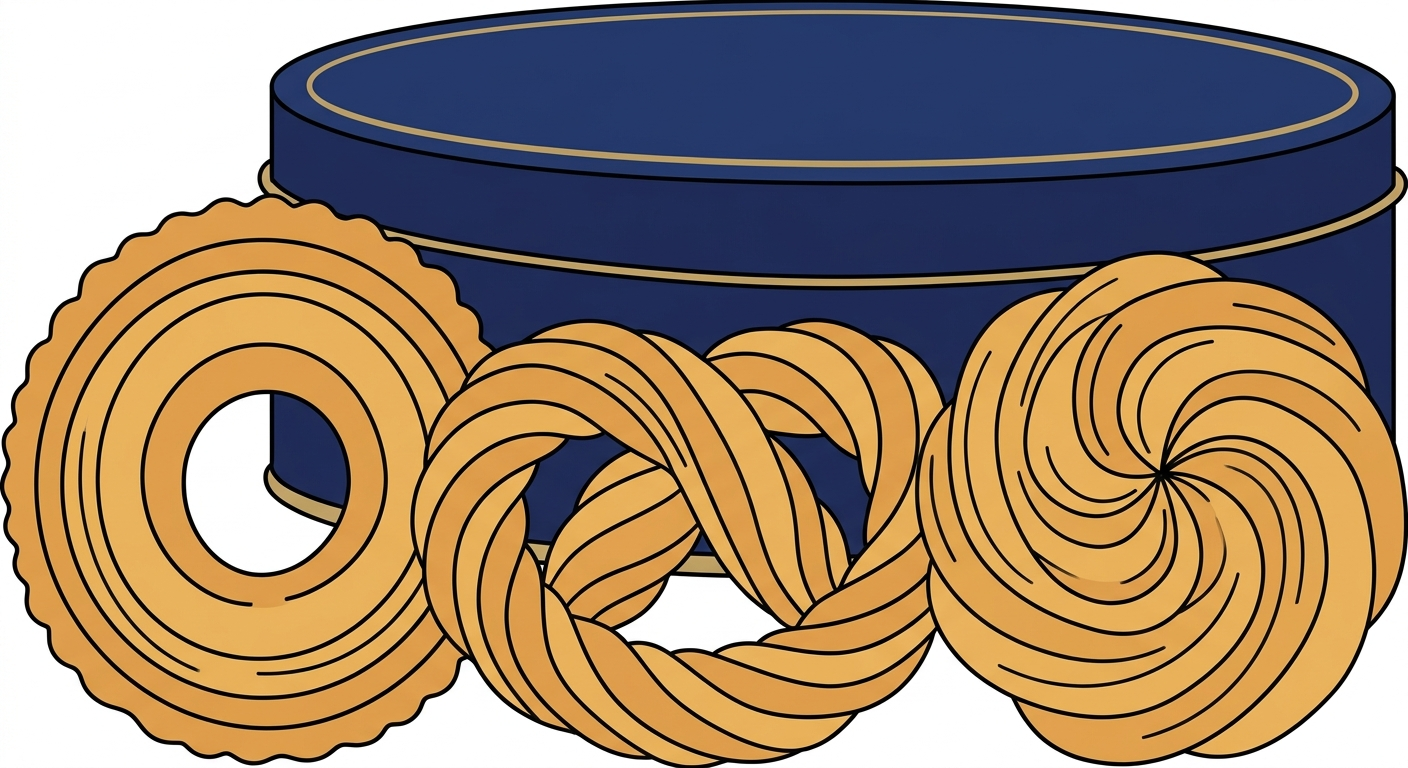
The Danish butter cookie is a crisp, short, lightly sweet cookie made from a high ratio of butter to flour, piped or pressed into shapes — vanilla rings, pretzels, braids, rounds — and baked until pale gold. The dough is essentially a piped shortbread: no eggs in the base recipe, no leavening, just butter, flour, sugar, and vanilla working together to produce a cookie that snaps cleanly and melts quickly. The butter is the point. Danish dairy has a high fat content and a distinct flavor that the cookie is built around, and the quality of the butter determines the quality of the result more directly than in most baked goods. The cookies are not complicated. What made them famous was the tin.
The Kjeldsen bakery opened in 1933 in Nørre Snede, a small village in Jutland, when Marinus Kjeldsen began selling his wife Anna’s butter cookies to neighboring villages. The cookies traveled well — their low moisture content and sturdy tin packaging kept them fresh during shipping — and by the 1950s Kjeldsen was exporting to the United States, and by 1963 to Hong Kong, where Danish butter cookies became so embedded in local gift culture that they are still strongly associated with the city. Royal Dansk, a separate company, began production in Helsingør in 1966 and packaged its cookies in the round blue tin that became the product’s most recognizable feature. The two companies merged in 1990 to form Kelsen, which now produces over 25,000 tons of cookies annually from factories in Denmark.
The blue tin accumulated a cultural life of its own. It appeared in households as a sewing kit, a button collection, a storage container — the disappointment of opening a tin expecting cookies and finding thread is a shared experience specific enough to be a meme decades before the word existed. The tin’s image, a Danish farmhouse called Hjemstavnsgaard on the island of Funen, was added in the early 1970s to evoke the farming heritage behind the butter. In 2019 Kelsen was acquired by Ferrero for $300 million. The cookies are still made in Denmark. The tin is still blue.
This content was created with the assistance of AI. Sources are currently being reviewed.