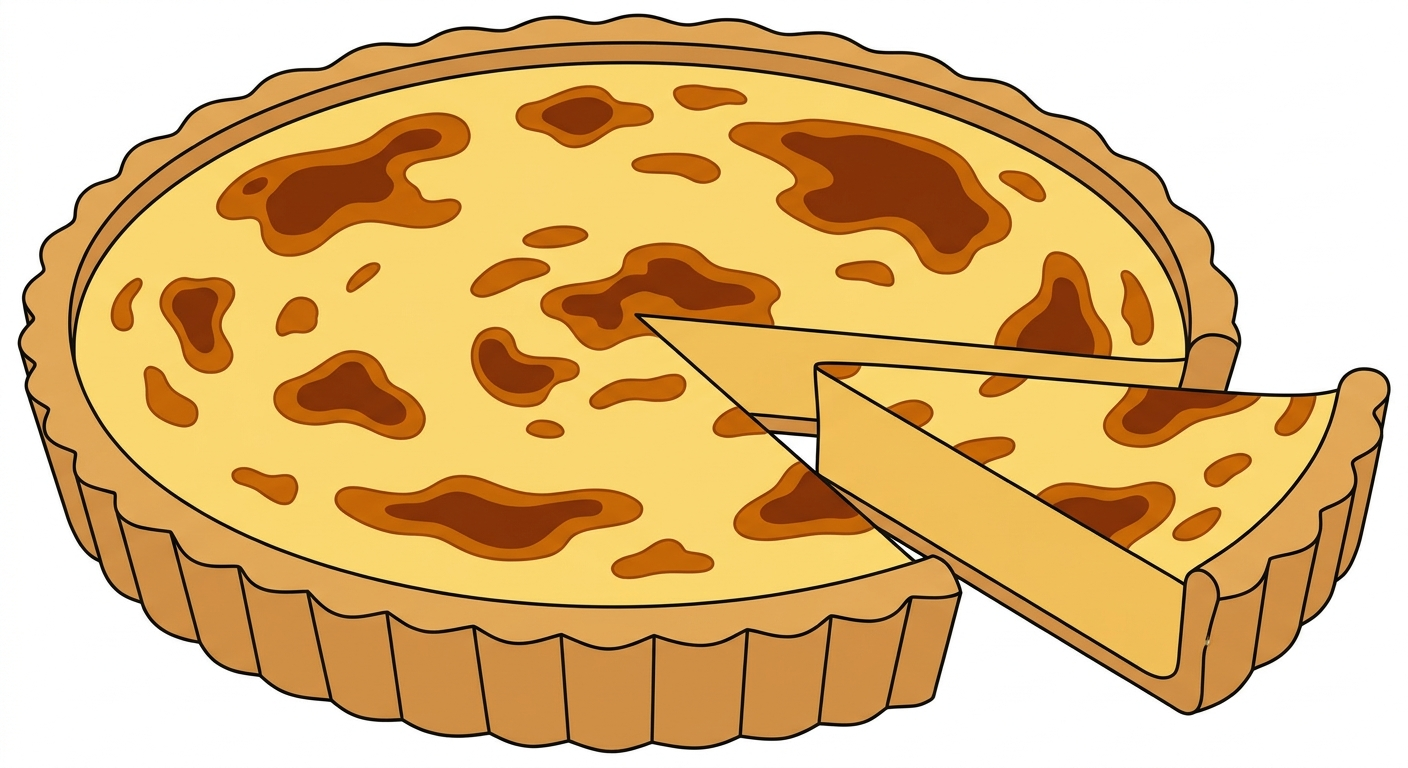
Tarte à la bouille is a custard pie built on a sweet dough crust — thick, tender, and closer to a sugar cookie than a conventional pie shell — filled with a cooked vanilla custard made from milk, eggs, cornstarch, butter, and sugar. The filling is set before it goes into the shell, poured in warm, and baked until the crust turns golden. A lattice of the same sweet dough typically covers the top. The name translates loosely from French as “boiled tart” or “burnt milk tart” — bouille referring to the method of cooking the custard on the stovetop before baking. It is not a fancy dessert. The ingredient list is short, the technique is straightforward, and the result is dense, creamy, and sweet without being complicated.
The sweet dough base — pâte sucrée in French — arrived in Louisiana with the Acadian settlers expelled from Canada’s Maritime provinces in the mid-eighteenth century. These French-speaking communities, displaced from what is now Nova Scotia and New Brunswick, settled in the rural bayou regions of south Louisiana and built a cooking tradition from what the land and the farm provided: milk, eggs, lard, sugar, and flour. The tarte à la bouille is a direct product of that pantry. It required no special equipment, no imported ingredients, and no techniques beyond what a home cook already knew. The custard filling is essentially la bouille — a simple Cajun milk pudding eaten on its own or spooned over cake — poured into a pie shell and baked into a more portable, sliceable form.
The pie has remained largely unknown outside of Cajun country, which is part of what distinguishes it from the better-traveled desserts of New Orleans. It circulates through church fundraisers, Knights of Columbus hall dinners, and family holiday tables in the parishes of Acadiana — St. Landry, St. Martin, Assumption, Lafourche. Grand Coteau, a small town in St. Landry Parish, holds an annual Sweet Dough Pie Festival in its honor each fall, drawing over a hundred vendors. Fruit-filled variations — fig, sweet potato, lemon, blackberry — exist alongside the custard original, but the tarte à la bouille is the version that predates the festival, the one that lives in grandmother’s recipe box rather than a bakery display case.
This content was created with the assistance of AI. Sources are currently being reviewed.