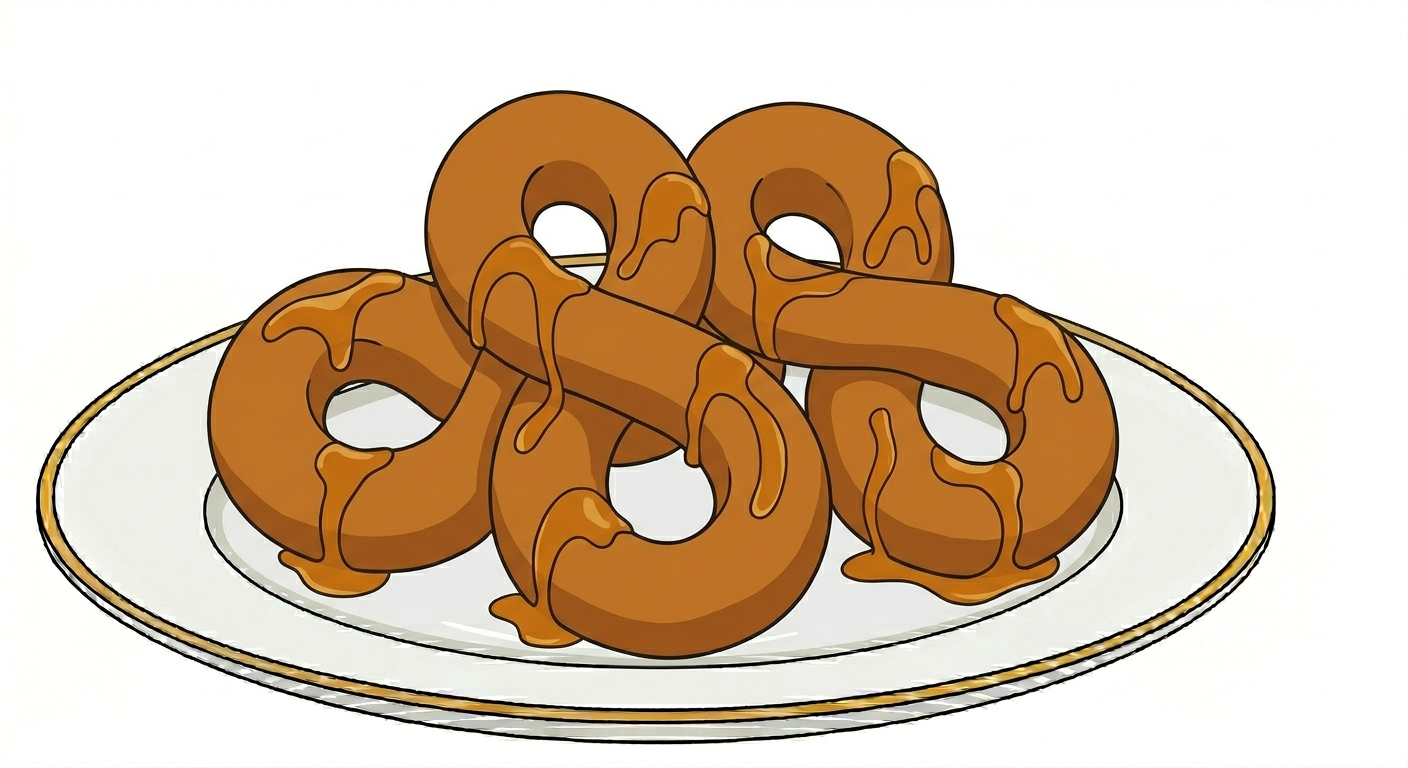
Cuban buñuelos are made from boiled and riced yuca and malanga — two starchy root vegetables common across the Caribbean — combined with egg, anise extract, salt, and just enough flour to bind the dough into a workable mass. The dough is rolled into ropes and twisted by hand into figure eights, then deep fried until golden and cooked through. The finished fritters are soft and pillowy inside, lightly crisped outside, and served immediately flooded with a warm syrup of sugar, water, cinnamon, star anise, and lime — a thin, fragrant glaze that soaks into the dough and pools on the plate. The figure eight is not merely decorative: the shape increases surface area for even frying, and the loops trap syrup in the folds. Some accounts attribute symbolic meaning to the shape — the infinity symbol, a wish for abundance into the new year — though the more practical explanation is that it is the natural form for a sticky, yielding dough that resists being formed into anything more precise.
The Cuban version diverged from its Spanish origin out of necessity. When Spanish colonizers arrived in Cuba, wheat did not thrive in the tropical climate and was expensive to import. The adaptation was to replace wheat flour with the root vegetables that grew readily on the island — yuca, malanga, boniato — producing a dough with a different texture, a more neutral flavor, and a lighter interior than a wheat-based fritter would yield. Anise, which flavored the original Spanish buñuelos, was retained in the syrup and worked into the dough itself, becoming the aromatic signature of the Cuban version. The result is a distinctly Cuban form of a shared Latin American tradition, shaped by what the island’s land offered rather than what the original recipe specified.
Buñuelos cubanos are a Noche Buena food — Christmas Eve — eaten after the roast pork dinner that anchors the Cuban holiday table. They are made at home in large batches, often by multiple generations working together, and eaten warm with syrup ladled over at the moment of serving. The tradition traveled with the Cuban diaspora and remains a fixture of Cuban-American Christmas celebrations in Miami and elsewhere. The smell of yuca and malanga frying with anise is, for many Cubans and Cuban-Americans, the specific sensory marker of Christmas Eve.
This content was created with the assistance of AI. Sources are currently being reviewed.