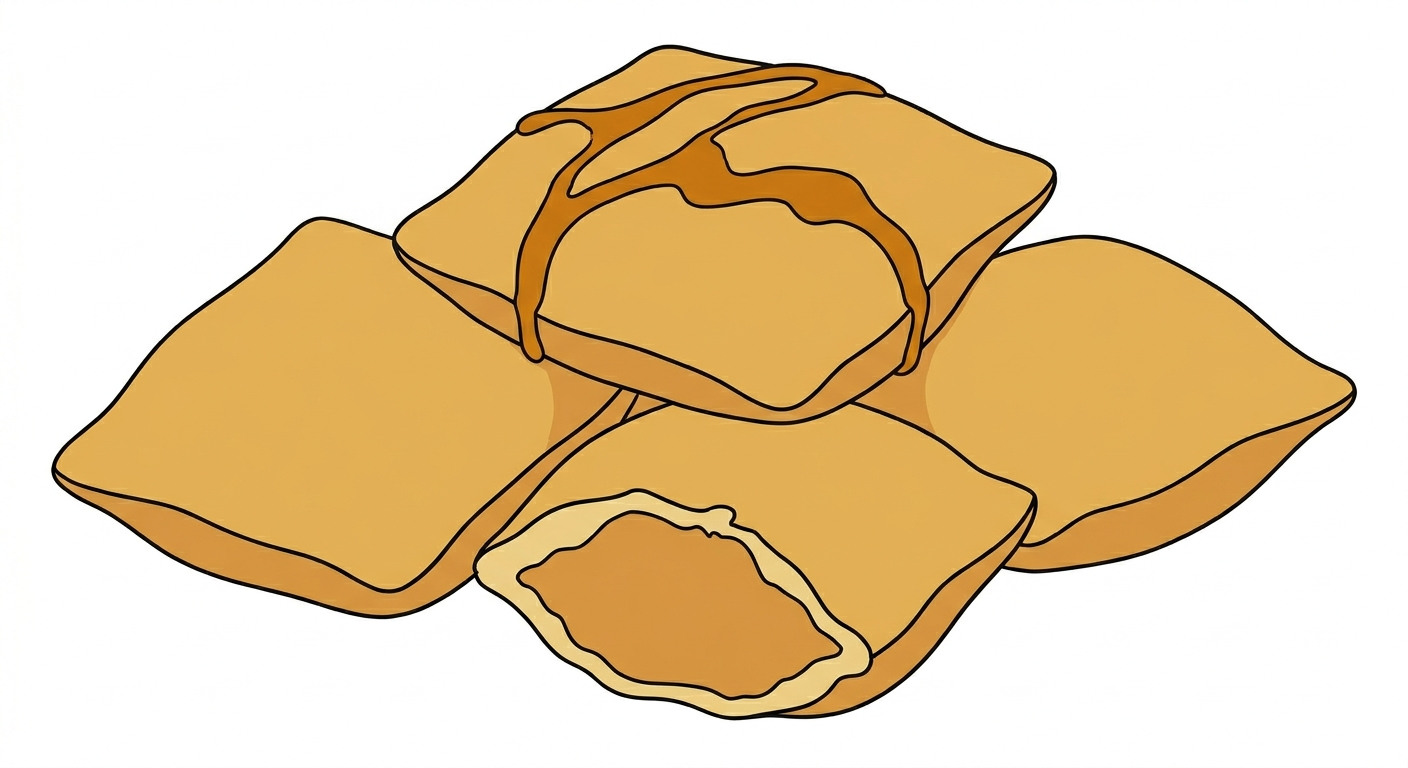
Sopapillas are small squares or triangles of unleavened dough — flour, baking powder, salt, and lard or shortening — dropped into hot oil, where steam converts the moisture in the dough into a pocket of air that inflates the dough from the inside into a hollow, pillow-shaped puff. The exterior fries golden and slightly crisp while the interior stays soft and empty. They are served hot, immediately, with honey drizzled over the top or provided on the side for dipping. In New Mexico, where sopapillas are considered a staple bread rather than a dessert, they arrive at the table alongside red or green chile dishes, used to scoop sauce, mop up stew, or cool a bite of something spicy. As a dessert they are drizzled with honey and sometimes dusted with powdered sugar or cinnamon. The same dough, the same technique, the same result — what changes is what surrounds them on the plate.
The origin runs through multiple converging traditions. The word derives from the Spanish sopaipa, itself rooted in a Mozarabic term meaning soaked bread, and Spanish settlers brought wheat flour, lard, and frying techniques to the Southwest during the colonial period beginning in the sixteenth century. Pueblo peoples and other Indigenous communities of the region had their own traditions of frying corn-based flatbreads, and the encounter between Spanish wheat dough and Indigenous frying methods produced what became the New Mexican sopapilla. A separate but related account connects the modern form to the period after the Long Walk of the Navajo to Bosque Redondo in the 1860s, when Native American and Hispanic communities stretched minimal government-issued flour rations into filling fried breads — the puffing of the dough making a small amount of flour go further. The Albuquerque area is most consistently cited as the point of origin for the New Mexican version.
Sopapillas should not be conflated with Navajo fry bread, which shares ingredients and the frying method but has a different origin, different cultural context, and a flatter, denser result without the steam pocket. They are also distinct from the Chilean sopaipilla — a similar name, a different food, made with pumpkin and eaten as a savory snack. The New Mexican sopapilla occupies an unusual position on the menu: served as bread, appetizer, and dessert simultaneously depending on the restaurant, the meal, and the diner. In New Mexico it is as expected at the table as a tortilla, and in many restaurants it arrives without being ordered.
This content was created with the assistance of AI. Sources are currently being reviewed.