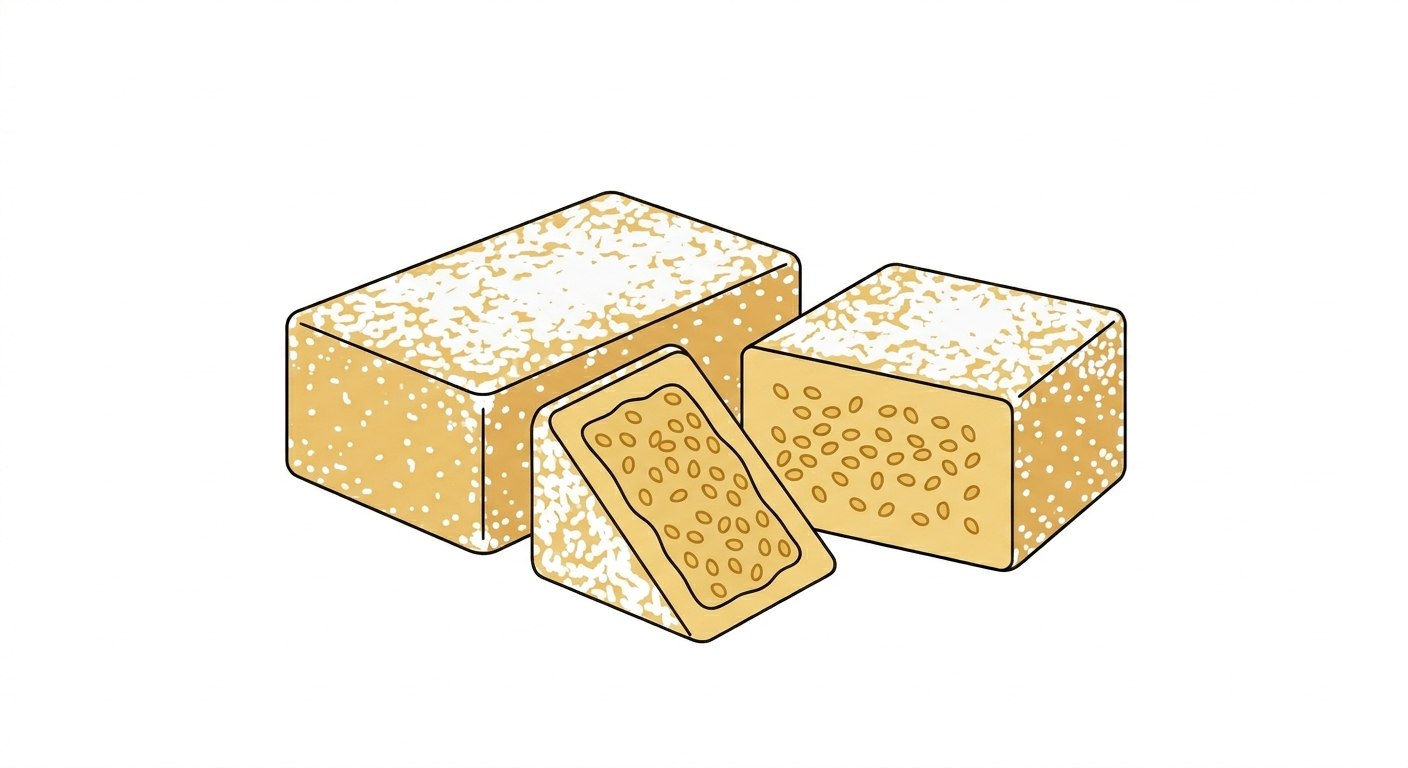
Chè lam is a chewy, dense confection — glutinous rice flour cooked with malt syrup until it pulls into a thick, pliable mass, then mixed with roasted peanuts, ginger, and sesame, pressed into blocks, and cut into small rectangles or squares. The texture is sticky and substantial, somewhere between a soft candy and a rice cake. The flavor is warm and layered — the malt syrup gives a deep, slightly fermented sweetness, the ginger cuts through with heat, the peanuts add crunch, and the sesame adds a toasty undertone that sits in the finish. It is not a delicate sweet. It is a food designed to be filling, to last, and to travel.
That practicality is embedded in its origin. The most documented account traces chè lam to the Lam Son insurgency of the early 15th century, when Vietnamese forces under Lê Lợi fought a decade-long resistance campaign against Ming Chinese occupation. Soldiers needed food that was calorie-dense, shelf-stable, and portable — something that could sustain a fighting force moving through difficult terrain without supply lines. Glutinous rice and malt syrup, both abundant in the northern Vietnamese agricultural regions where the uprising was based, combined into a food that met all of those requirements. The peanuts and ginger came with it.
Whether that origin is strictly historical or has accumulated legend around a real practice is difficult to verify at six centuries of distance, but the functional logic is sound — chè lam is exactly the kind of food that a military campaign would produce, and the villages of Thanh Hóa province, where the insurgency was centered, remain the most closely associated with its production today.
The second origin story runs alongside the first without contradicting it. Chè lam appears in accounts of Buddhist offerings during the Lunar New Year, prepared as a clean, vegetarian sweet to be placed on ancestral altars and temple offerings. The same qualities that made it practical for soldiers — long shelf life, dense nutrition, simple ingredients — also made it appropriate for ceremonial use, where food prepared in advance and presented in quantity was practical for households observing Tết.
The craft villages of Dương Lâm in Hanoi and Thanh Hóa province are where traditional production is concentrated. Artisans in these villages still cook the malt syrup and glutinous rice flour by hand in large pots, pulling and working the mixture to the correct consistency before adding the peanuts and ginger and pressing it into molds. The process requires experience to judge — the syrup temperature, the moment when the mixture is ready to be worked, the proportion of ginger that gives heat without overwhelming the malt sweetness. Machine production exists. The hand-cooked version is the standard that the machine versions are measured against.
Chè lam is a Tết food and a village gift — the kind of sweet brought home from a northern province as something specific to that place, wrapped simply, eaten in small pieces with tea. It has not traveled internationally and is not widely known outside Vietnam, which is consistent with a category of food whose meaning is tied to season, place, and the specific memory of eating it somewhere that it is made well.
This content was created with the assistance of AI. Sources are currently being reviewed.