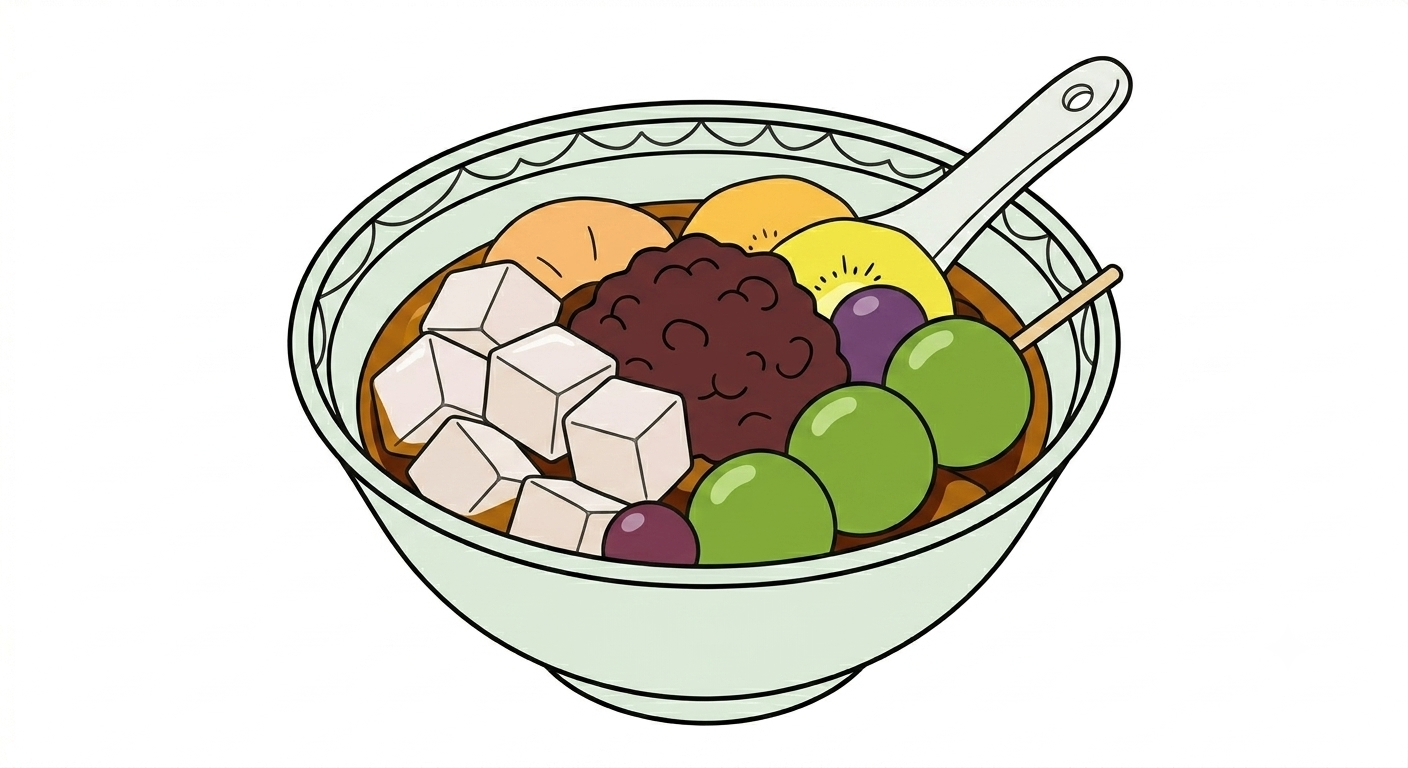
Anmitsu is a composed dessert — small cubes of kanten agar jelly arranged in a bowl alongside sweet red bean paste, shiratama mochi balls, cooked red endo peas, fresh or canned fruit, and a small pitcher of kuromitsu, the thick black sugar syrup made from Okinawan kokuto that you pour over everything yourself just before eating. The kanten is white, translucent, and almost flavorless — it provides texture and temperature rather than taste. The anko is dense and sweet. The kuromitsu is dark, molasses-like, and faintly bitter at the edges of its sweetness. The fruit is whatever is in season. The mochi balls are soft and slightly chewy. Together they produce a bowl that is simultaneously light and substantial, cold and sweet, with a range of textures that requires attention to eat rather than simply shoveling.
The name breaks down directly — an from anko, the red bean paste, and mitsu from the syrup. The dessert developed from an earlier preparation called mitsumame, which was simply the kanten cubes and endo peas served with syrup and no bean paste. Anmitsu is mitsumame made more substantial, the red bean paste added to give it depth and enough sweetness to be properly satisfying. The specific origin is unusually well documented for a dessert of its kind. Wakamatsu, a shop in Ginza, Tokyo, is credited with creating anmitsu in the early Showa period — the shop still operates today and still serves the original recipe, which is the kind of continuity that makes Tokyo’s old sweet shops worth seeking out specifically.
Kanten — the agar derived from tengusa and other red algae harvested from the waters around the Izu Islands and Amakusa — is the ingredient that makes anmitsu possible and the ingredient that makes it specifically Japanese. Agar has been used in Japanese cooking since the 17th century, when it was discovered that the seaweed extract, when dissolved in water and allowed to cool, sets into a stable, clear jelly that holds its shape at room temperature — unlike gelatin, which begins to melt the moment it warms. In the heat of a Tokyo summer, that stability matters. Anmitsu can sit on a table for the length of a conversation without collapsing, which is part of what made it the dessert of choice at the kissaten and traditional sweet shops where people went to sit, talk, and spend an afternoon.
The cream anmitsu variation — a scoop of vanilla ice cream added to the bowl — arrived later and is now equally canonical, served at Mihashi in Ueno alongside the traditional version. Mihashi, founded in 1948, sources its adzuki beans from Tokachi in Hokkaido, its brown sugar from Hateruma Island, and its kanten from Amakusa — an ingredient sourcing philosophy that treats the quality of each component as non-negotiable, which is consistent with the Japanese confectionery tradition that produced anmitsu in the first place.
Anmitsu is summer food, primarily — the cold jelly and the sweetness calibrated to heat and humidity in the way that certain foods are calibrated to specific conditions and lose something when those conditions change. It is eaten in the afternoon, at a table, with tea or barley tea alongside. It is the dessert of the old Tokyo sweet shop aesthetic — the painted signs, the low tables, the unhurried pace of a city that still makes room for the specific pleasure of sitting somewhere beautiful and eating something cold and sweet while the summer moves outside.
This content was created with the assistance of AI. Sources are currently being reviewed.