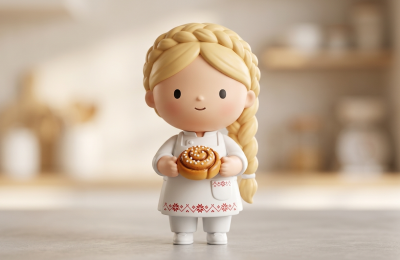
Finnish baking is closely tied to coffee culture — Finland consistently ranks as the world’s highest per capita coffee consumer, and the tradition of kahvipöytä, the coffee table spread, means that baked goods are a daily presence in Finnish social life rather than an occasional treat. Cardamom is the defining spice of Finnish baking, appearing in breads, pastries, and cakes in quantities that distinguish Finnish baking from other Scandinavian traditions.
Pulla is a cardamom-spiced enriched bread, soft and slightly sweet, eaten daily across Finland. Korvapuusti are cinnamon and cardamom rolls made from pulla dough — the Finnish equivalent of a cinnamon bun but with a distinct shaping technique and heavier cardamom flavor than Swedish or American versions. Laskiaispulla are cream-filled pulla buns eaten specifically during Laskiainen, the Finnish Shrove Tuesday celebration, filled with whipped cream and jam or almond paste.
Wild berries are central to Finnish desserts. Blueberries, lingonberries, cloudberries, and Arctic brambleberries are foraged seasonally and used in pies, puddings, jams, and tarts. Mustikkapiirakka — a blueberry pie made with a quark-based filling in a shortcrust shell — is one of the most common Finnish home-baked desserts. Cloudberries, which grow in the Arctic and sub-Arctic regions of Finland, are among the most prized and expensive berries in the country.
Runeberg torte is a cylindrical almond and rum cake topped with raspberry jam and sugar icing, eaten specifically on February 5th — the birthday of Finnish national poet Johan Ludvig Runeberg. It is one of the clearest examples of a Finnish dessert with a fixed cultural occasion and a documented origin story.
This content was created with the assistance of AI. Sources are currently being reviewed.