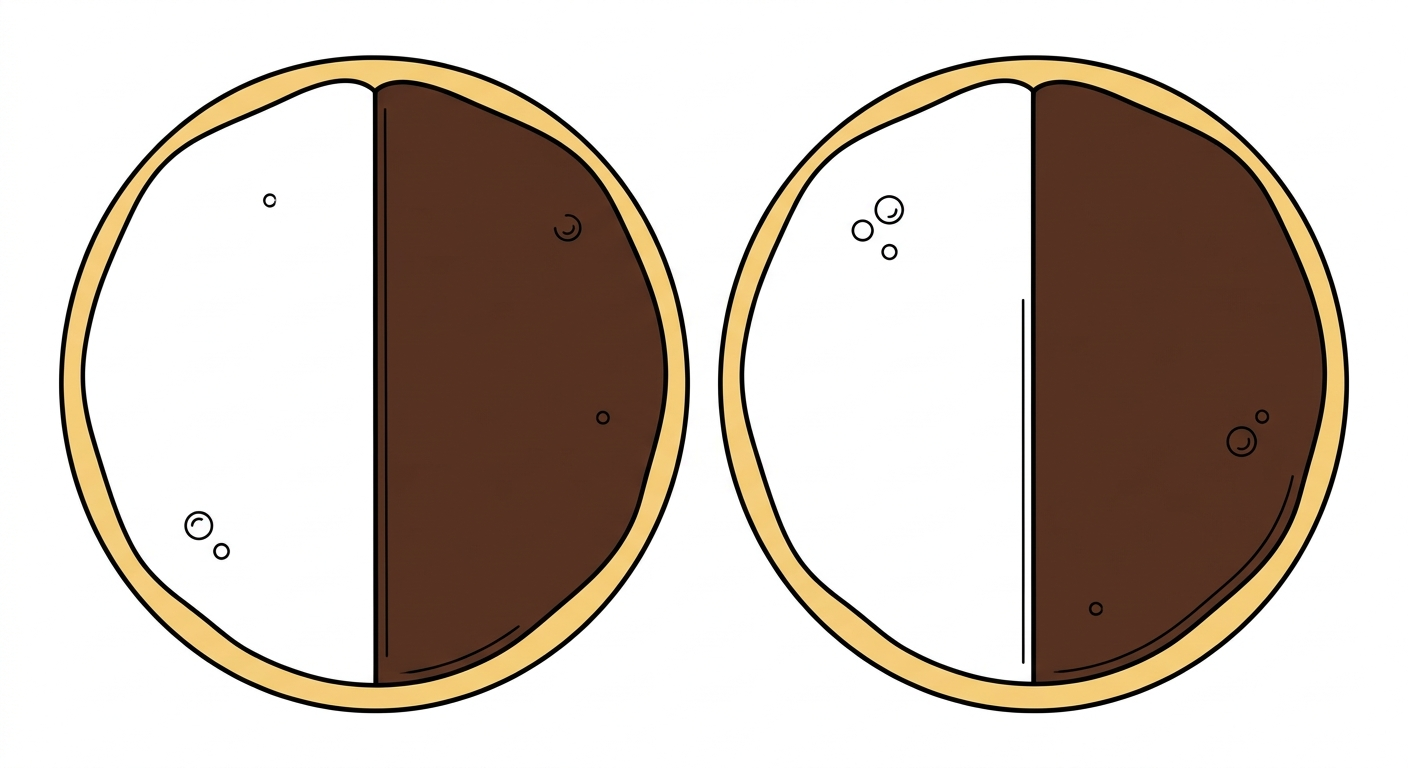
The black and white cookie is a soft, cake-like round — closer to a drop cake than a conventional cookie — iced with two distinct glazes: vanilla fondant on one half, chocolate fondant on the other, meeting in a clean line down the center. The base is made from a thickened cupcake-style batter, which produces a tender, slightly crumbly texture that holds the icing without becoming soggy. It is eaten at room temperature, usually in a single sitting, and the question of whether to eat each half separately or get both in every bite is the kind of thing New Yorkers have opinions about.
The most documented origin points to Glaser’s Bake Shop in Manhattan’s Yorkville neighborhood, opened in 1902 by Bavarian immigrants Justine and John Glaser. A competing claim comes from Hemstrought’s Bakery in Utica, New York, which introduced a similar item called the half-moon cookie in the early twentieth century. The two are related but distinct: the black and white has a flatter, shortbread-adjacent base with fondant icing, while the half-moon is domed and uses a cake base with buttercream frosting. Both trace to German baking traditions, and the German Amerikaner — a glazed, cake-like pastry with a similar structure — is the likely common ancestor of both American versions. The origin of the name “Amerikaner” for that pastry in Germany suggests the connection ran in both directions.
After World War II the black and white cookie became firmly embedded in New York’s Jewish bakery culture, appearing in delis and Jewish-owned bakeries across the city. The association stuck, though the cookie itself predates that cultural adoption. It entered broader American consciousness through a 1994 episode of Seinfeld, in which Jerry uses the two-toned icing as a monologue on racial harmony — a moment that added a layer of cultural weight to an already iconic object. Glaser’s Bake Shop closed in 2018 after 116 years. The cookie outlasted it.
This content was created with the assistance of AI. Sources are currently being reviewed.