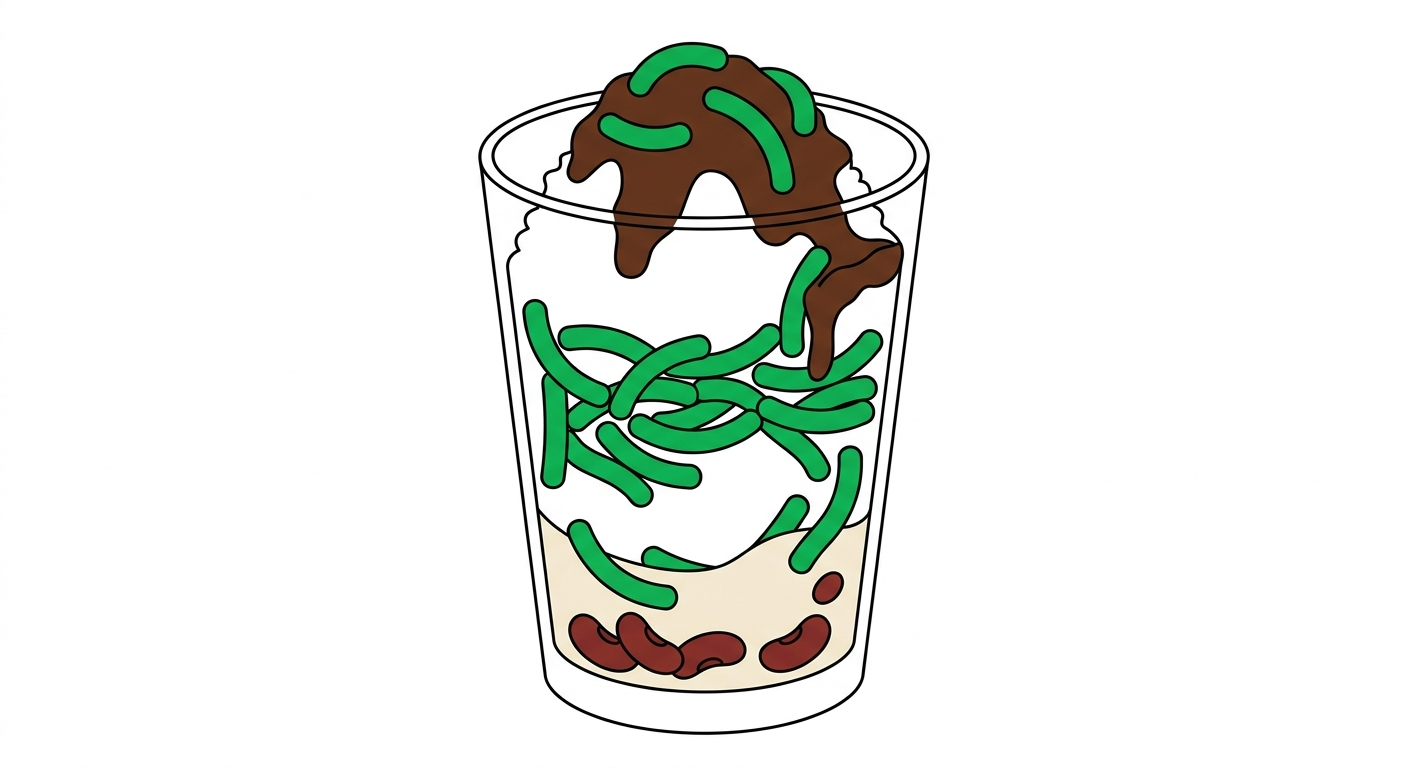
Cendol is shaved ice layered with coconut milk, palm sugar syrup, and green rice flour jellies — thin, worm-like strands pressed through a strainer and tinted electric green by pandan leaf juice. The palm sugar goes in dark and thick, bleeding into the coconut milk as it is poured, the two liquids pooling around the ice in a color gradient from white to deep amber. The green jellies sit on top or are buried beneath the ice depending on who is assembling the bowl. The whole thing is eaten with a spoon, working from the top down, the ice melting gradually into the coconut milk and making the liquid at the bottom sweeter and colder as you go. It is a dessert for hot weather, which in most of Southeast Asia means it is a dessert for every day.
The three core elements — pandan jelly, coconut milk, palm sugar — are all native to the Southeast Asian archipelago. Pandan is a leafy plant with a grassy, slightly nutty fragrance that functions as the vanilla of Southeast Asian cooking, present in both sweet and savory preparations across the region. Coconut milk comes from the fruit that grows everywhere along the equatorial belt. Palm sugar is produced from the sap of the sugar palm, dark and complex in a way that refined sugar is not, with a faint molasses quality that is part of what makes cendol taste like it belongs to a specific place rather than to a generic category of cold sweets. The combination of these three ingredients in their current form is old enough that the dessert precedes any of the national identities now associated with it.
The oldest documented reference is in the Kakawin Kresnayana, a Javanese manuscript written by Mpu Triguna in the 12th century during the Kediri Kingdom in East Java. The dessert described there is closer to dawet — the Indonesian name for the same preparation made without shaved ice, served as a drink in a tall glass. Dawet is still made and consumed throughout Java, particularly in Central Java and Yogyakarta, where it is sold by street vendors carrying the traditional equipment on a shoulder pole and where a version called es dawet ireng uses black jellies colored by ash from burned rice stalks. The wedding ritual called Dodol Dawet incorporates the drink into Javanese marriage ceremonies, the bride and groom’s parents selling it symbolically to guests — a ritual old enough to suggest that dawet was already deeply embedded in Javanese culture long before it was written down.
The shaved ice version — cendol as distinct from dawet — developed later, most likely in the port cities of the Malay Peninsula where trade brought ice technology and where the dense, humid heat made a cold version of the drink commercially viable. Penang and Melaka in Malaysia both claim particular authority over their versions of cendol, and both have good reason — Penang’s cendol uses gula Melaka, the specific palm sugar from Melaka that is considered the best available, and the Melaka version has been documented in a Dutch East Indies cookbook as early as 1866. Malaysia declared cendol an Intangible Cultural Heritage Object, which is the kind of institutional claim that reflects how thoroughly the dessert has been absorbed into Malaysian national food identity.
The debate over origin between Indonesia, Malaysia, and Singapore has been active for decades and is unlikely to resolve. The honest answer is that the dessert is regional rather than national — it belongs to the food culture of the Malay Archipelago in the same way that certain foods belong to the Mediterranean basin, crossing political borders that did not exist when the food first appeared. In Vietnam it is bánh lọt, served in chè. In Thailand it is lot chong. In Myanmar it is mont let saung. In Cambodia it is bang-aem lot. The pandan jelly and coconut milk run through all of these variations as constants, the shaved ice appears and disappears depending on climate and custom, and the palm sugar darkens or lightens depending on what is available locally. The bowl of cendol eaten in Penang and the glass of dawet drunk in Yogyakarta are the same food at different points in a very long history.
This content was created with the assistance of AI. Sources are currently being reviewed.