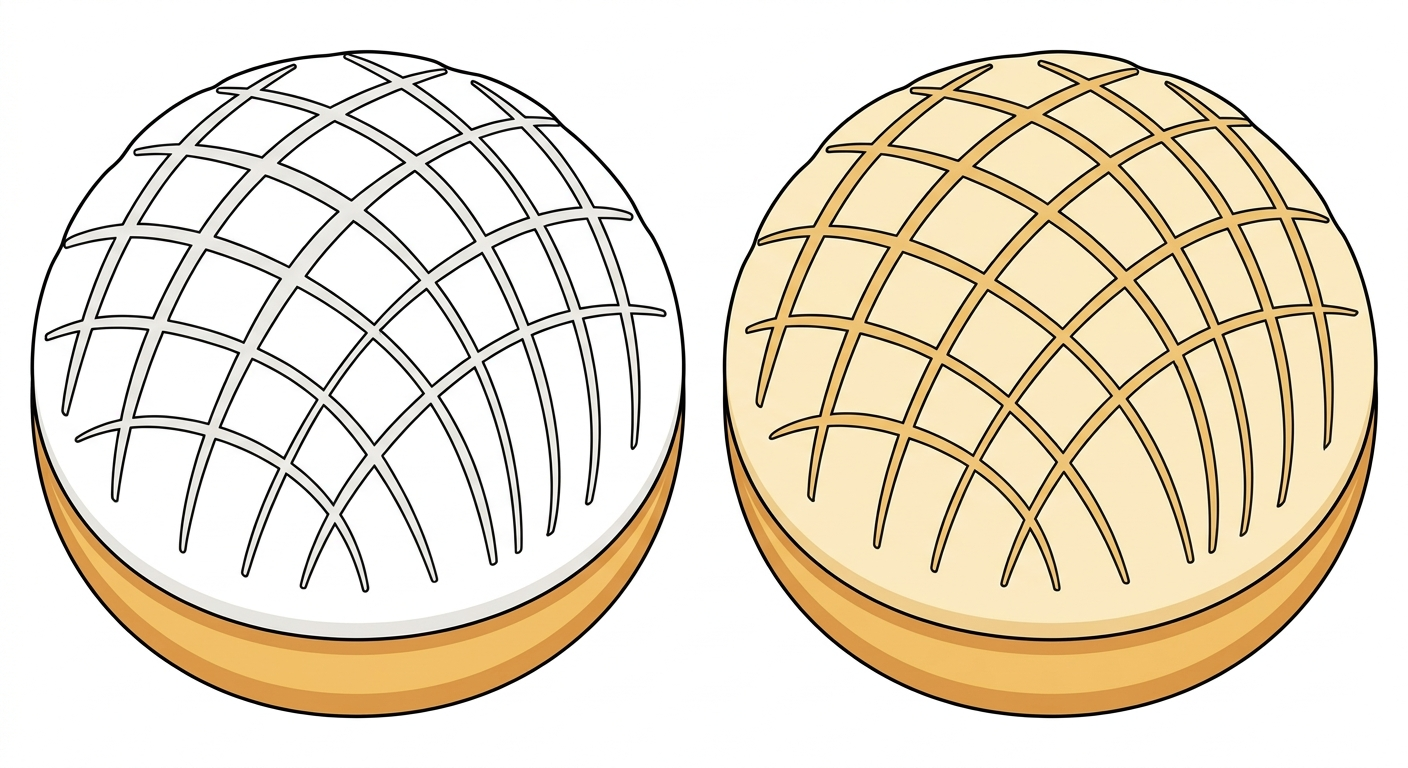
A concha is a round, domed sweet bread roll made from an enriched, brioche-adjacent dough — soft, slightly sweet, and tender — topped with a thick paste of flour, butter, and sugar that is scored before baking into the ridged pattern of a seashell. The topping bakes into a firm, crumbly crust that cracks slightly when you pull the bread apart, contrasting with the pillowy interior. Standard colors and flavors are white or yellow for vanilla, pink for strawberry, and brown for chocolate — the color comes from the topping paste, not the dough itself. The bread is eaten for breakfast, as an afternoon snack, or with hot chocolate or café de olla, and is available daily in panaderías across Mexico and in Mexican-American communities throughout the United States.
The concha belongs to pan dulce — sweet bread — a category of Mexican pastries that developed in two distinct phases. The first was the Spanish colonial introduction of wheat in the sixteenth century; before that, wheat was not grown in Mesoamerica, and the Catholic Church’s requirement that communion wafers be made from wheat made its cultivation a colonial priority. The second phase was the French influence of the nineteenth century, which peaked during the presidency of Porfirio Díaz, who actively promoted French culture and cuisine as a modernizing force. French bakers migrated to Mexico, bringing enriched doughs, lamination techniques, and decorative approaches that Mexican bakers absorbed and adapted. The result was a distinctly Mexican baking tradition that borrowed French methods but produced its own forms, shapes, and names — conchas, marranitos, orejas, cuernitos — each named for what it looked like rather than where it came from.
The concha’s shell pattern connects it visually to similar sugar-crusted buns elsewhere — the Hong Kong bolo bao and the Japanese melon pan share the cookie-topped structure, and food writers have debated the connections between them without conclusive resolution. What is certain is that the concha developed within the Mexican pan dulce tradition and became its most recognizable form. It is sold individually, carried in paper bags, eaten standing at a counter or at a kitchen table. The panadería that makes them fresh daily is a neighborhood institution, and the concha is its standard.
This content was created with the assistance of AI. Sources are currently being reviewed.