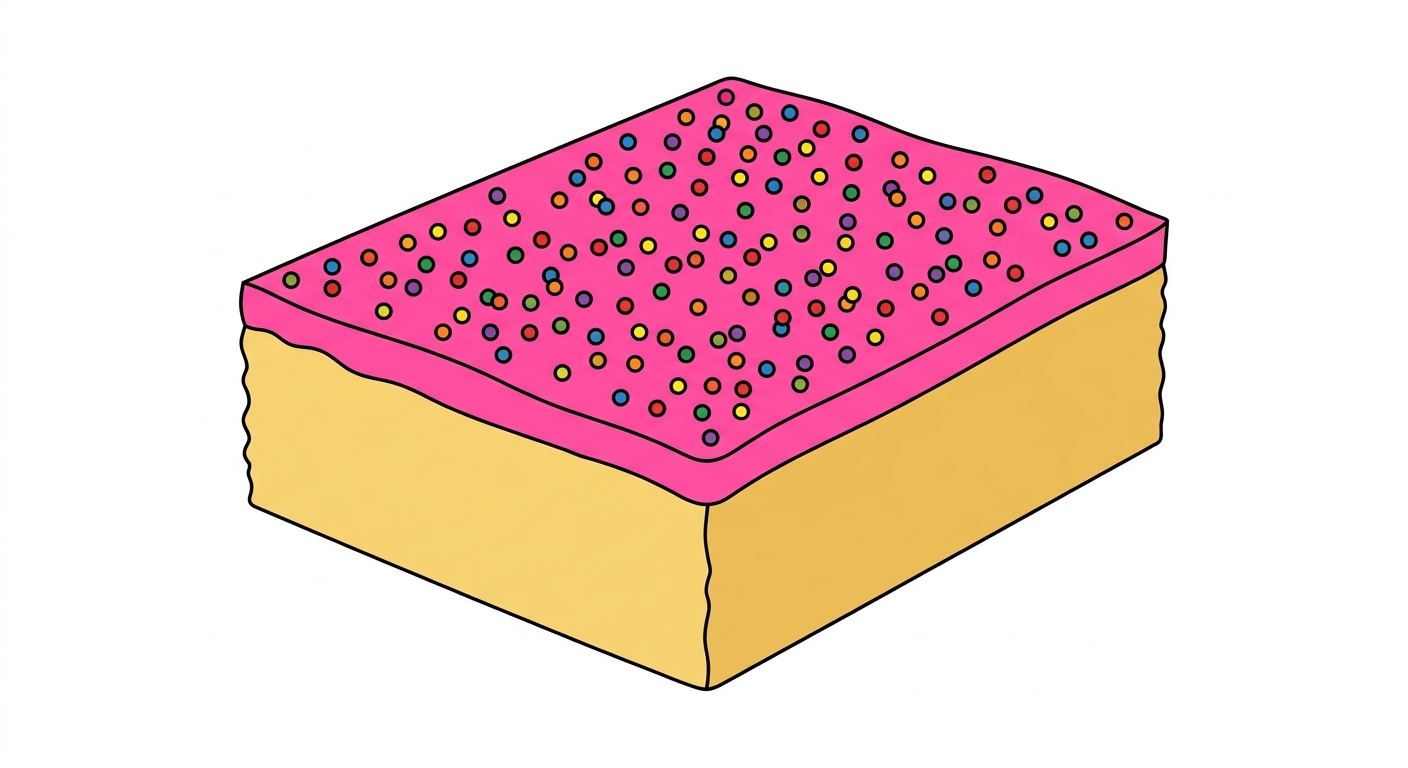
Cortadillo is a sheet cake — a single layer of light, fluffy sponge baked in a large pan, topped with bright pink frosting and a shower of rainbow nonpareils, then cut into squares or rectangles and sold by the slice. The cake is yellow and tender. The frosting is sweet, thick, and unmistakably pink. The sprinkles are non-negotiable. In a panadería display case full of conchas, cuernitos, and bolillos, the cortadillo is the one you can see from across the room.
The name comes from the Spanish verb cortar — to cut — which describes exactly how it is sold. A full sheet cake is baked, frosted, and then cut into individual portions for the display case. Some bakeries make two-layer versions with strawberry jam between them. The single-layer version is the standard. Both are correct, and people who grew up eating one version will defend it against the other.
Pan dulce as a category arrived in Mexico through the Spanish colonial period, when wheat, European baking techniques, and the panadería as an institution were all introduced to a food culture that had no prior tradition of wheat-based oven baking. The Spanish brought the bakery. What happened inside it was shaped by a second wave of outside influence in the mid-19th century, when the French Intervention brought French bakers and pâtisserie sensibility into direct contact with Mexican baking culture. The light sponge base of the cortadillo — génoise-adjacent, egg-forward, tender rather than dense — reflects that French influence more than it reflects the Spanish bread tradition. The pink frosting and the sprinkles are entirely Mexican, a visual language of celebration that belongs to the panadería and nowhere else.
The cortadillo is specifically associated with Nuevo León, the northern Mexican state where it is most deeply embedded in local baking culture, though it now appears in panaderías across Mexico and in Mexican and Mexican-American communities throughout the United States. It is sold by the slice for a few pesos — accessible enough to be an everyday item, festive enough to feel like a treat. It is eaten for breakfast with café de olla or hot chocolate, as an afternoon snack, at birthday parties, and at no occasion at all. There is no wrong time for cortadillo.
The TikTok dot cake trend of the early 2020s brought unexpected attention to cortadillo when people noticed the visual resemblance between the viral heavily-frosted cakes and something that had been sitting in panadería cases for generations. The cortadillo predates the trend by decades and has no relationship to it beyond a shared aesthetic logic — bright frosting, sprinkles, the visual pleasure of a cake that does not try to be subtle. The panadería version was never trying to be photogenic. It has always just looked like that.
This content was created with the assistance of AI. Sources are currently being reviewed.