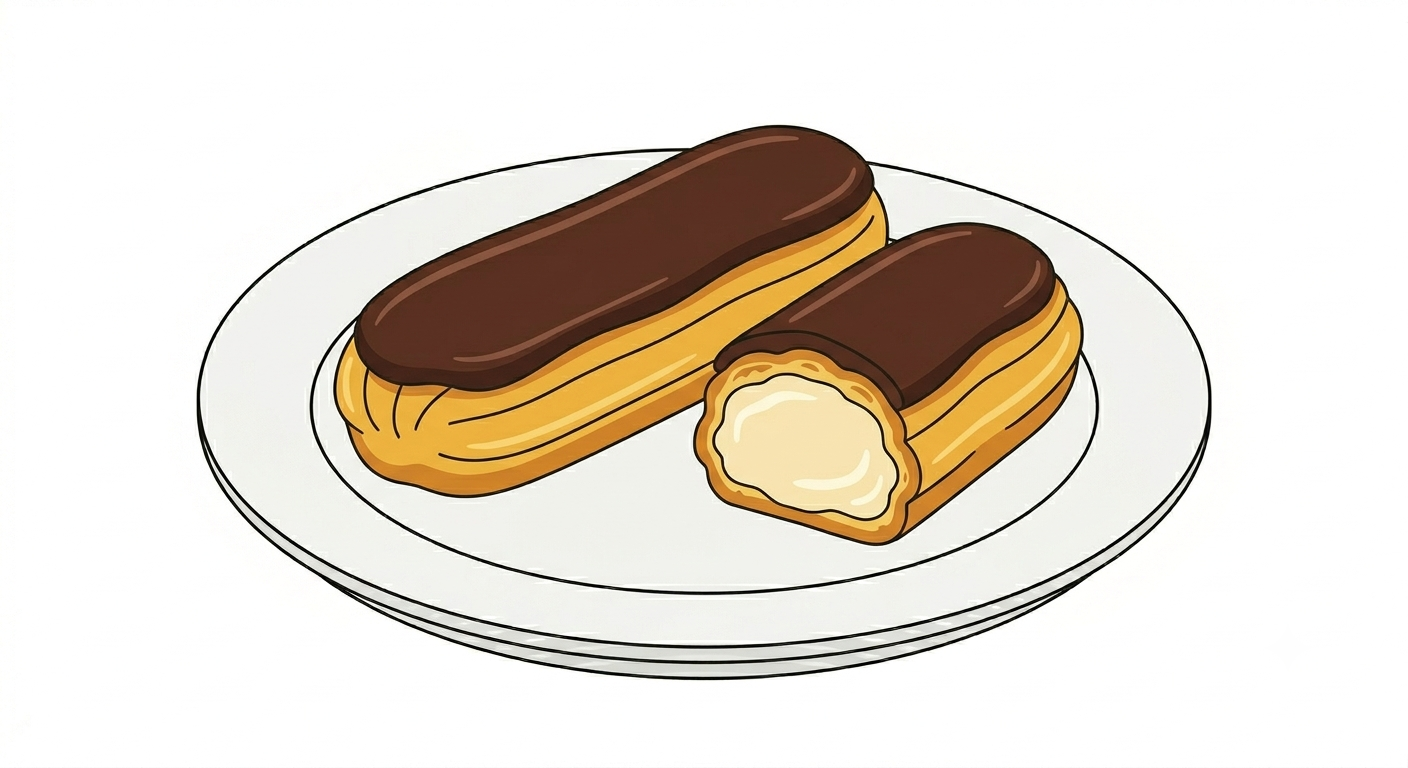
The éclair is a French pastry made from choux dough piped into a long finger shape, baked hollow, filled with pastry cream, and finished with a glossy coat of chocolate fondant on top. It is one of the foundational objects of French pâtisserie — not flashy in concept, but demanding in execution, and immediately recognizable in any language. When everything is working, the shell is light and slightly crisp, the cream is cool and rich, and the chocolate on top provides just enough bitterness to balance the sweetness underneath.
Choux pastry itself is a French invention — a cooked dough made by heating water, butter, and flour together before beating in eggs, which gives it a high moisture content that creates steam in the oven and causes the pastry to puff and hollow out. The technique was developed in the 16th century, attributed variously to a chef named Pantanelli who came to France with Catherine de’ Medici, and later refined by Marie-Antoine Carême, who seems to appear in the origin story of nearly every significant French pastry. The éclair as a distinct form — elongated, filled, glazed — appears in the 19th century, by which point French pâtisserie had codified most of its classic shapes and formats.
The name means “lightning” in French, and the most entertaining explanation is that the pastry was so good it was eaten in a flash. More likely it refers to the way the chocolate glaze catches the light. Either way, the name stuck, and the éclair became a permanent fixture of every serious French pastry case from Paris to the provinces.
In recent years the éclair has undergone the full modernist treatment — elongated showcases filled with exotic creams, topped with mirror glazes, decorated with edible gold and geometric precision. Parisian pastry chef Christophe Adam built an entire shop, L’Éclair de Génie, around reimagined versions of the form. Some of them are genuinely brilliant. But the original chocolate éclair, made well, needs nothing added to it.
This content was created with the assistance of AI. Sources are currently being reviewed.