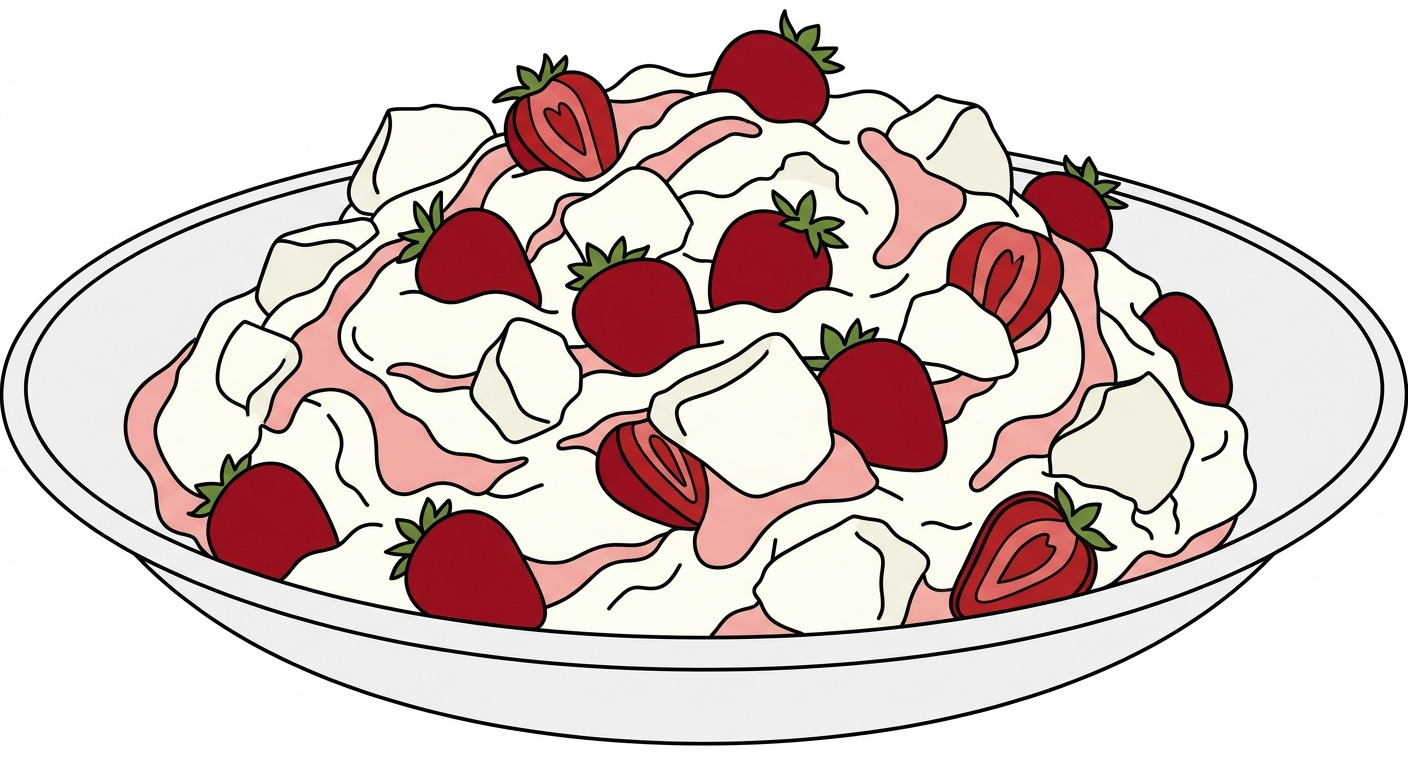
Eton mess is three ingredients combined without ceremony: crushed meringue, whipped cream, and fresh strawberries, folded together and served immediately in a bowl or glass. There is no layering, no plating precision, no structure to preserve. The meringue breaks into shards and powder, the cream folds around it, the strawberries — macerated or fresh — release their juice into the whole. It is served in summer, eaten cold, and consumed quickly before the meringue softens beyond the point where it still provides contrast. The mess is not incidental to the dessert. It is the dessert.
The first documented mention appears in 1893, when historian Arthur Beavan recorded the serving of “Eton Mess aux Fraises” at a garden party attended by Queen Victoria the evening before Prince George’s wedding. The name connects it to Eton College, the prestigious boarding school in Berkshire, where it was sold in the school’s tuck shop from at least the 1930s and served at the annual cricket match against Harrow School — one of England’s oldest school sporting rivalries. Early versions at Eton were made with strawberries or bananas mixed with ice cream or cream; the meringue was a later addition that became the defining element. The popular origin story — a Labrador sat on a picnic basket containing a pavlova, and the wreckage was served anyway — is almost certainly invented after the fact. The name predates the story.
The broader lineage of cream-based English desserts — syllabubs, fools, cranachan — stretches back to the seventeenth century, and the combination of cream and fruit with some form of sugar-based crunch is not unique to Eton mess. Meringue arrived in Britain from France and Switzerland in the eighteenth century and became fashionable in upper-class households through the nineteenth, which places it in exactly the right time and social milieu for the dessert to develop at a school like Eton. Strawberry season in England runs from June through August, which coincides precisely with the Eton-Harrow match. The dessert is less an invention than a confluence of what was available and what was obvious.
This content was created with the assistance of AI. Sources are currently being reviewed.