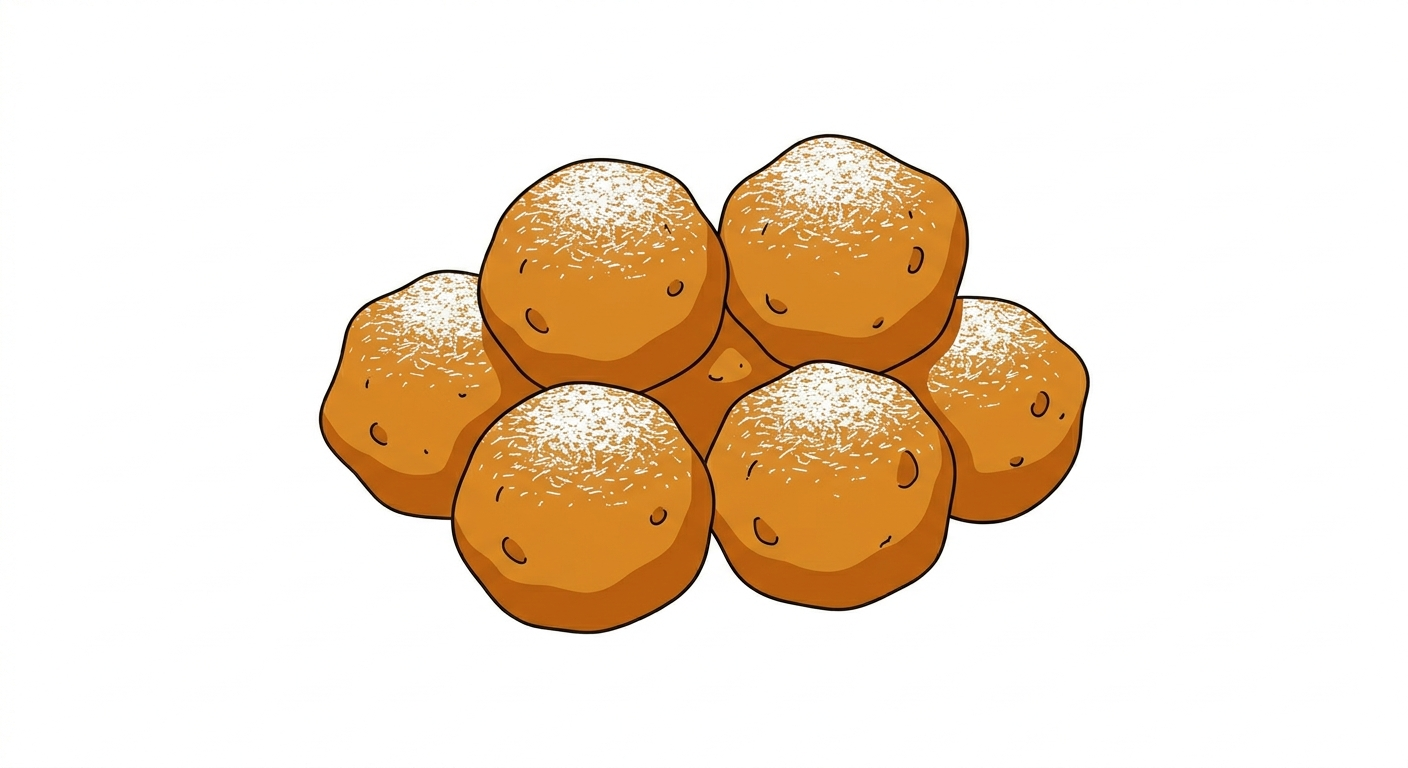
Fritule are small, round fried dough balls — a yeasted batter of flour, eggs, milk, sugar, lemon or orange zest, a splash of rum or rakija, and sometimes raisins, dropped by the spoonful into hot oil and fried until golden on the outside and soft inside. They are dusted with powdered sugar immediately and eaten warm. The rum in the batter is not incidental — it serves a practical function, preventing the dough from absorbing too much oil during frying, which keeps the fritule light rather than greasy. The citrus zest and the spirit together give them a particular aromatic quality that distinguishes them from a plain doughnut hole, and that combination is what people mean when they say fritule smell like Christmas.
Christmas Eve in Dalmatia without fritule is, by local consensus, not properly Christmas Eve. The connection is that specific. They appear at carnival season too, and increasingly throughout the year as their popularity has spread from the Adriatic coast into continental Croatia, but Christmas is where they belong most completely — made at home in large batches, passed around warm, eaten standing in the kitchen before anyone sits down to anything else.
The origin is Venetian. The Republic of Venice controlled the Dalmatian coast from the 13th century until 1797, a period of roughly five centuries during which Venetian culture, language, architecture, and food became deeply woven into coastal Croatian life. The Italian frittelle — small fried dough balls made with raisins, citrus zest, and spirit, eaten at Carnival in the Veneto and Friuli-Venezia Giulia regions — are the direct ancestor of Croatian fritule. The name is a Croatian adaptation of the Italian word. The recipe traveled the same route as the governance — across the Adriatic, into Dalmatian kitchens, and then stayed after the Republic fell.
What Croatia did with the inherited recipe was make it its own. Regional variations accumulated over centuries: Istrian fritule incorporate hazelnuts, apple, and chocolate alongside the standard ingredients. Dubrovnik versions tend toward a simpler batter. Some families use yogurt or sour cream in the dough instead of milk, which produces a slightly tangier result. Each village and each household has its own version that it considers the correct one, and the argument about whose grandmother made the best fritule is perennial and unresolvable.
The technique of forming them is also specific — experienced fritule makers squeeze dough from a closed fist, pushing a ball out between thumb and forefinger and dropping it directly into the oil with a spoon dipped in oil to prevent sticking. The resulting shapes are irregular, each one slightly different from the last, which is understood as a feature rather than a flaw. A bowl of fritule is not supposed to look uniform. It is supposed to look like something made by hand in a kitchen on Christmas Eve, which is exactly what it is.
This content was created with the assistance of AI. Sources are currently being reviewed.