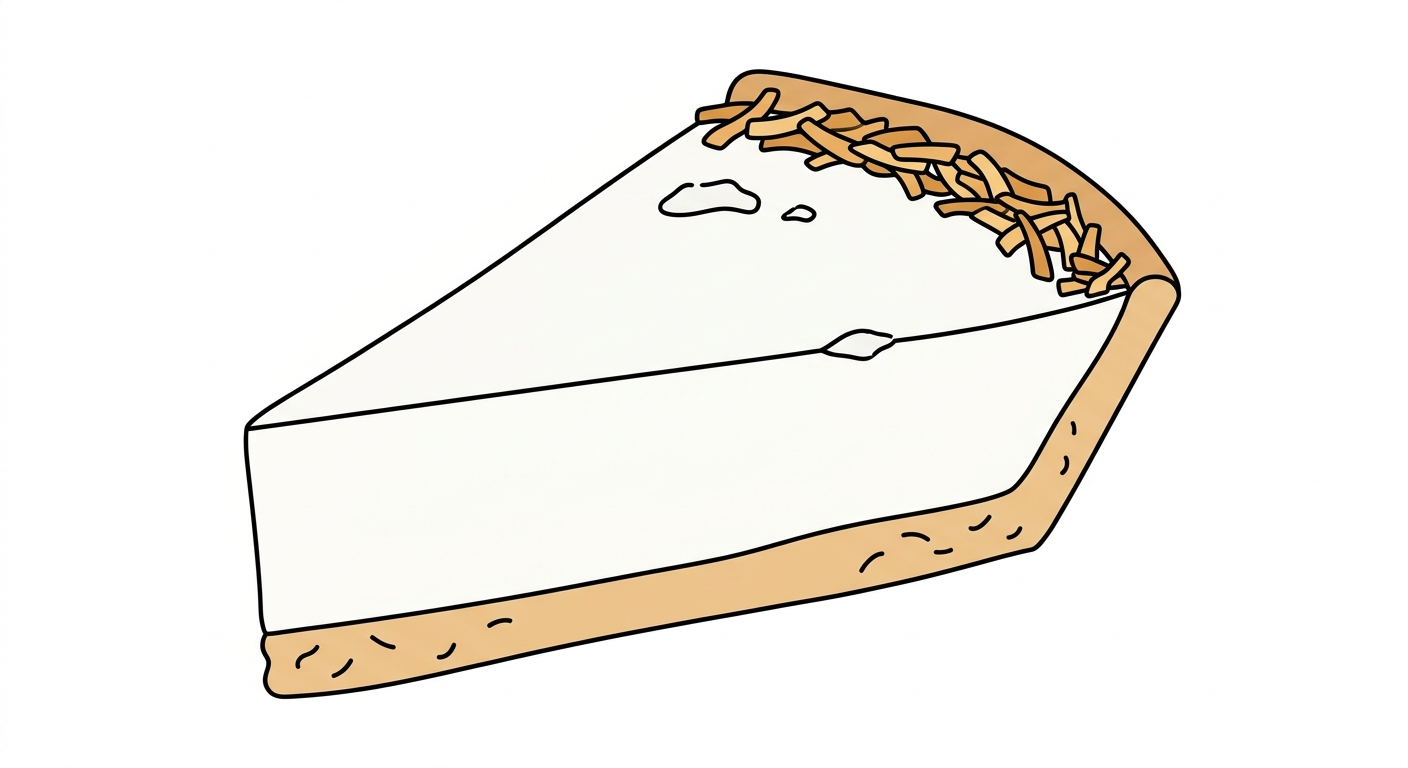
Haupia is a Native Hawaiian coconut pudding whose name reveals its history: hau means “cool,” and pia is the Polynesian arrowroot originally used to thicken it. Today, it is more commonly made with coconut milk, water, sugar, and cornstarch—cooked until thick and set into a dense, gelatinous, and sliceable block. It has been served at luaus for generations, cut into squares and eaten by hand alongside kalua pork, poi, and lomi salmon. It is one of the few Native Hawaiian foods that has remained a constant across Hawaiian celebrations regardless of the ethnic background of the host; in the islands, haupia appears at Japanese, Filipino, Portuguese, and mixed-heritage gatherings alike.
The pie form is an adaptation that arrived with American baking infrastructure—a graham cracker or pastry crust filled with the same haupia mixture and chilled until set. It is a direct product of Hawaii’s post-statehood food culture, where Native ingredients absorbed American formats without abandoning their essential character. The result is a dessert that is both distinctly Hawaiian and structurally familiar to anyone who has eaten a cream pie.
The chocolate haupia pie is a further variation featuring a layer of chocolate pudding beneath the coconut. While local restaurant chains helped make it a daily staple, the version created by Ted’s Bakery on the North Shore is widely credited with turning the pie into a global icon of modern Hawaiian cuisine. Both the plain and chocolate-layered versions are considered “correct,” though the plain block remains the older, ceremonial form.
Haupia is served at funerals as consistently as at celebrations in Hawaii. It is a food of community and obligation as much as pleasure—present because it is expected, and because it connects the table to the shared, multi-generational history of the islands.
This content was created with the assistance of AI. Sources are currently being reviewed.