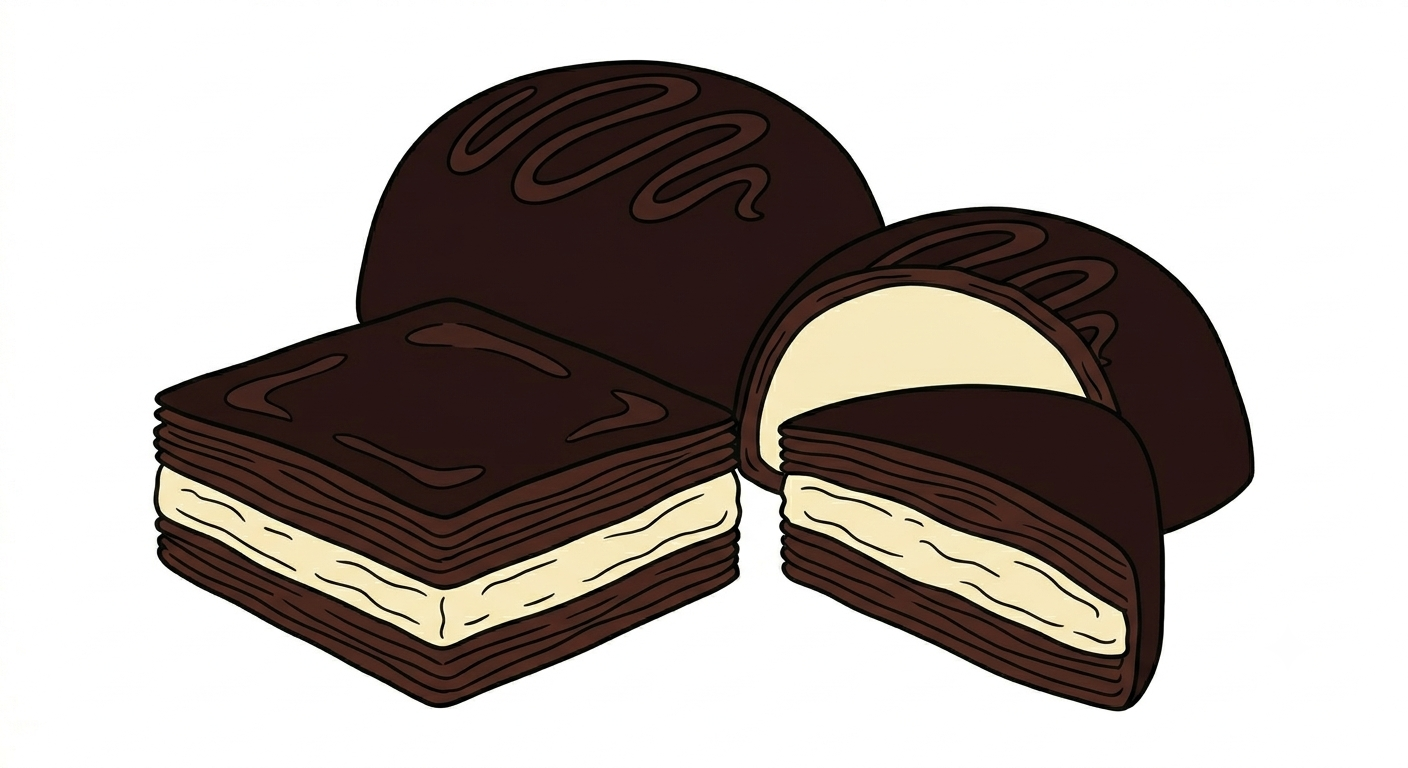
The Joffre cake is a small, dense cylinder of chocolate — thin layers of buttermilk sponge alternating with chocolate ganache or buttercream, the whole thing enclosed in a dark chocolate glaze that sets smooth and firm. It is intensely chocolate, not especially sweet, and sized to be finished in a few bites. That last detail was not accidental. It was a design specification.
The cake was created in January 1920 at Casa Capșa, Bucharest’s most celebrated restaurant, hotel, and café — a place that had been the center of Romanian high society since 1852 and that had hosted, by that point, nearly every significant diplomatic and cultural event the city had seen for the better part of a century. The occasion was the visit of French Marshal Joseph Joffre, Commander-in-Chief of French forces during the First World War, who had come to Bucharest at the invitation of King Ferdinand I and Queen Marie of Romania. Joffre was there to present the French Military Medal to the king and the Croix de Guerre to the city of Bucharest — a ceremony of post-war gratitude between two countries that had fought on the same side and shared the enormous cost of it.
A banquet followed at Casa Capșa. The pastry chef, trained in Paris, was tasked with creating something appropriate to the occasion. He created a chocolate cake shaped to honor the guest — the cylindrical form is said to reference either the French military casquette or the Adrian helmet worn by French and Romanian soldiers during the war, both of which have the same domed silhouette that the cake carries. There was one additional constraint: Marshal Joffre was diabetic, and the cake needed to be portioned so that a man with his condition could eat it without risk. Small, intensely flavored, a single serving. The size is built into the concept.
Casa Capșa was the right place for this kind of creation. The French ambassador Paul Morand, who was posted in Bucharest in the 1940s, described it as “the heart of the city, topographic and ethical” — a place where Bucharest’s intellectual and political class gathered, where the best French-influenced cooking in Romania was produced, and where a pastry chef educated in Paris would naturally reach for the techniques and sensibility of French confectionery when composing something for a French marshal. The Joffre cake is Romanian in origin and French in spirit, which is precisely the kind of thing that happens at the intersection of two allied cultures in the immediate aftermath of a war they survived together.
The cake became a Romanian classic, moving from the white tablecloths of Casa Capșa into the broader confectionery culture of the country. The Romanian saying that attached itself to it — “one piece of Joffre is always followed by another one” — is both a compliment and a diagnosis. It is the kind of cake that does not allow for satisfaction with a single serving, which is ironic given that its original portion size was dictated by medical necessity.
Today it is made in both the traditional domed cylindrical form and as a rectangular slice, as your illustration shows both versions — the round original and the layered square adaptation that came later, easier to cut and serve for large groups. Both are correct. Both carry the same ratio of sponge to ganache to glaze, the same darkness of chocolate, the same density that makes the small size feel exactly sufficient while also making another piece feel necessary. The marshal for whom it was named never returned to Bucharest. The cake has never left.
This content was created with the assistance of AI. Sources are currently being reviewed.