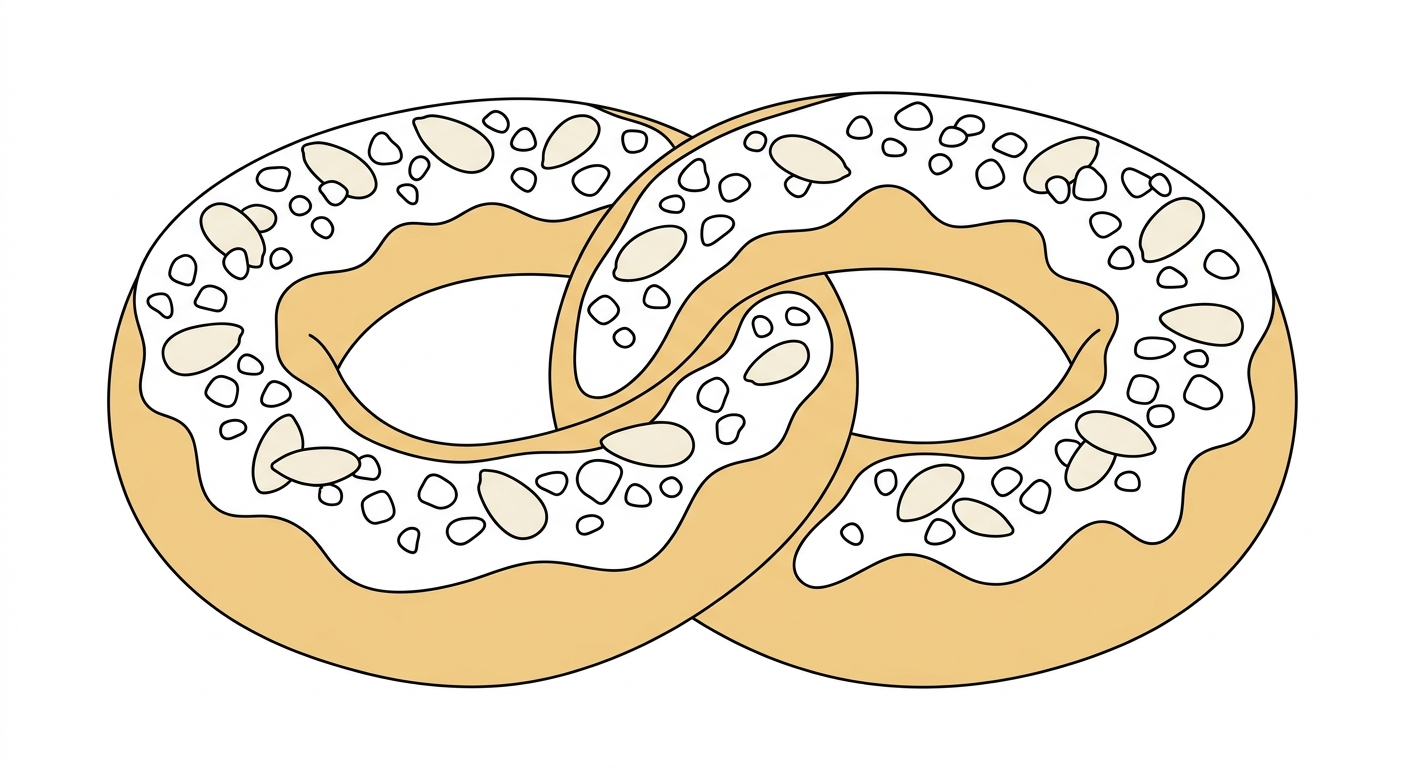
Kringla are soft, lightly sweetened Scandinavian cookies shaped into a loose figure-eight or pretzel form, baked until just set and still tender throughout. They are not crisp cookies — there is no snap to them — but rather something closer to a soft bread roll in cookie form, with a fine, slightly cakey crumb and a mild flavor of vanilla, cardamom, or anise depending on the baker and the region. They are understated in the best possible way: not too sweet, not too rich, not too anything. They are the kind of thing you eat two or three of without noticing, which is either a warning or a recommendation.
The kringla shape — a twisted loop derived from the pretzel form — has roots that extend across Scandinavia and into medieval European baking, where the pretzel was a symbol of good luck and prosperity and appeared in religious and celebratory contexts long before it became a snack food. In Norway, kringla were a traditional part of the holiday baking calendar, made in large quantities in the weeks before Christmas alongside other Julebakst — Christmas cookies — and stored in tins to be eaten throughout the season. The soft texture and mild spice profile made them a natural fit for the Norwegian preference for baked goods that are comforting rather than indulgent.
The Norwegian-American community in the Upper Midwest — Minnesota, Wisconsin, North Dakota — preserved the kringla tradition with particular fidelity, and in those communities the cookie remains a staple of church potlucks, holiday cookie exchanges, and family gatherings in a way that has outlasted most other immigrant food traditions. Norwegian-American kringla recipes are passed down through families with the kind of seriousness usually reserved for something more complicated, which reflects the emotional weight the cookie carries rather than any technical difficulty in making it. The recipe is genuinely simple. The attachment to it is not.
Buttermilk is the ingredient that appears most consistently in Norwegian-American versions of the recipe, giving the dough a slight tang and a tenderness that distinguishes it from plainer Scandinavian versions. Some recipes add sour cream instead, or a combination of both. The result in either case is a cookie that is soft enough to feel almost ephemeral — light, barely there, gone before you’ve fully registered eating it.
This content was created with the assistance of AI. Sources are currently being reviewed.