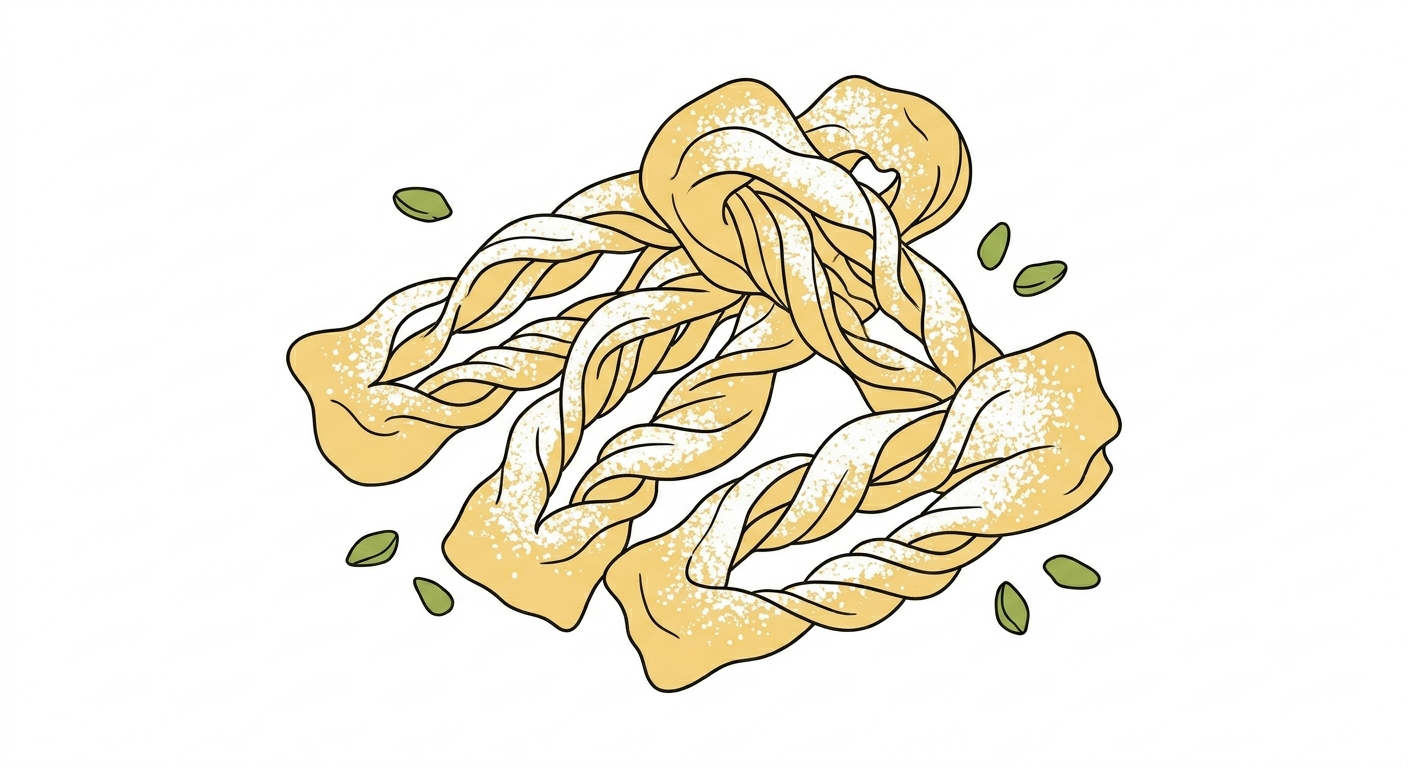
Kroštule are thin, twisted strips of fried dough — a simple, enriched dough of flour, eggs, butter, sugar, citrus zest, and a splash of rakija or white wine, rolled paper-thin, cut into strips or rectangles, tied or twisted into loose knots and ribbons, then fried quickly in hot oil until they puff and blister and turn pale gold. They shatter when you bite them. The powdered sugar on top goes everywhere. That is part of eating them correctly.
The name carries its meaning in the sound of it. The Croatian word hrustati means to crunch, and kroštule — hrustule, hrštule, depending on the region and the speaker — are named for the noise they make. The Italian source word, crostoli, means crispy by way of oil, which is an equally accurate description. Both languages arrived at the same object from the same direction.
That direction is Venice. The crostoli of the Veneto and Friuli-Venezia Giulia regions — thin, fried, sugared, eaten at Carnival — traveled to the Dalmatian and Istrian coast during the centuries of Venetian rule and became kroštule in the process. The core technique remained identical. The local character accumulated through the ingredients that Croatian cooks added — rakija instead of grappa, local citrus, the particular regional preference for how thin to roll the dough and how long to fry it. Istrian versions, Dalmatian versions, and island versions all differ slightly from each other in the same way, each village convinced its own recipe is the correct one.
Kroštule belong to a family of angel wing pastries that appears across Europe under different names — chruściki in Poland, faworki, bugie in Liguria, cioffe in central Italy, žagarėliai in Lithuania. All of them are thin fried dough, shaped into twists or bows, dusted with powdered sugar, and eaten at Carnival or Christmas. The shared form reflects a shared logic — before Lent, use the butter, eggs, and fat that the fasting season will prohibit. Make something light and plentiful and communal. Fry it in large batches. Eat it with coffee or brandy while it is still warm.
In Croatia, kroštule are made at home in quantities that assume a crowd. The dough is simple enough that production scales easily, and the frying goes quickly once the oil is hot. A large bowl of kroštule on a table at Carnival or Christmas Eve disappears faster than it took to make — which is the correct outcome for a pastry designed to be passed around and eaten without ceremony, the powdered sugar settling on whatever surface is nearby and on whoever reaches in first.
This content was created with the assistance of AI. Sources are currently being reviewed.