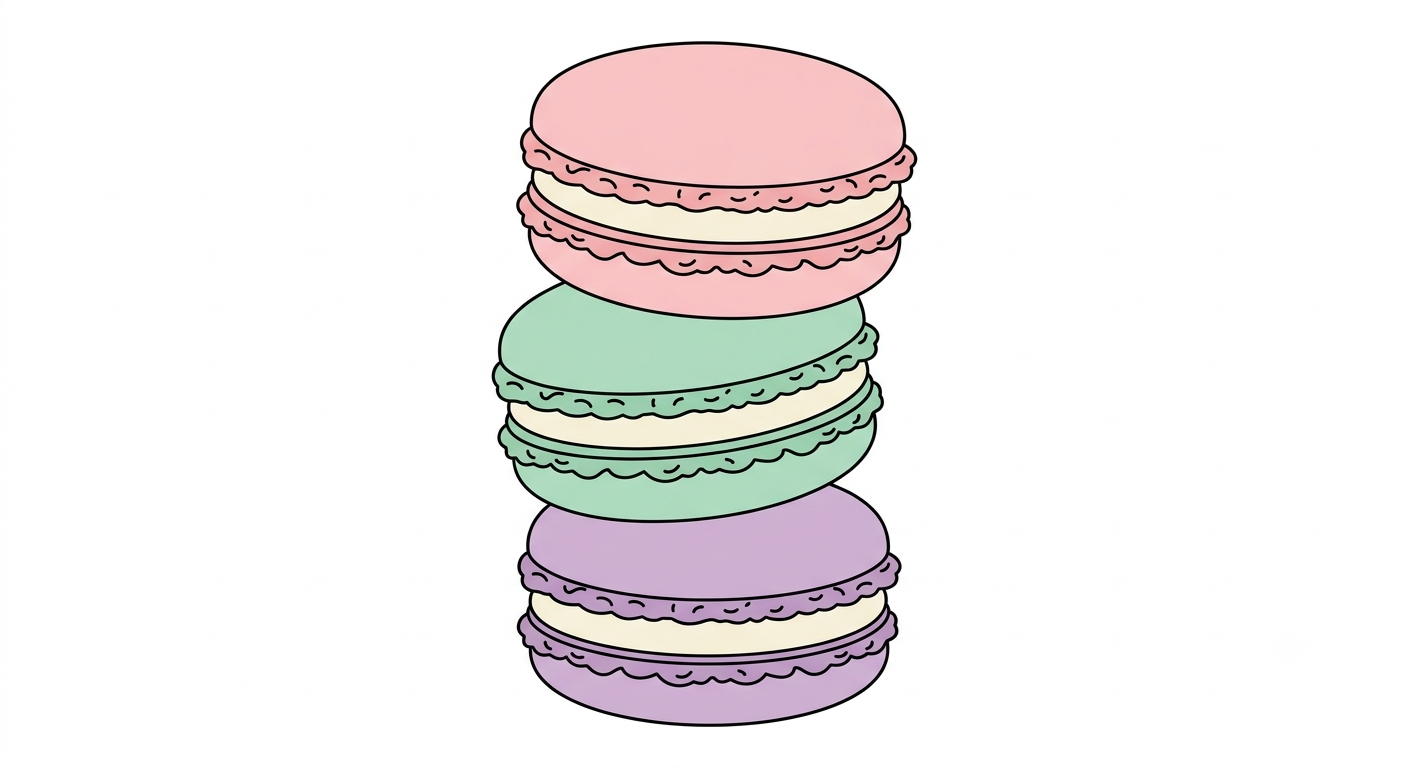
The macaron as most people picture it — two domed shells of almond meringue, smooth and slightly crinkled at the base, sandwiching a layer of ganache, buttercream, or jam — is a French invention in its final form and an Italian one in its origins. Both of those things are true and neither cancels the other out. What France did was take a simple Italian almond cookie and spend three centuries refining it into something that now functions as shorthand for French pastry culture globally. The Italians gave France the idea. France gave the world the object.
The macaron’s earliest traceable ancestor is the almond-based biscuit that moved through the medieval Arab world and into Italy via Sicily. Like many other almond-based pastries, the macaron has its origins in the Middle East, where it is believed to have been eaten in the Middle Ages before being discovered by the first European navigators. The almond itself is not European, and most of the foundational techniques for working it into confectionery came from the Arab culinary tradition before they became Italian and then French. Fauchon
In the 16th century Catherine de Medici, the wife of King Henry II of France, introduced macarons to the French when she married the French king and brought her Italian pastry chefs with her to France. At the time the small round cake was still called “maccherone” — a single unfilled shell, already light and tender inside, but without the ganache filling that would eventually define it. What arrived in France was an ingredient and a technique, not a finished product.
What happened next was slow and regional. Over the centuries the macaron spread throughout France, with cities and regions appropriating it into their own specialties — the Macaron d’Amiens in Picardy, the Macaron de Joyeuse in Ardèche, versions in the Basque Country, Saint-Émilion, Nancy, and Montmorillon. These are all single shells — no filling, no sandwich — and they are still made and sold in their respective towns. Most visitors to France never encounter them because the Parisian version has absorbed all the cultural oxygen.
It was only from the 1830s that the modern macaron first appeared, ostensibly invented by a baker named Pierre Desfontaines, with jams, liqueurs, and spices initially serving as fillings. The two-shell sandwich construction — the thing that makes the contemporary macaron what it is — is therefore a 19th-century addition to a 16th-century cookie built on a medieval Arab foundation. The Ladurée patisserie in Paris eventually standardized and glamorized the format, and from there the macaron’s reputation as the apex of French confectionery was largely secured by marketing as much as by merit.
The macaron is genuinely excellent when made well. The shell should have a thin crisp surface that gives way immediately to something soft and slightly chewy underneath — a texture called moelleux that is easy to describe and difficult to achieve. The filling should be present enough to be tasted but not so thick that it overwhelms the shell. The flavors, historically simple, have expanded into everything imaginable — rose, salted caramel, matcha, yuzu, black truffle — most of which work better in concept than in execution.
What has not changed is the macaron’s structural fragility and its sensitivity to humidity, temperature, and timing. It is one of the more technically demanding items in the French pastry repertoire, which is part of why it became a symbol of skill, and part of why so many of them, sold in airport shops and hotel lobbies around the world, taste like sweetened chalk. The real thing, from a competent hand, is worth the reputation it carries. The imitations are what make people skeptical.
This content was created with the assistance of AI. Sources are currently being reviewed.