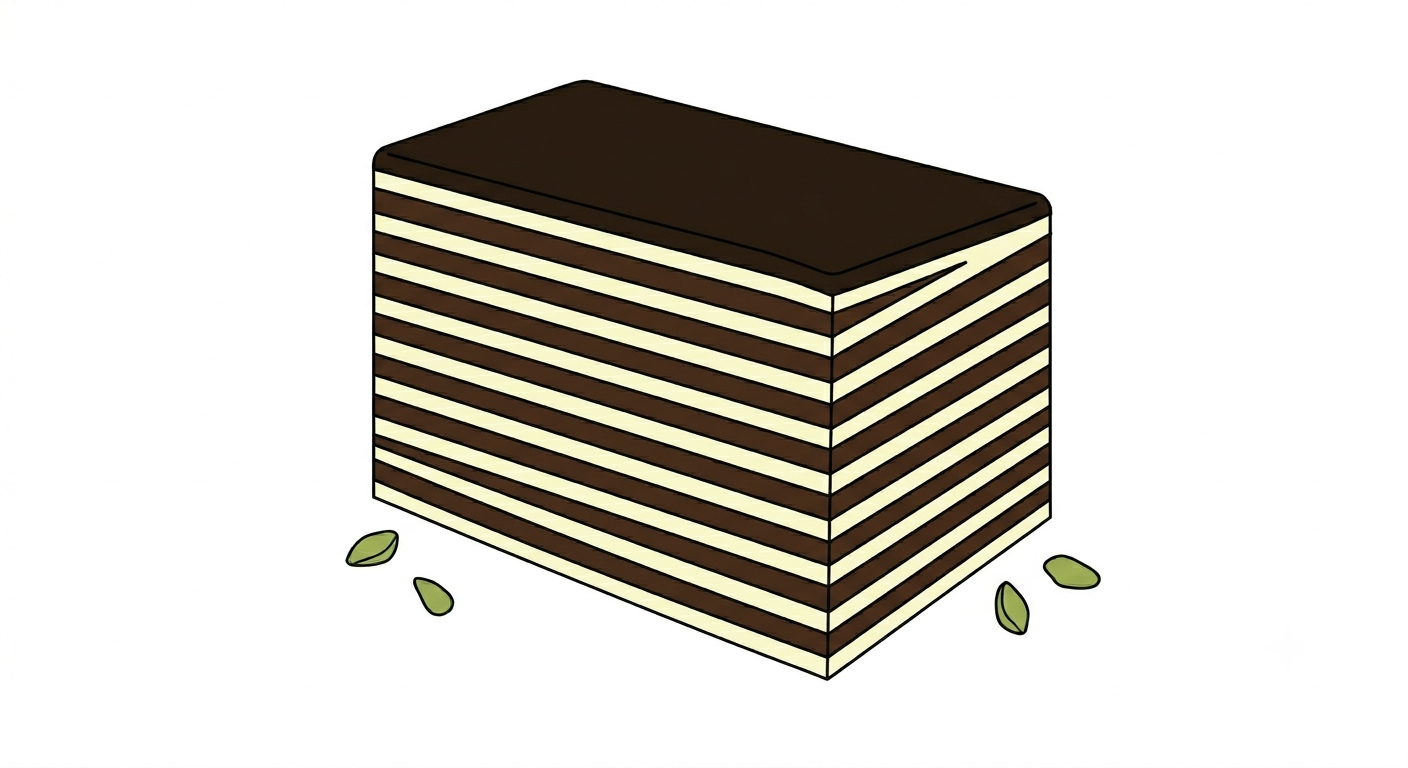
Mađarica is a layered cake — thin sheets of pale, slightly crisp pastry alternating with a dark, cocoa-rich chocolate cream, the whole thing finished with a dark chocolate glaze that sets firm in the refrigerator overnight. When cut, the cross-section is a precise striped pattern of brown and cream, as many as seven or eight layers deep, each one distinct. It is a cake that rewards patience and punishes shortcuts. The layers need to be thin and even. The filling needs to cool completely before assembly. The whole construction needs a night in the refrigerator before it can be sliced cleanly. None of this is negotiable. Every Croatian grandmother who has ever made it will tell you the same thing.
The name means “Hungarian girl,” which is the most honest thing about the cake’s origin and the part that Croatians tend to navigate around carefully, since mađarica is now claimed so completely as a Croatian dessert that the foreign etymology requires some acknowledgment. The name reflects what the cake is: a Croatian adaptation of the Hungarian layered cake tradition that arrived through the culinary currents of the Austro-Hungarian Empire. The Dobos torte — Hungary’s most celebrated layered cake, built from sponge layers and chocolate buttercream with a caramel top — is the most visible point of comparison, and the visual similarity is clear enough that the connection is not seriously disputed. What Croatia did was take the logic of the layered cake and rebuild it with its own proportions, its own filling, and its own rhythm.
The Austro-Hungarian period left a distinct mark on the food culture of continental Croatia, particularly in Zagreb and the northern regions that sat most directly within the empire’s sphere. Coffee house culture, cream-filled pastries, layered cakes, careful technique — these are all inheritances from that period, and mađarica is one of the clearest examples. It belongs to a family of Central European festive cakes that includes Hungarian rétes, Austrian Sachertorte, and the various cream slices and layered confections that appear across the former empire’s territories, all of them sharing a certain seriousness of construction and a tendency to be associated with celebration.
In Croatia, mađarica is exactly that — a celebration cake. It appears at Christmas, at birthdays, at weddings, at any gathering significant enough to warrant effort. Every family has its own recipe, usually handwritten in a notebook and passed down, with small variations in the filling ratio, the amount of rum added, whether dark chocolate or cocoa powder takes precedence, and how thick to make the glaze. These variations are taken seriously. The cake that a person grew up eating is the correct version, and all others are approximations.
It is cut into small rectangles rather than wedges, which is part of what makes it work for large gatherings — it multiplies cleanly and holds well, surviving the refrigerator for days without losing its structure. That practicality is part of its durability as a festive staple. A cake that requires two days to make and then feeds a crowd reliably is a cake worth learning, and mađarica has been learned and relearned across Croatian kitchens for generations, carrying its Hungarian name and its entirely Croatian identity in the same breath.
This content was created with the assistance of AI. Sources are currently being reviewed.