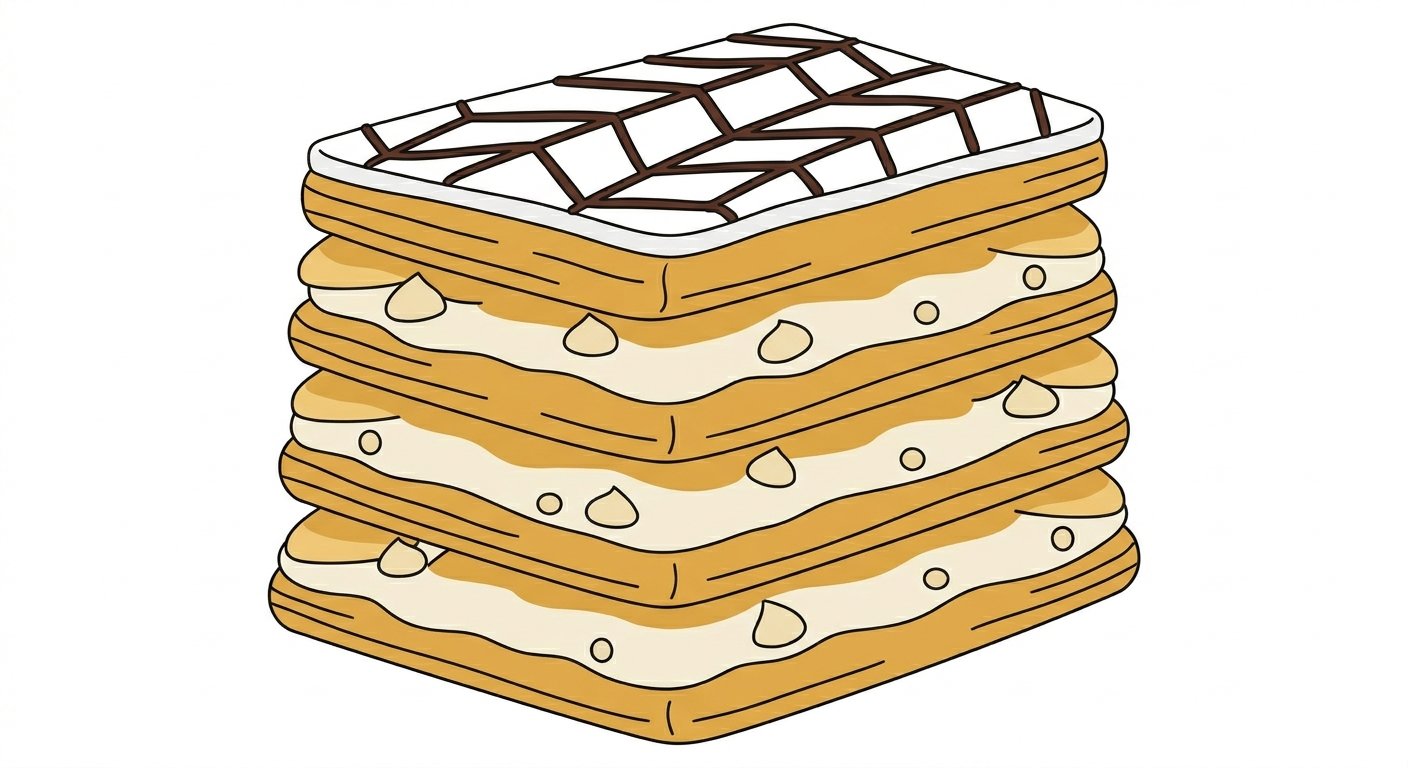
Mille-feuille is a French pastry built from three sheets of puff pastry, sandwiched with pastry cream and finished with a top layer of white fondant striped with chocolate — that signature feathered pattern as much a part of its identity as the filling inside. The name means “a thousand leaves,” a nod to the many paper-thin layers of dough that shatter satisfyingly under the fork before yielding to the cool, silky cream beneath.
The origins are contested, as they often are with great French classics. The earliest known recipe appears in François Pierre de la Varenne’s Le Cuisinier François in 1651, but the pastry as we recognize it today — refined, precise, properly laminated — is generally credited to the great Parisian pastry chef Marie-Antoine Carême in the early 19th century. Carême elevated French pâtisserie to an art form, and mille-feuille fit squarely into that ambition: technically demanding, visually composed, and unapologetically rich.
In France it’s called mille-feuille in the north and millefoglie just across the border in Italy, where the same construction shows up with slight regional variations. In the U.S. and parts of the English-speaking world, it travels under the name Napoleon — an attribution that culinary historians still bicker over, with theories ranging from a corruption of napolitain (Neapolitan) to a genuine nod to the emperor, though there’s no strong evidence Bonaparte had any particular affection for it.
What distinguishes a well-made mille-feuille from a mediocre one is the pastry. Proper lamination — folding cold butter into dough repeatedly to build hundreds of distinct layers — is unforgiving work. When it’s done right, the layers puff apart in the oven into something that’s simultaneously sturdy enough to hold filling and delicate enough to collapse at the slightest pressure. That contrast is the whole point.
This content was created with the assistance of AI. Sources are currently being reviewed.