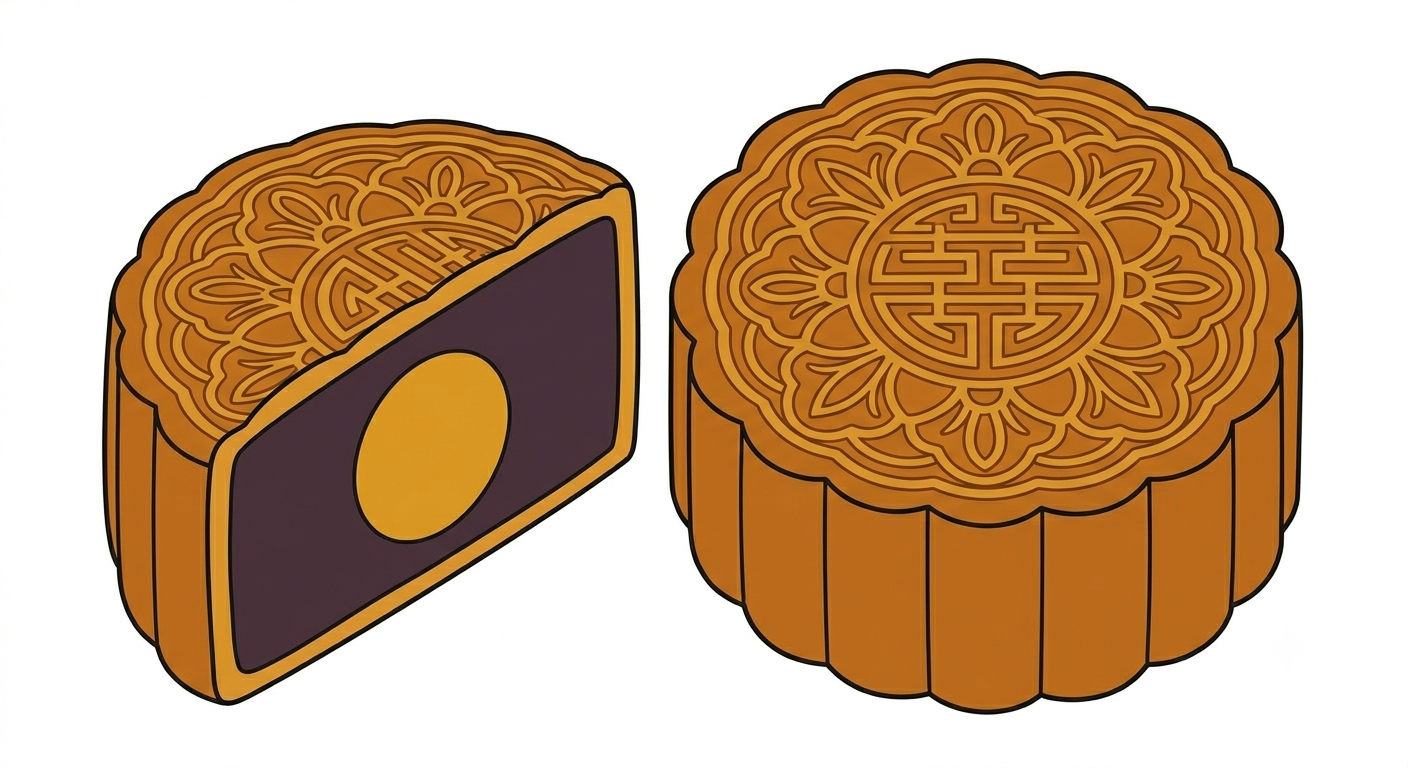
A mooncake is a dense, round pastry — a thin, golden-brown crust pressed into an ornate mold and filled with a thick, sweet paste, most traditionally lotus seed or red bean, often with a whole salted duck egg yolk at the center. The yolk is the moon. That is not metaphor — it is the explicit symbolic logic of the pastry. The round cake represents the full moon. The golden yolk at the center represents the moon again, more literally. The whole object is an edible version of the thing it is made to celebrate, which is the kind of formal coherence that takes centuries of tradition to arrive at.
Mooncakes are eaten during the Mid-Autumn Festival, which falls on the fifteenth day of the eighth lunar month — the night of the year’s fullest, brightest moon. The festival’s origins go back to the Zhou Dynasty, over three thousand years ago, when Chinese emperors worshipped the moon at harvest time in the belief that it would bring a plentiful crop. The mooncake as a specific pastry emerged later, during the Yuan Dynasty between 1279 and 1368, and it arrived carrying a story that became one of the more dramatic origin myths in food history.
The Yuan Dynasty was Mongol rule over China, and it was not a comfortable period for the Han Chinese population. According to the most widely told account, rebel leader Zhu Yuanzhang and his strategists used mooncakes to coordinate an uprising — hiding strips of paper inside the pastries with instructions to revolt on the fifteenth night of the eighth month. The mooncakes were distributed freely, the Mongols did not inspect them, and the messages reached their recipients. The rebellion succeeded. The Yuan Dynasty fell. The Ming Dynasty began in 1368. Whether the story is literally true or is a legend that accumulated around a real event, it has been attached to the mooncake ever since, giving a festive pastry an unusually consequential backstory.
The classic filling is lotus seed paste surrounding a salted duck egg yolk — the paste sweet, smooth, and dense; the yolk intensely savory, fatty, and slightly grainy, cutting through the sweetness in a way that makes the combination more interesting than either element alone. Red bean paste is the other traditional standard. Both fillings are packed tightly, leaving almost no air inside the crust, which gives the mooncake its characteristic density and weight — a single piece is genuinely filling, and the traditional sharing of one mooncake among a family, cut into wedges, makes practical as well as symbolic sense.
The crust is pressed into carved wooden or ceramic molds that emboss the surface with patterns — flowers, the Chinese characters for longevity or harmony, the name of the bakery, sometimes an intricate landscape. The mold is what gives each mooncake its face, and the quality of the mold and the precision of the pressing are visible markers of care. A well-made mooncake has clean, sharp edges on its surface design. A poorly made one does not.
Modern mooncakes have expanded into territory far beyond the traditional — snow skin mooncakes with chilled, mochi-like exteriors; ice cream fillings; chocolate, durian, matcha, truffle. These are commercial products aimed at younger consumers and gift-giving markets, and they are successful on those terms. The traditional baked mooncake with lotus paste and egg yolk remains the standard, the thing that people who grew up eating mooncakes reach for when the festival comes, and the version that carries the weight of the history.
Mooncakes are as much a gift object as they are a food. They are boxed, often elaborately, and exchanged between families, friends, and business associates in the weeks leading up to the festival. The gifting economy around mooncakes is substantial enough that it has its own cultural commentary in China — the boxes becoming increasingly ornate, the prices climbing, the gap between the packaging and the contents growing wider each year. None of this has displaced the actual eating of mooncakes under the moon in September, which remains the point.
This content was created with the assistance of AI. Sources are currently being reviewed.