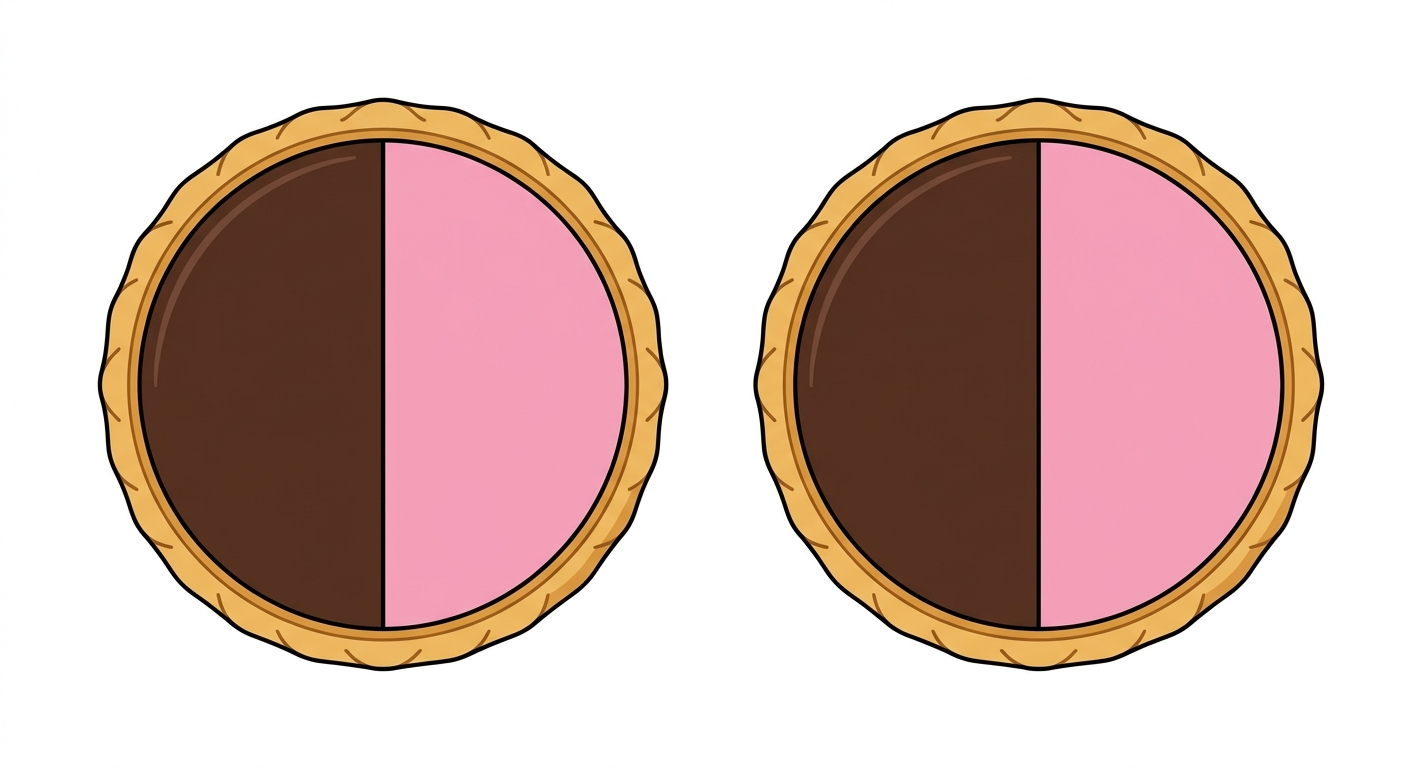
Neenish tarts are small shortcrust pastry shells often lined with a thin layer of raspberry jam, filled with mock cream, and topped with two-tone fondant icing split precisely down the middle. Mock cream—a shelf-stable buttercream made from butter, sugar, and milk or condensed milk—mimics the texture of whipped cream without the dairy perishability. That precise 50/50 icing split, usually chocolate and pink (or chocolate and white), is the tart’s entire visual signature and makes it immediately identifiable in any Australian or New Zealand bakery.
While the origin is a point of trans-Tasman rivalry, the earliest known recipe appeared in a New Zealand newspaper in 1895. However, the tart became a quintessential Australian icon by the mid-twentieth century, a staple of milk bars and corner stores alongside finger buns, vanilla slices, and lamingtons. It is a product of British colonial baking traditions adapted for local conditions; mock cream was used not just for its sweetness, but because it could withstand the Southern Hemisphere heat in the decades before universal refrigeration.
Mock cream is the detail that most distinguishes neenish tarts from their European counterparts. It holds its shape at room temperature and has a specific, dense sweetness that fresh cream cannot replicate. For many who grew up with the bakery original, a neenish tart made with real whipped cream is considered a substitution, not an upgrade.
The name’s origin remains a mystery. While a popular Australian legend attributes the invention to a “Ruby Neenish” from New South Wales in 1913, the earlier New Zealand records suggest the name likely has older, perhaps European, roots. Regardless of its birth, the neenish tart remains a deeply regional treasure, recognized instantly at home and almost entirely unknown to the rest of the world.
This content was created with the assistance of AI. Sources are currently being reviewed.