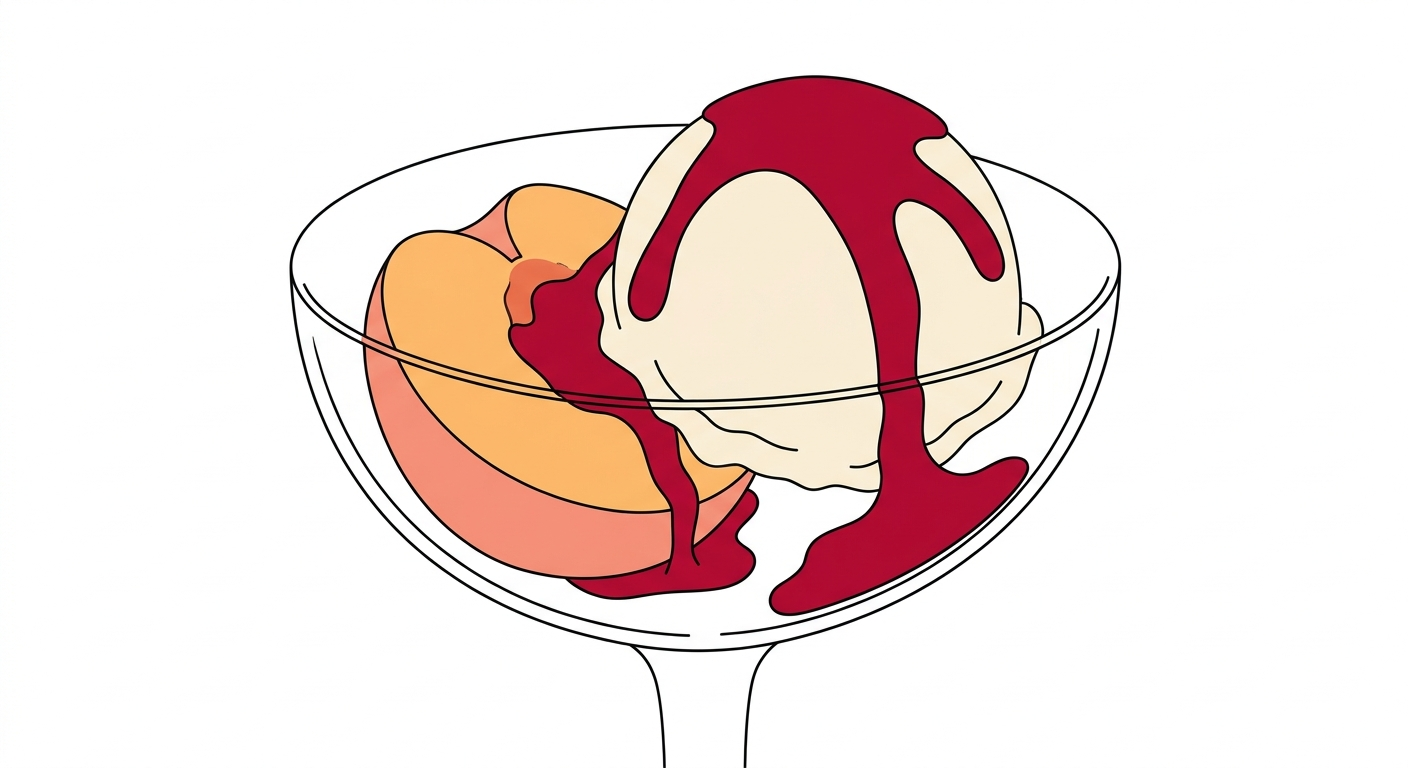
Peach Melba is three things — a poached white peach, vanilla ice cream, and a raspberry purée — assembled in that order and served cold. The peach is halved, poached in vanilla syrup until just tender, and placed over the ice cream. The raspberry sauce goes over everything: strained, sweetened, slightly tart, deeply colored. There is no whipped cream in the original. There are no almonds. The dish that appears on contemporary menus under the name peach Melba — loaded with cream, sometimes with almonds, sometimes with both peaches and strawberries — is an elaboration of an original that was precise in its simplicity. Escoffier’s version required three components in the correct proportions and nothing else. The restraint is the point.
The origin is documented and specific. In 1892, the Australian soprano Nellie Melba was performing in Wagner’s Lohengrin at Covent Garden. The Duke of Orléans gave a dinner at the Savoy Hotel in her honor, where Auguste Escoffier was chef. The opera featured a boat in the shape of a swan, and Escoffier — moved by her performance and by the visual image of the swan — created a dessert of fresh peaches and vanilla ice cream served in a silver dish set atop an ice sculpture of a swan. He called it Pêche au Cygne — peach with a swan. When Melba asked the name, Escoffier replied, with his permission, it would be called Melba.
A few years later, when Escoffier moved to the Carlton Hotel with César Ritz, he revised the dessert — removing the ice swan, adding raspberry purée, and formally naming it Pêche Melba. The raspberry sauce is the second act, and it is what transformed the dish from a theatrical gesture into a recipe. The combination of the vanilla ice cream’s sweetness, the poached peach’s delicacy, and the raspberry purée’s acidity produces a balance that requires all three elements — remove any one and you have something lesser.
Nellie Melba — born Helen Porter Mitchell in Richmond, Victoria — was one of the most celebrated opera singers of the late 19th and early 20th centuries. Her stage name was borrowed from Melbourne, her home city, compressed into a single syllable that traveled with her across Europe and America. Escoffier named two things after her: Peach Melba and Melba toast, the thin, twice-baked bread he created during her illness in 1897. That a French chef working in London created two dishes for an Australian singer performing in Italian opera in the Wagnerian repertoire is the kind of biographical detail that makes the late Victorian world feel particularly compressed and interconnected.
Peach Melba became one of the most widely replicated desserts in the French classical repertoire, appearing in hotel restaurants and dining rooms across Europe and North America for most of the 20th century. It is a dish of its era — precise, elegant, built on the French technique of poaching fruit and the luxury of good vanilla ice cream — and it has aged in the way that classical dishes age, neither entirely fashionable nor entirely obsolete, present on menus that want to signal a connection to a particular tradition of serious cooking. The original is worth knowing. The peach should be white, not yellow. The sauce should be strained. The ice cream should be vanilla, full stop. Everything else is a variation, and most variations make it worse.
This content was created with the assistance of AI. Sources are currently being reviewed.