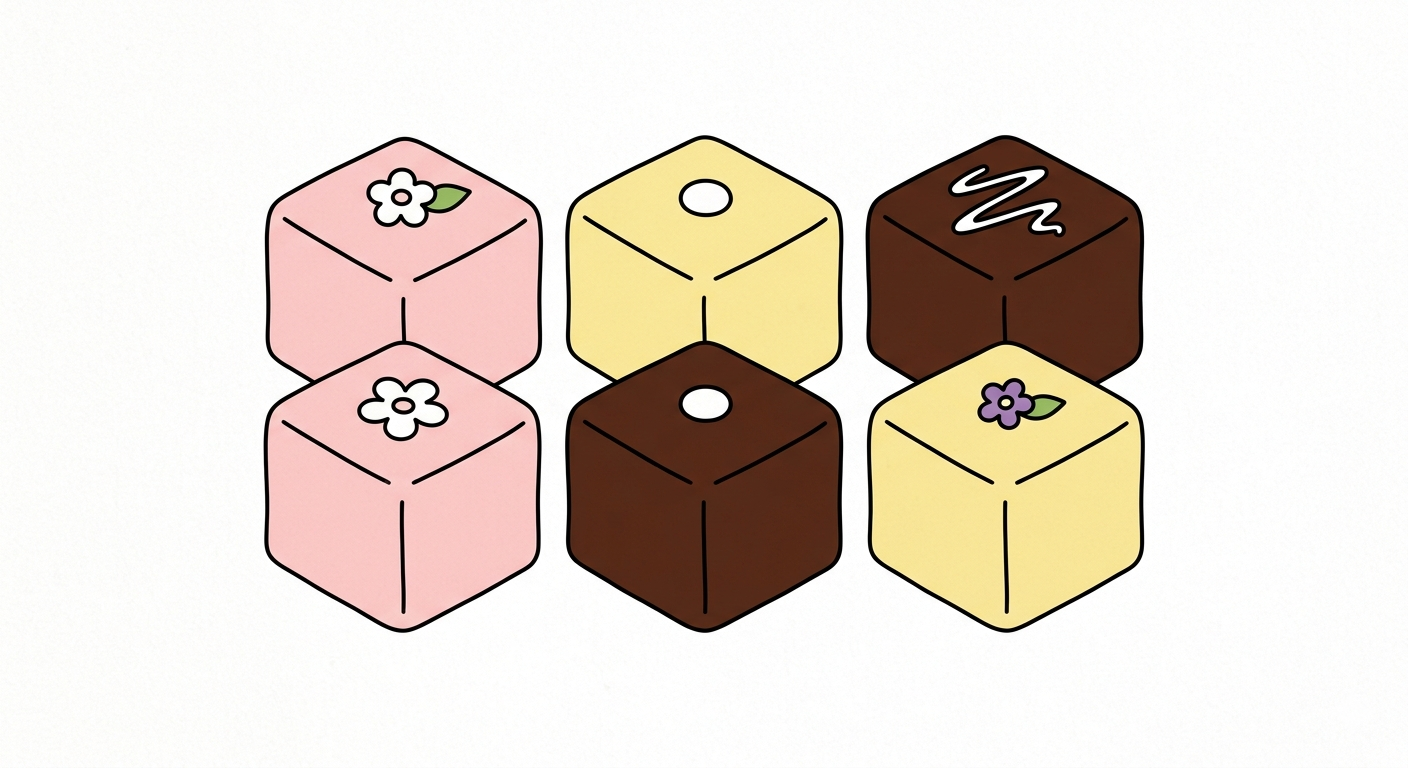
A petit four glacé is a small square of layered sponge cake — typically génoise — filled with jam or buttercream, cut to uniform size, and coated on all sides in a poured fondant glaze that sets smooth and opaque. The top is decorated: a crystallized violet, a piped rosette, a piece of candied fruit, a thin chocolate line. The whole thing is roughly two bites. The decoration is not optional — it is what distinguishes a petit four glacé from a cake scrap with icing on it. The precision of the finish is the point.
The name means small oven in French, and the origin is practical rather than elegant. In 18th and 19th century French baking, large stone and brick ovens fired with coal or wood took hours to reach temperature and hours more to cool down. Bakers used the intense heat — grand four — for bread, roasts, and large cakes. Once that work was done and the fire began to die, the oven retained significant residual heat — petit four — that was too cool for bread but still useful. Small, delicate items that required lower, gentler heat went in at this stage: meringues, dry cookies, marzipan, and eventually the small glazed cakes that took the name of the oven setting that produced them.
The category formalized over the 19th century as French pâtisserie systematized itself. What had started as a practical use of leftover heat became a defined classification within the French pastry kitchen, with its own subcategories, techniques, and service conventions. Petits fours glacés — the glazed, iced variety — emerged as the most technically demanding subset, requiring the baker to cut sponge to exact dimensions, apply filling evenly, and pour fondant at the correct temperature to achieve a surface that is smooth, level, and without drips. The fondant pour is where most failures happen. Too hot and it runs off entirely. Too cool and it sets before it levels. The window is narrow.
By the late 19th and early 20th centuries, petits fours glacés had become a fixture of formal French service — presented on tiered stands at afternoon tea, passed at receptions, served as the final punctuation of a long dinner. The miniature scale served a social function: a guest who had eaten through several courses could accept a petit four without commitment, and the decorated surface signaled that someone had taken considerable trouble on their behalf. The size was a courtesy. The finish was the statement.
The decoration on top follows conventions that have remained largely stable for over a century. Crystallized flowers — violet and rose are traditional — sit centered on the fondant surface. Candied fruit pieces, silver dragées, piped chocolate, and small marzipan shapes are all standard. Each piece on a well-made tray is identical to the others in size and distinct from the others in decoration, producing the particular visual effect of a petit four assortment: uniform in structure, varied in surface, collectively more impressive than any individual piece.
Contemporary versions appear in flavors well beyond the classical vanilla and chocolate — matcha, passion fruit, raspberry, salted caramel — and the fondant glaze is sometimes replaced with mirror glaze or chocolate coating. The format has also been adopted far outside France, appearing in hotel pastry kitchens, wedding receptions, and afternoon tea services globally. The French original remains the standard. The technique required to produce it well has not changed, and the gap between a carefully made petit four glacé and a carelessly made one is visible from across the room.
This content was created with the assistance of AI. Sources are currently being reviewed.