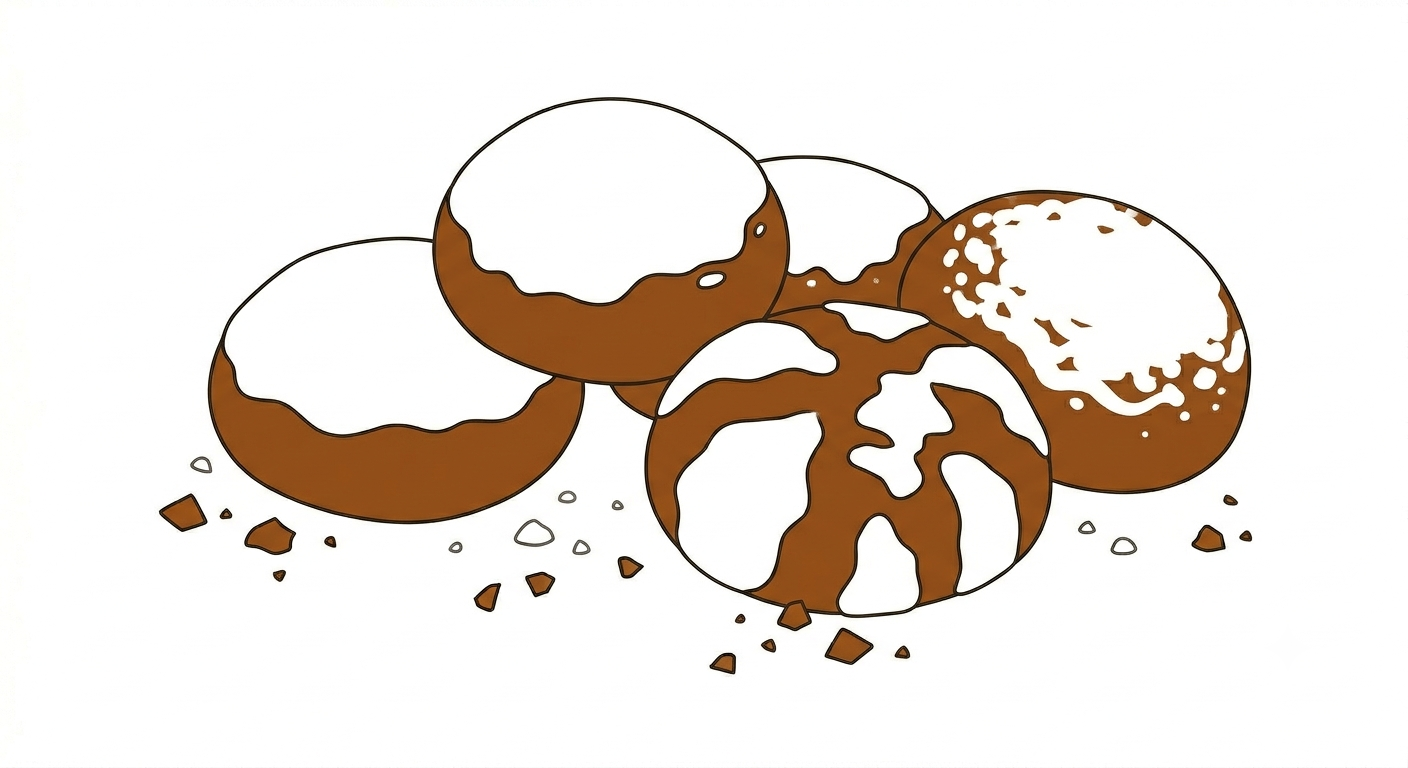
Pfeffernüsse are small, round German spice cookies — dense, chewy at the center, and coated in a thin white sugar glaze or rolled in powdered sugar while still warm. The name means “pepper nuts,” which accurately identifies one of the key ingredients but undersells the complexity of the spice profile. A properly made Pfeffernüsse contains black pepper, yes, but also anise, cinnamon, cardamom, cloves, and nutmeg in varying combinations depending on the baker and the region. The pepper is not aggressive — it provides a faint warmth and a slight bite that keeps the cookies from being merely sweet and pushes them into something more interesting and more grown-up.
Pfeffernüsse belong to the broader family of German Weihnachtsplätzchen — Christmas cookies — that have been produced in the months leading up to the holiday for centuries. The spice trade was central to medieval German commerce, particularly through the Hanseatic League cities of the north, and the availability of exotic spices — pepper, cardamom, anise — made spiced baked goods a marker of prosperity and celebration. Nuremberg and Aachen both have long traditions of spiced Christmas baking, and both cities claim a degree of ownership over the broader category of Lebkuchen, the spiced gingerbread tradition that Pfeffernüsse sit adjacent to without quite belonging to.
The cookies are traditionally made weeks before Christmas and stored in tins to age, a practice that is not merely nostalgic — the resting period genuinely improves them. Freshly baked Pfeffernüsse are good; week-old Pfeffernüsse, having had time for the spices to mellow and integrate and the texture to settle, are noticeably better. It is one of the few baked goods where patience is rewarded in a measurable way.
Pfeffernüsse are also a significant tradition in the Netherlands, where they appear as Pepernoten — smaller, crunchier, and more heavily anise-forward — and are associated with Sinterklaas on December 5th rather than Christmas. The Dutch and German versions have diverged enough to be distinct objects, though they share a common ancestor in the medieval spiced biscuit tradition of northern Europe.
This content was created with the assistance of AI. Sources are currently being reviewed.