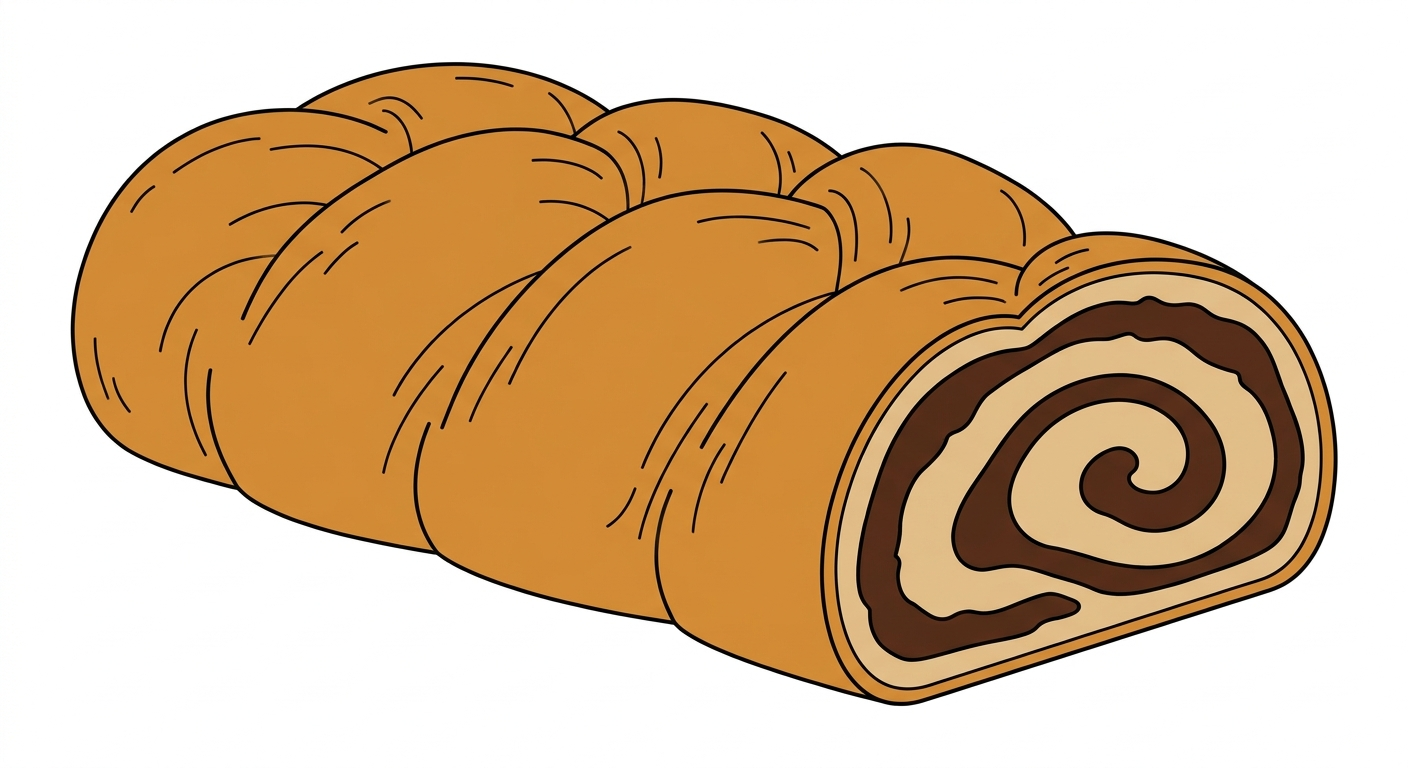
Povitica is a rolled sweet bread — a yeasted dough stretched until it is nearly transparent, covered in a thick paste of ground walnuts, sugar, honey, butter, and sometimes rum or cinnamon, then rolled tightly into a log, coiled into a loaf pan, and baked until golden. The cross-section when sliced reveals a dense spiral of alternating dough and filling, sometimes thirty layers deep, each one distinct. The walnut paste is the dominant flavor — sweet, rich, slightly bitter from the nuts, with the dough providing structure rather than competing for attention. A slice is heavier than it looks and more satisfying than something so simple should be.
The thinness of the dough is what defines it and what makes it demanding. The dough is rolled on a floured cloth, stretched gradually from the center outward, pulled at the edges with the backs of the hands until it covers the entire surface of a large kitchen table — thin enough to read through, thin enough that a tear means starting over. The rolling technique is the skill being passed down when a grandmother teaches a grandchild to make povitica. The recipe itself is straightforward. The hands are the instruction.
The name comes from the South Slavic verb poviti, meaning to wrap or envelop, which describes the preparation exactly. The pastry is documented in Croatian and Serbian sources from 1575, placing it firmly in the pre-Ottoman period of South Slavic food culture. It exists across the region under different names — potica in Slovenia, orahnjača in parts of Croatia, bejgli in Hungary using a similar but distinct technique — and the family resemblance across all of these reflects a shared Central and Eastern European tradition of sweet rolled breads that likely developed in parallel rather than from a single source.
Originally, the filling communicated wealth. Walnuts were not universally affordable, and a povitica made with ground walnuts and honey was a statement about what a household could provide. Poorer versions used herbs, fat, or other available fillings. The walnut version eventually became the standard as walnuts became more accessible, but the memory of it as a luxury food persisted in the care with which it is still made — stretched by hand across a tablecloth, rolled with attention, baked for celebrations rather than for ordinary mornings.
Christmas and Easter are the occasions most closely associated with povitica in Croatia. It appears at both ends of the liturgical year as a food that requires enough effort to mark the occasion rather than simply fill it. The loaves are made in advance, kept for several days without losing quality — the walnut filling preserves moisture in a way that keeps the bread from going stale quickly — and cut into slices thick enough to be satisfying but thin enough that one loaf serves a table.
The Croatian diaspora carried povitica to the United States in the late 19th and early 20th centuries, where it took root most visibly in Kansas City — specifically in the Strawberry Hill neighborhood, a predominantly South Slavic community where Croatian and Slovenian families had settled. A Kansas City company, the Strawberry Hill Povitica Company, has been producing and shipping walnut povitica since 1984, which is how the pastry acquired a modest American profile well beyond the Croatian-American community. The Great British Bake Off featured it as a technical challenge, which produced the particular confusion of British bakers encountering a Central European pastry with no frame of reference, which is a reasonable summary of povitica’s relationship with international recognition — present, respected in its own sphere, largely unknown outside it.
This content was created with the assistance of AI. Sources are currently being reviewed.