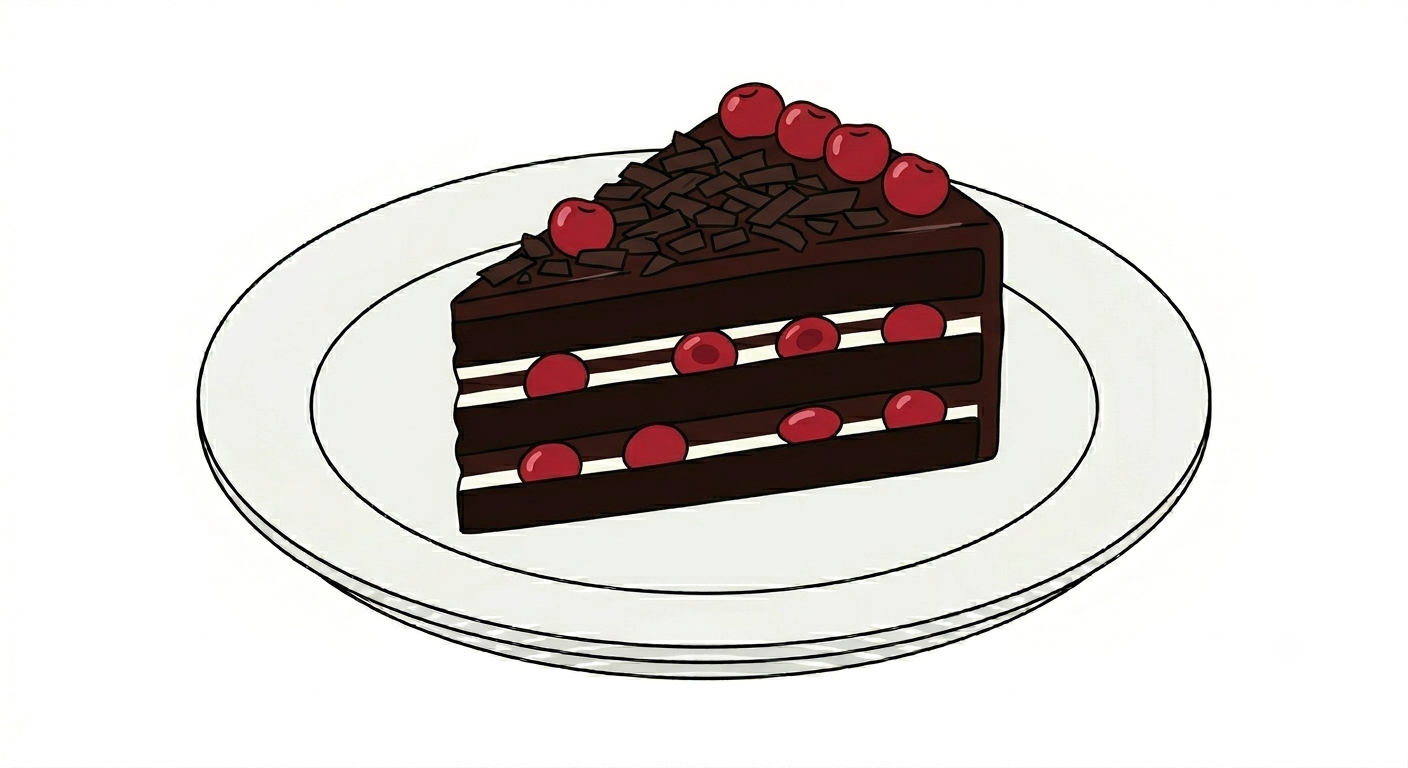
Schwarzwälder Kirschtorte — Black Forest cake in English — is a German layer cake built from chocolate sponge, whipped cream, and sour cherries, soaked generously with Kirschwasser, the clear cherry brandy distilled in the Black Forest region of southwestern Germany. It is finished with more whipped cream, more cherries, and a coating of chocolate shavings across the top and sides. It is an unapologetically abundant cake, and it does not pretend otherwise.
The Black Forest region — the Schwarzwald — sits in Baden-Württemberg, a landscape of dense fir forests, river valleys, and cherry orchards that have historically produced some of Germany’s finest fruit. Kirschwasser has been distilled there for centuries, and the combination of cherries and chocolate has deep roots in the regional kitchen. The cake as a formal, assembled construction is generally credited to Josef Keller, a pastry chef who claimed to have created it in 1915 at the Café Agner in Bad Godesberg, though the first documented recipe in print doesn’t appear until 1934. As with most beloved classics, the exact origin is disputed enough to keep food historians occupied indefinitely.
What is not disputed is the cake’s cultural reach. Through the mid-20th century, Schwarzwälder Kirschtorte became one of the most recognizable German exports in the dessert world — appearing on the menus of German restaurants internationally and becoming something of a shorthand for German baking in the popular imagination. This visibility came at a cost: the cake was reproduced so widely and so carelessly that mediocre versions, made with canned cherries, artificial flavoring, and barely-there Kirschwasser, became the norm in many places.
Under German law, a cake can only be labeled Schwarzwälder Kirschtorte if it contains a minimum percentage of Kirschwasser — a small but pointed reminder that the spirit is not optional. It is what separates the cake from a generic chocolate cherry confection and gives it the faintly boozy depth that makes the whole thing cohere.
This content was created with the assistance of AI. Sources are currently being reviewed.