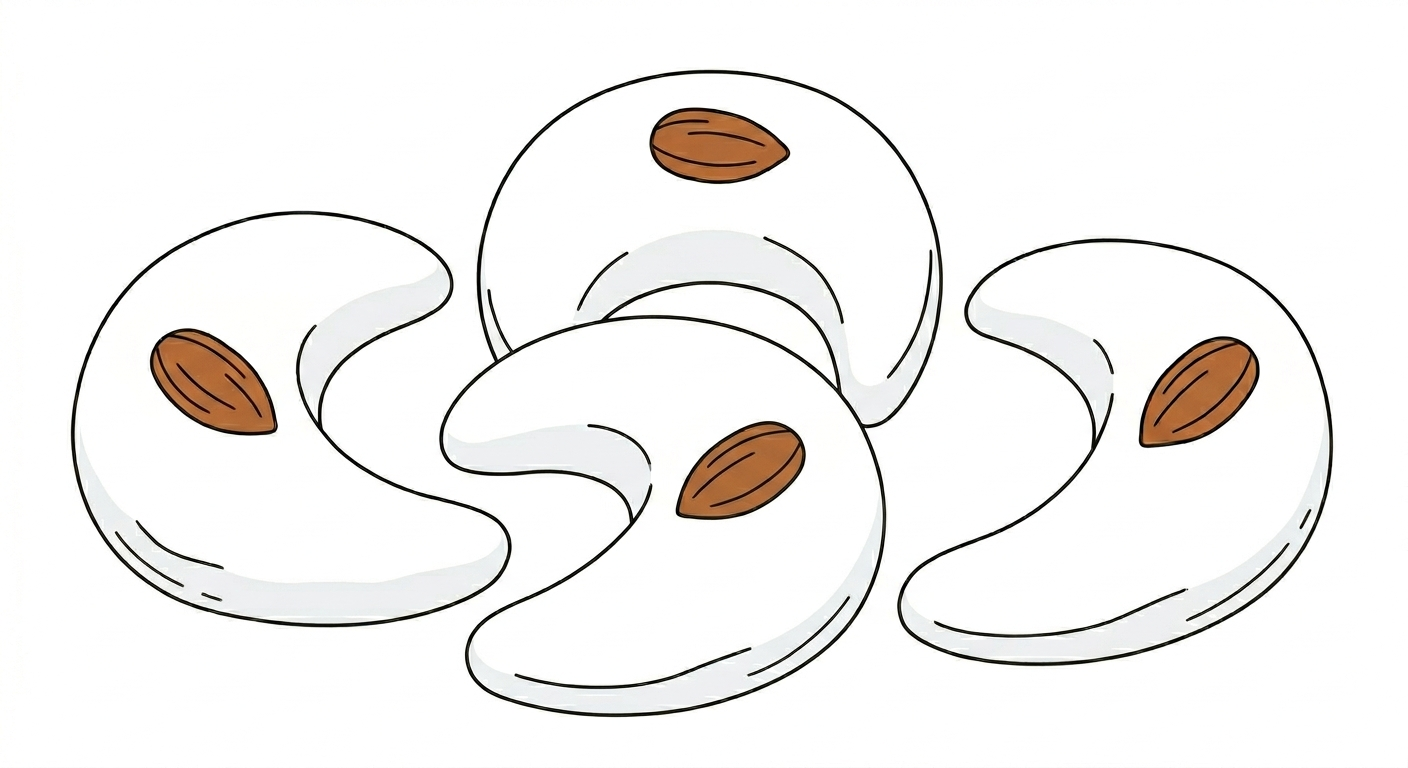
Tcharek msaker is a crescent-shaped cookie — a thin, delicate dough of white flour, butter, and orange blossom water wrapped around a filling of ground almonds, sugar, and more orange blossom water, baked until just golden, then steeped briefly in orange blossom water again and rolled immediately in powdered sugar while still warm. The sugar clings and sets into a white coating that gives the cookie its appearance and part of its name — msaker translates from Algerian Arabic as coated with sugar. Tcharek means crescent. The name describes the object completely.
The cookie is simultaneously crunchy and tender. The outer shell gives way in one bite to the almond filling, which is soft, fragrant, and marzipan-like in texture without being as dense as marzipan. The orange blossom water runs through both the dough and the filling, tying the whole thing together with a floral note that is present without being dominant. The powdered sugar on the outside adds sweetness and the particular sensation of something that looks delicate and is, in fact, quite satisfying.
The origin is Ottoman. Algeria came under Ottoman rule in the early 16th century, and Algiers became a significant Ottoman city — cosmopolitan, commercially active, and subject to the culinary currents that moved through the Ottoman world from Istanbul to the Maghreb. The crescent shape of tcharek is tied directly to that history: the crescent was the symbol of the Ottoman Empire and of the Turkic tradition before it, and shaping a celebratory cookie into that form during the Ottoman period in Algiers was not a neutral aesthetic choice. The cookie and the shape were connected.
The almond filling sits in the same tradition as the almond pastes that appear across North African and Middle Eastern confectionery — a broad culinary current that moved through Arab, Moorish, and Ottoman baking traditions and that tcharek participates in without being reducible to any single one of them. What makes tcharek specifically Algerian is the combination of that filling with the particular dough, the orange blossom steeping after baking, and the powdered sugar coating — a sequence of steps that produces something distinct from the Moroccan kab el ghazal it is sometimes compared to, despite the surface visual similarity.
The distinction matters and is contested. Moroccan cornes de gazelle and Algerian tcharek share a crescent shape and an almond filling but have different origins, different doughs, and different finishing techniques. The Ottoman connection applies to the Algerian version and not the Moroccan one — the Ottoman Empire never colonized Morocco, which remained independent while Algeria was under Ottoman rule for three centuries. Conflating the two flattens a history that is specific and significant to both countries.
Tcharek is made for weddings, Ramadan, Eid, and any occasion significant enough to call for the full range of Algerian sweets. It appears on celebration tables alongside makrout, baklava, and zlabia, each carrying its own history and its own place in the hierarchy of festive pastry. A Baghdadi poet, Abu Talib al-Ma’muni, praised tcharek by name in verse — which is either a measure of how good the cookie is or a measure of how seriously the medieval Arab world took its confectionery, and possibly both.
This content was created with the assistance of AI. Sources are currently being reviewed.