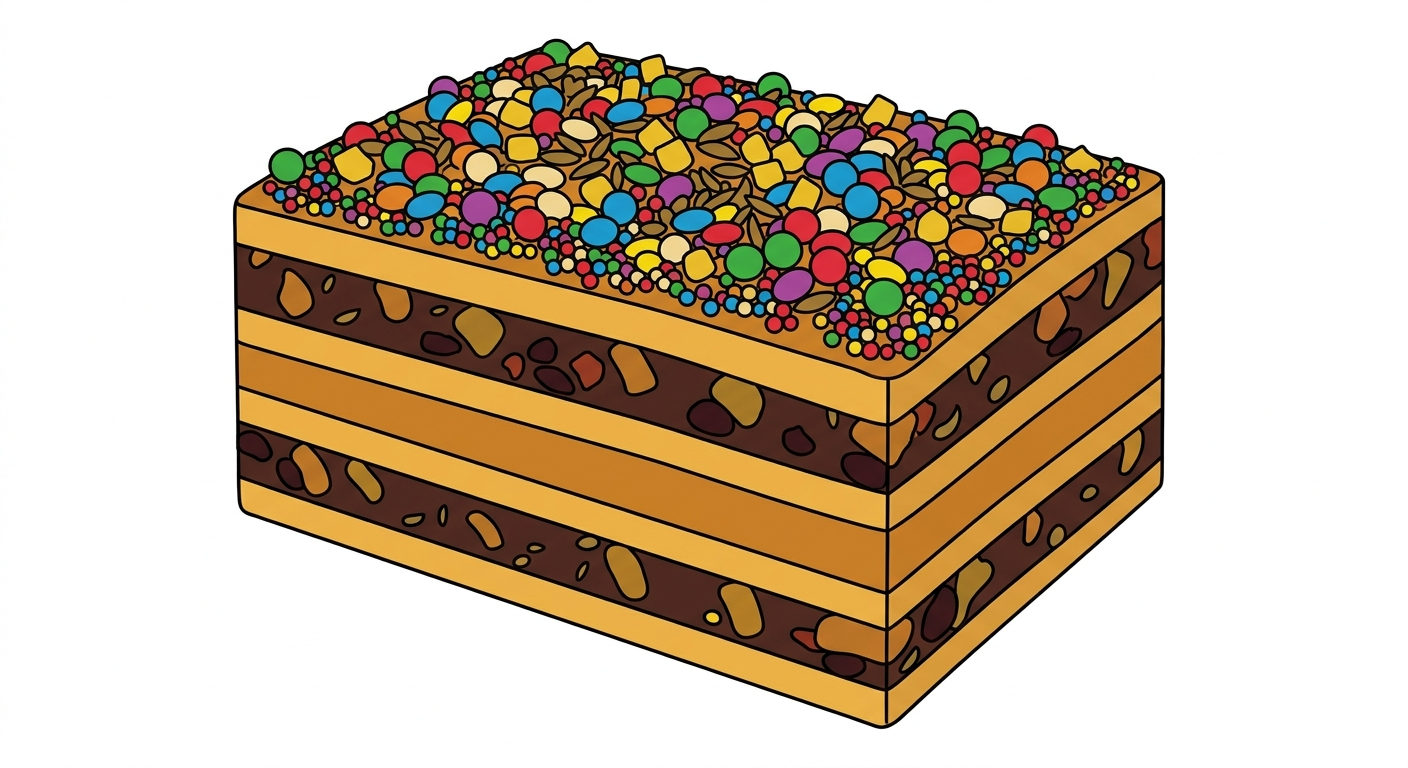
Turrón de Doña Pepa is named after Josefa Marmanillo, an enslaved Afro-Peruvian woman known as Doña Pepa, who according to tradition created the recipe in the eighteenth century after being miraculously cured of paralysis through her devotion to Señor de los Milagros — the Lord of Miracles, the most venerated religious image in Peru. In gratitude she made a sweet offering and distributed it in the streets during the October procession. The dessert has been associated with that procession ever since.
The construction is specific. Anise-scented dough is baked into flat cookie bars, then stacked in a lattice grid and soaked in chancaca syrup — a dark, unrefined cane sugar syrup made by dissolving chancaca, a solid raw sugar block similar to panela, in water with cinnamon and clove. The soaking continues until the bars absorb the syrup and soften slightly. The assembled turrón is then covered in rainbow sprinkles, dried fruit, and candy — the bright, colorful topping that gives it its distinctive festive appearance.
Turrón de Doña Pepa is only made and sold in October, during the month-long celebration of Señor de los Milagros. Outside of October it does not exist in Lima’s bakeries or street stalls. The restriction is cultural and absolute — attempting to find it in any other month is pointless. This makes it one of the most strictly seasonal foods in the world, produced in enormous quantities for thirty days and then absent for the remaining ten months of the year.
During October the streets around the procession route are lined with vendors selling turrón wrapped in paper, carried home in stacks. It is distributed, gifted, and eaten communally. The Afro-Peruvian origin of the dessert is part of its documented history and is acknowledged in Peruvian food writing as a contribution of the African diaspora to Peruvian culinary culture.
This content was created with the assistance of AI. Sources are currently being reviewed.