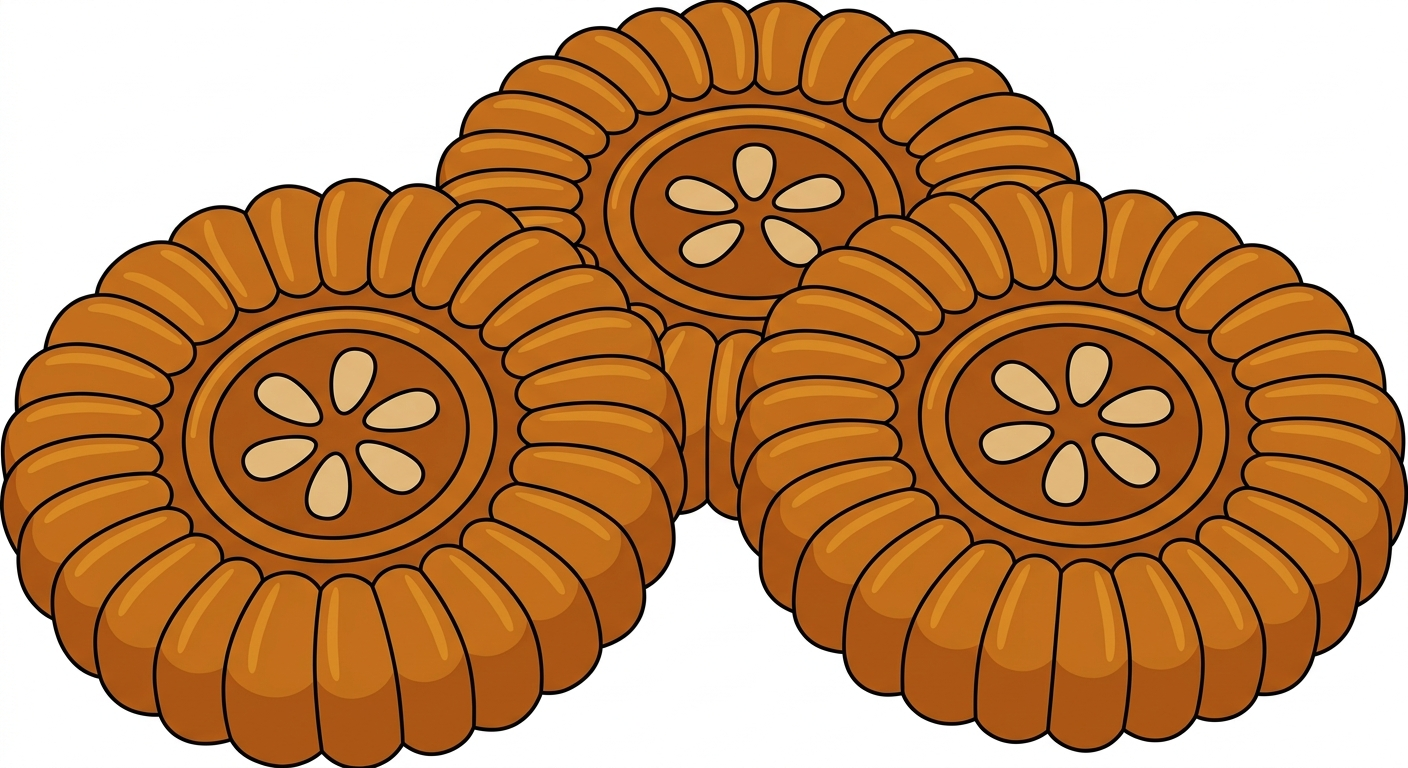
Yakgwa is a fried wheat cookie — a dough of flour, sesame oil, honey, rice wine, and ginger juice, pressed into a carved flower-shaped mold, fried slowly in warm oil until golden, then submerged in a honey and ginger syrup for at least twenty-four hours. The syrup penetrates the cookie completely during the soaking period, so by the time yakgwa is eaten it is saturated all the way through — sticky on the surface, chewy in the center, with the sesame oil and ginger running through every layer. The flower shape comes from the mold, traditionally carved with a lotus motif, and the impression on the surface is sharp enough in a well-made yakgwa that the petals are distinct. The name translates as medicinal confection — yak meaning medicine, gwa meaning sweet — because honey was understood in pre-modern Korean medicine as a healing substance, and a food built around it carried that designation by association.
The history begins in the Three Kingdoms period, roughly the 1st century BCE to the 7th century CE, where records in the Samguk Yusa — a collection of unofficial Korean histories compiled by the monk Iryeon in the 13th century — describe grain-based confections shaped like fruit and used in ancestral rites when actual fruit was unavailable. The word gwa, meaning cookie or fruit, appears in that context, establishing the earliest traceable lineage for what would become yakgwa. The specific form with honey and sesame oil developed through the Unified Silla period, from the 7th to 10th centuries, when yakgwa was made for Buddhist temple ceremonies and royal households — both contexts where honey was treated as a sacred and medicinal ingredient.
The Goryeo Dynasty, which ran from 918 to 1392, is where yakgwa became culturally central. Buddhism was the state religion, and Buddhist ritual required that ancestral offerings contain no meat — yakgwa, as an elaborate and expensive confection, filled that role on ceremonial tables. The demand for yakgwa during this period was significant enough that Kings periodically issued bans on its production to prevent shortages of flour and honey. A confection banned by royal decree for causing food shortages is a confection being made in very large quantities, which reflects both how embedded it had become in ceremonial life and how costly its ingredients were.
During the Joseon Dynasty the shape was refined into the flower form that became standard — the lotus mold producing the distinctive petaled surface that distinguishes yakgwa from other Korean confections. The soaking period, during which the fried cookie absorbs the ginger honey syrup, was also established during this period as the technique that gives yakgwa its specific texture. The cookies are fried at a lower temperature than most fried dough — slow frying in warm rather than hot oil — which allows the interior to cook through without the exterior hardening before the syrup can penetrate.
Yakgwa appears at Chuseok, Seollal, weddings, death anniversaries, and jesa — the ancestral memorial rites that remain an active part of Korean family practice. It is not everyday food. It is occasion food, made for tables that require something that carries weight. The commercial versions available at Korean markets are chewier and denser than the handmade originals. The homemade version, made correctly with the slow fry and the full soaking period, is flakier and more delicate — light enough that the distinction between the two is immediately apparent to anyone who has eaten both.
A recent viral phenomenon in South Korea called yakgeting — competitive pre-ordering of yakgwa from artisan bakeries that sell out immediately upon release — reflects a renewed interest in traditional Korean confectionery among younger generations, driven partly by social media and partly by a genuine reassessment of hangwa, the broader category of traditional Korean sweets, as serious culinary objects worth pursuing. Yakgwa has been on Korean ceremonial tables for over a thousand years. The pre-order queue is new. The cookie is not.
This content was created with the assistance of AI. Sources are currently being reviewed.