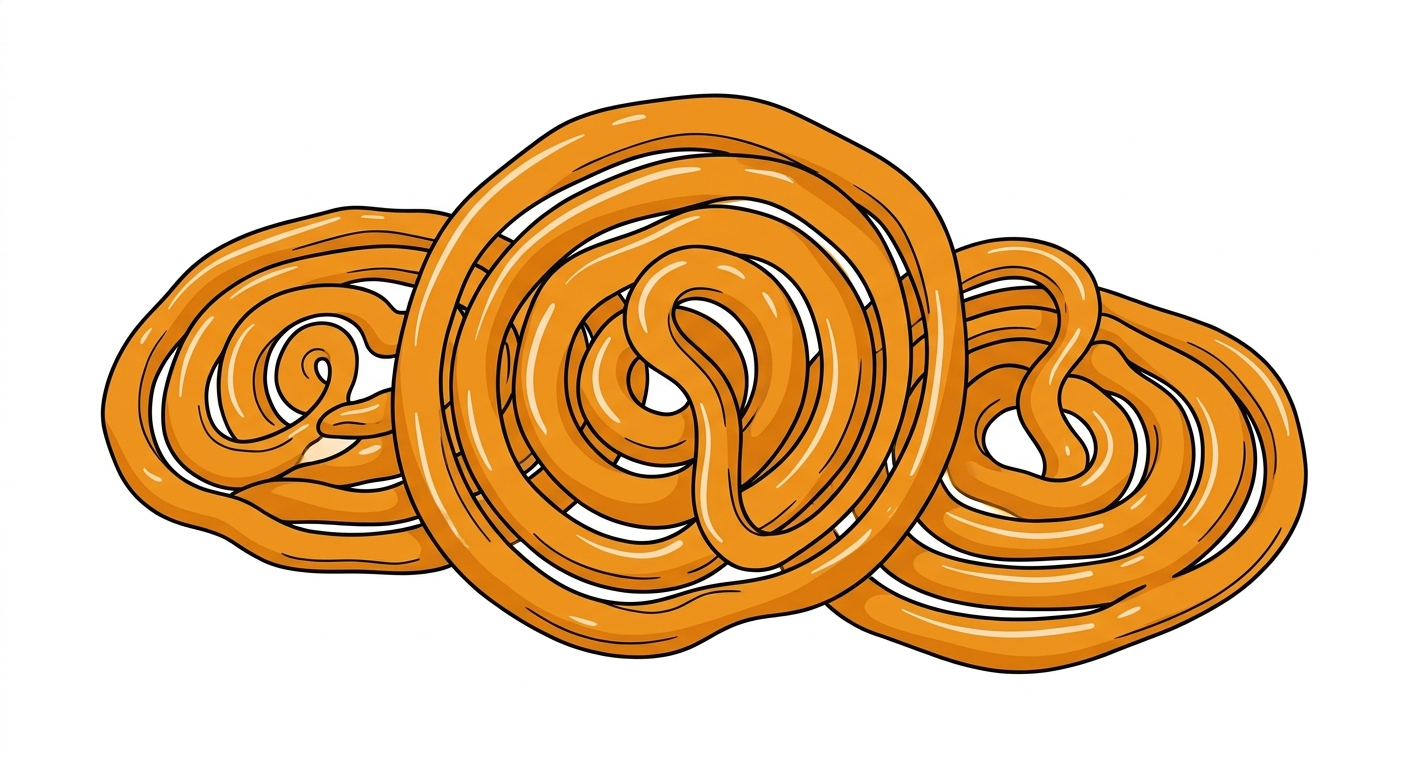
Zlebia are fried spirals — a fermented batter of flour, yeast, yogurt, and sometimes a pinch of cardamom, poured in a thin stream through a small-holed vessel directly into hot oil, traced into coiling, lacy rounds that fry quickly into a crisp, golden lattice, then lifted out and submerged immediately in a syrup of honey or sugar water scented with orange blossom water or rose water. The result is simultaneously crunchy and sticky, the fried batter absorbing just enough syrup to be saturated without going soft. They are eaten hot, pulled apart with fingers, the syrup running. They do not improve with time. They are best within minutes of leaving the oil.
The fermentation is what distinguishes zlebia from other fried dough in the Maghrebi repertoire. The batter is left to ferment for several hours before frying, developing a slight tang and a network of bubbles that produce the characteristic laciness when it hits the hot oil — the batter spreads and the bubbles expand, creating the open, irregular structure that makes zlebia look like a piece of delicate metalwork and eat like something entirely different. The technique requires practice. The pour has to be steady and consistent to produce a spiral rather than an irregular blob, and the speed of the pour determines how open or closed the lattice becomes.
Zlebia belong to the zalabiyeh family — a broad category of fried batter sweets that appears across the Arab world, West Asia, and North Africa under different names: zulbiya in Iran, jalebi in the Indian subcontinent, mushebek in Egypt and Ethiopia, zlabia in Algeria, zlebia in Tunisia. The oldest documented recipe for this family of foods comes from a 10th-century Arabic cookbook, and the form has been moving along trade and pilgrimage routes ever since. The Tunisian version is distinguished by the yogurt in the batter, which adds acidity and contributes to the fermented flavor, and by the orange blossom water in the syrup, which is characteristic of Maghrebi rather than Levantine preparation.
In Tunisia, zlebia are Ramadan food — specifically and most intensely Ramadan food. During the month of fasting, zlebia vendors set up in markets and streets, frying in large pans over open flame from late afternoon onward, the smell reaching well ahead of the stall. They are part of the iftar table — the meal that breaks the fast at sunset — eaten sweet and hot alongside harira, brik, and other foods that mark the end of the day’s abstention. The seasonal concentration of zlebia production means they are associated with Ramadan in the way that certain foods everywhere are associated with specific times of year — present at other moments but never quite the same outside their season.
They also appear at weddings, where the act of making them in public — a vendor pouring batter in practiced spirals over hot oil, a crowd watching — is part of the occasion’s spectacle. The making of zlebia is inherently visual, the spiraling batter tracing its pattern in the oil before setting, and that visibility is part of what makes it appropriate for celebration. It is a food that announces itself.
This content was created with the assistance of AI. Sources are currently being reviewed.