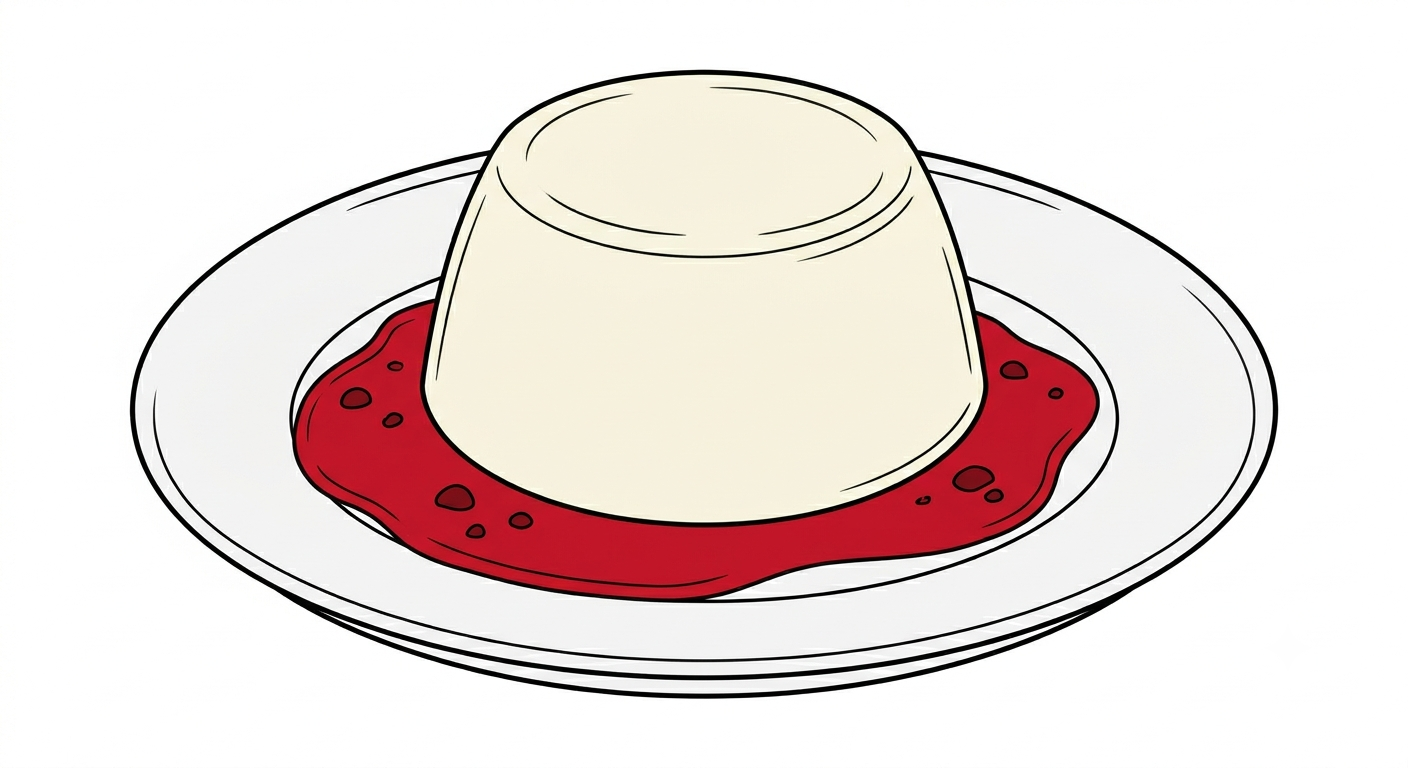
Panna cotta is an Italian molded dessert made from cream, sugar, and gelatin — heated together until the sugar dissolves and the gelatin blooms, poured into molds, and chilled until it sets into something that trembles when unmolded and holds its shape only just. The name means “cooked cream,” which is accurate but gives no indication of how delicate the result is. A properly made panna cotta should be on the verge of not holding together — firm enough to unmold cleanly, soft enough that it quivers at the slightest movement and collapses almost immediately on the tongue. The texture is the achievement. The flavor — vanilla, cream, a faint sweetness — is the backdrop against which that texture registers.
Panna cotta comes from Piedmont in northwestern Italy, a region with a dairy tradition as serious as anywhere in Europe. The earliest documented recipes appear in the mid-20th century, though similar preparations — cream set with gelatin or isinglass — existed in Italian and broader European cooking well before that. Some food historians connect it to a dish made by a Hungarian woman in the Langhe hills in the early 20th century, though the details are vague enough that the origin remains loosely attributed rather than firmly established. What is clear is that panna cotta became a fixture of Piedmontese restaurant cooking in the latter half of the 20th century before spreading across Italy and eventually becoming one of the most internationally recognized Italian desserts.
The simplicity of the ingredient list is deceptive. The ratio of gelatin to cream is everything — too much and the result is rubbery and dense, too little and it won’t hold its shape. Whole cream produces the richest result, but some versions use a combination of cream and milk for a lighter texture. Flavorings beyond vanilla — coffee, citrus zest, amaretto, honey — are common and generally successful, though the plain vanilla version remains the standard against which others are measured.
Panna cotta is almost always served with something alongside it — a pool of berry coulis, a spoonful of caramel, macerated fruit, or a drizzle of honey — and those accompaniments are not optional garnishes but functional components that provide the acidity or bitterness the cream alone lacks. The dessert is rich and neutral by design, and it needs contrast to come fully alive.
This content was created with the assistance of AI. Sources are currently being reviewed.