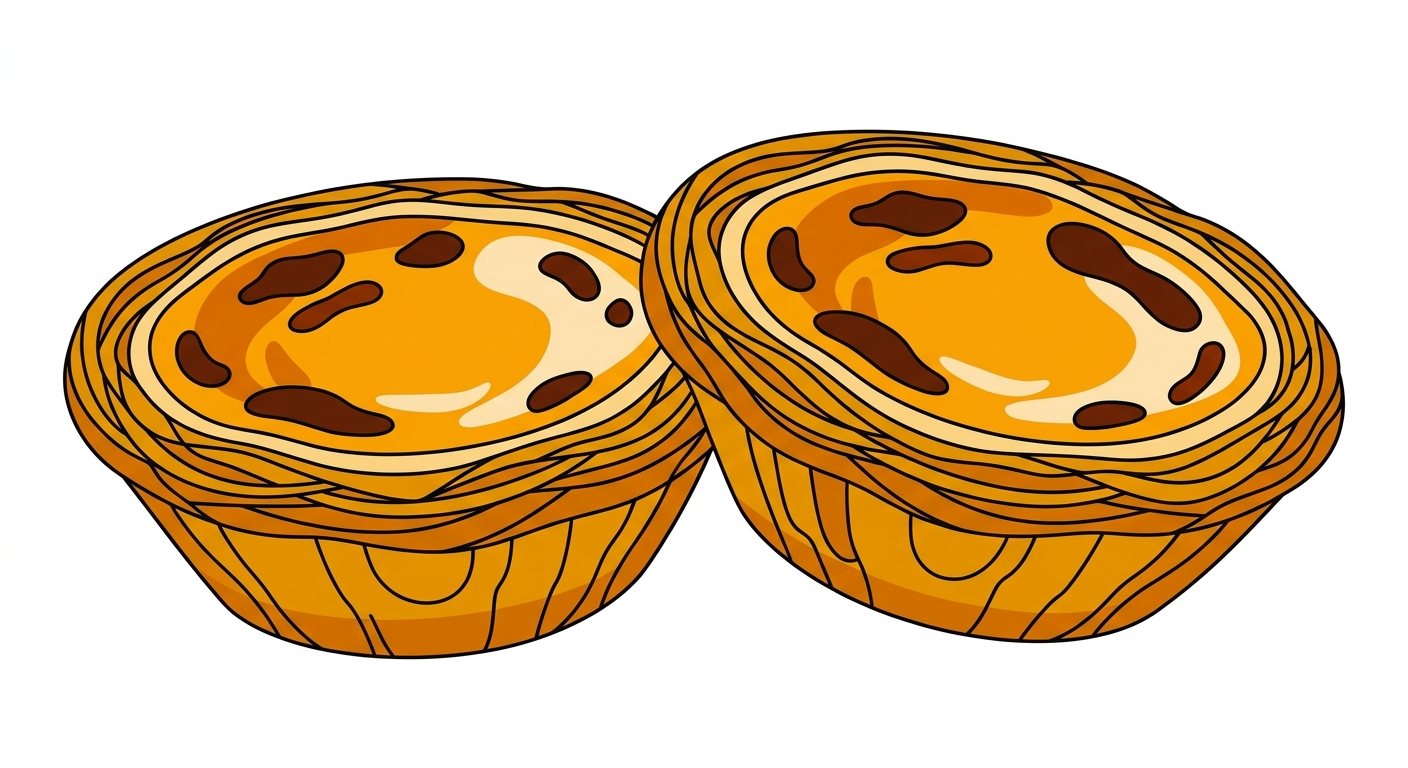
A pastel de nata is a small custard tart — a flaky, laminated pastry shell filled with a custard of egg yolks, sugar, cream, and a little flour, baked at extremely high heat until the custard blisters and chars in irregular patches across the surface. That charring is not a flaw. It is the thing. The contrast between the caramelized top, the silky custard beneath, and the shattering crispness of the shell is what makes the pastel de nata one of the most precisely calibrated pastries in the world. It is eaten warm, dusted with cinnamon and powdered sugar if you want, standing at a counter, with a small espresso. That is the correct way. Everything else is a reasonable approximation.
The origin is the same story that runs through all of Portuguese conventual pastry. Egg whites were needed in large quantities for starching the habits of monks and nuns, which left an abundance of egg yolks with nowhere to go. Monasteries and convents across Portugal turned those surplus yolks into an entire tradition of dessert — dense, sweet, egg-rich pastries that became the doçaria conventual, the convent sweets that still define Portuguese baking today.
The pastel de nata specifically is credited to the monks of the Jerónimos Monastery in Belém, a civil parish on the western edge of Lisbon along the Tagus River. The monastery is a Manueline masterpiece — ornate, sprawling, built with the wealth that came from the Age of Discovery — and it is where the tart was born sometime before the 18th century. The monks sold them to visitors arriving by steamboat to see the monastery and the nearby Torre de Belém, using the income to sustain the community. It was practical commerce before it was cultural heritage.
The Liberal Revolution of 1820 changed everything. The political upheaval that followed destabilized religious institutions across Portugal, cutting their funding and eventually forcing closures. When the Jerónimos Monastery shut its doors in 1834, the monks sold the recipe to the owner of a nearby sugar refinery rather than let it disappear. Three years later, in 1837, the Fábrica de Pastéis de Belém opened just a short walk from the monastery — and has been operating continuously ever since. The original recipe remains a closely guarded secret, known only to a small number of master bakers and passed down within the operation. The tarts made there are called pastéis de Belém, a name that is legally protected and belongs only to that shop. Every other version, made by every other bakery in Portugal and around the world, is called pastel de nata.
The distinction matters and also doesn’t. The Belém version is excellent — baked in the original wood-fired ovens, with a custard that has a particular depth of flavor the copies struggle to match. The lines outside are long and worth it. But the spread of the pastel de nata beyond that single shop is what turned a monastic recipe into a national symbol. Bakeries across Portugal developed their own versions, each with slight variations in custard texture, shell thickness, and degree of char. The tart became an everyday item — available at every padaria, every café, every highway rest stop — without losing its status as something worth eating carefully.
Internationally, the pastel de nata traveled along the routes of Portuguese colonial history, taking root most significantly in Macau, where it transformed into the dan tat and spread across the Chinese-speaking world. Hong Kong bakeries carry it. Chinatowns in cities across Southeast Asia, North America, and Europe sell versions of it. The custard tart that a monk invented from leftover egg yolks in a Lisbon monastery is now one of the most widely replicated pastries on earth, which would probably have surprised everyone involved in its original creation.
This content was created with the assistance of AI. Sources are currently being reviewed.