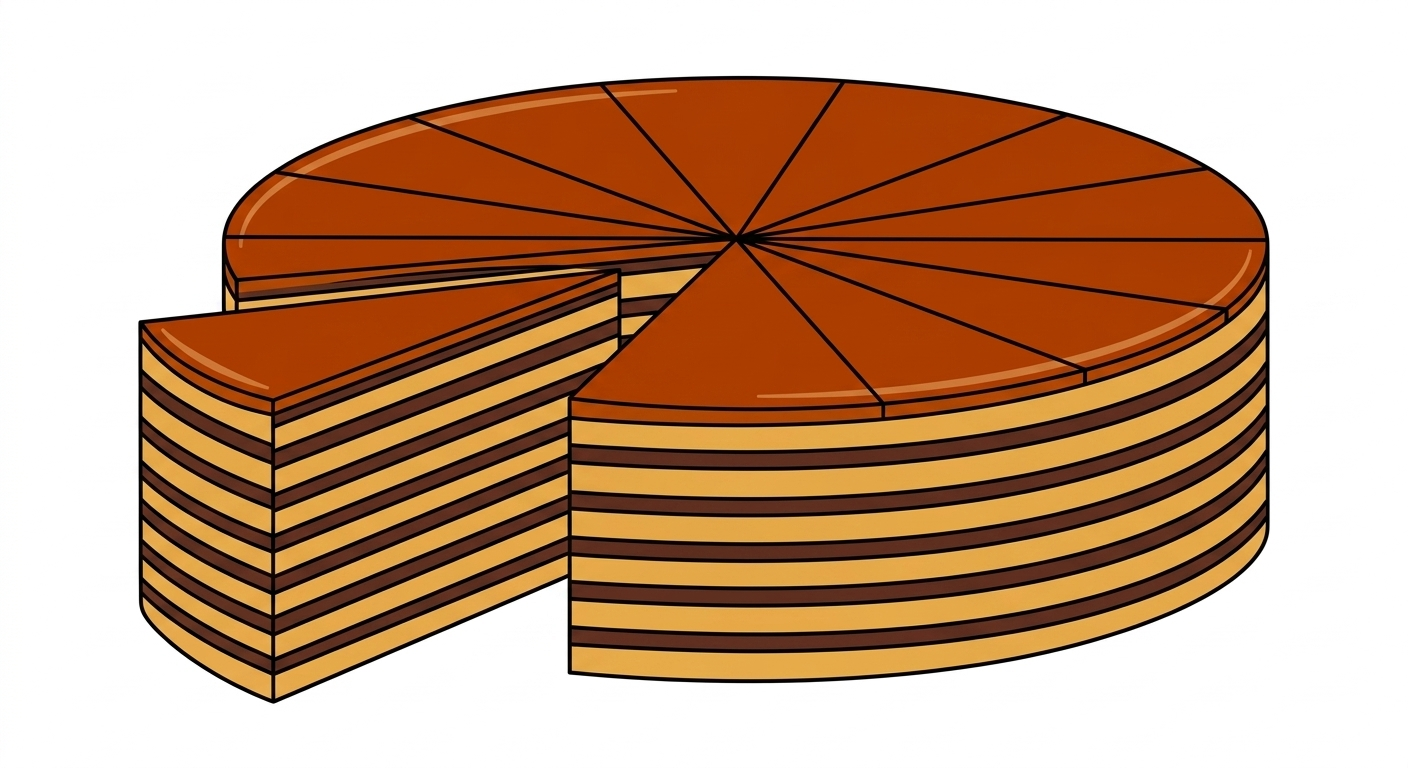
Dobos torte is a Hungarian layer cake built from six to eight very thin rounds of sponge cake alternated with chocolate buttercream, finished with a hard caramel glaze on top that is scored into individual portions with a knife before it fully sets — the only practical way to cut through it cleanly once hardened. The sides are typically pressed with ground hazelnuts or almonds. The sponge layers are baked separately and are closer to a firm crêpe than a conventional cake round — thin, light, and slightly dry on their own, designed to absorb the buttercream rather than contribute flavor independently. The caramel top is the structural and visual signature: flat, amber, glossy, and brittle, it cracks on the knife and shatters under a fork. Each slice arrives with a caramel shard balanced on top, sometimes stood upright.
József C. Dobos created the cake in 1884 in Budapest, where he operated a well-known gourmet shop selling imported cheeses, wines, and specialty foods. His interest in shelf life drove the design — without reliable refrigeration, most cakes of the period were filled with pastry cream or whipped cream and deteriorated quickly. Dobos encountered chocolate buttercream on travels in France, where it was not yet widely used in Hungarian pastry kitchens, and recognized that its higher fat content made it far more stable than conventional fillings. The hard caramel top served the same purpose: it sealed the uppermost layer and protected the cake during transport. Dobos introduced the torte at the National General Exhibition of Budapest in 1885, where Emperor Franz Joseph I and Empress Elisabeth were among the first to taste it. The Emperor’s approval led to a royal court appointment. Dobos toured the cake through European capitals himself, keeping the recipe a closely guarded secret until his retirement in 1906, when he donated it to the Budapest Confectioners’ and Gingerbread Makers’ Chamber of Industry so it could not be monopolized after his death.
The recipe that survived into the twentieth century was not identical to the original — the finer details were lost during the Second World War — which accounts for the variation in layer count and proportion across modern versions. The torte remains Hungary’s most internationally recognized cake and a fixture of Budapest’s historic coffeehouse culture. It is the acknowledged ancestor of the New Orleans doberge cake, which Beulah Ledner adapted in the 1930s by replacing the buttercream filling with custard and renaming it to suit the city’s French-inflected sensibility.
This content was created with the assistance of AI. Sources are currently being reviewed.