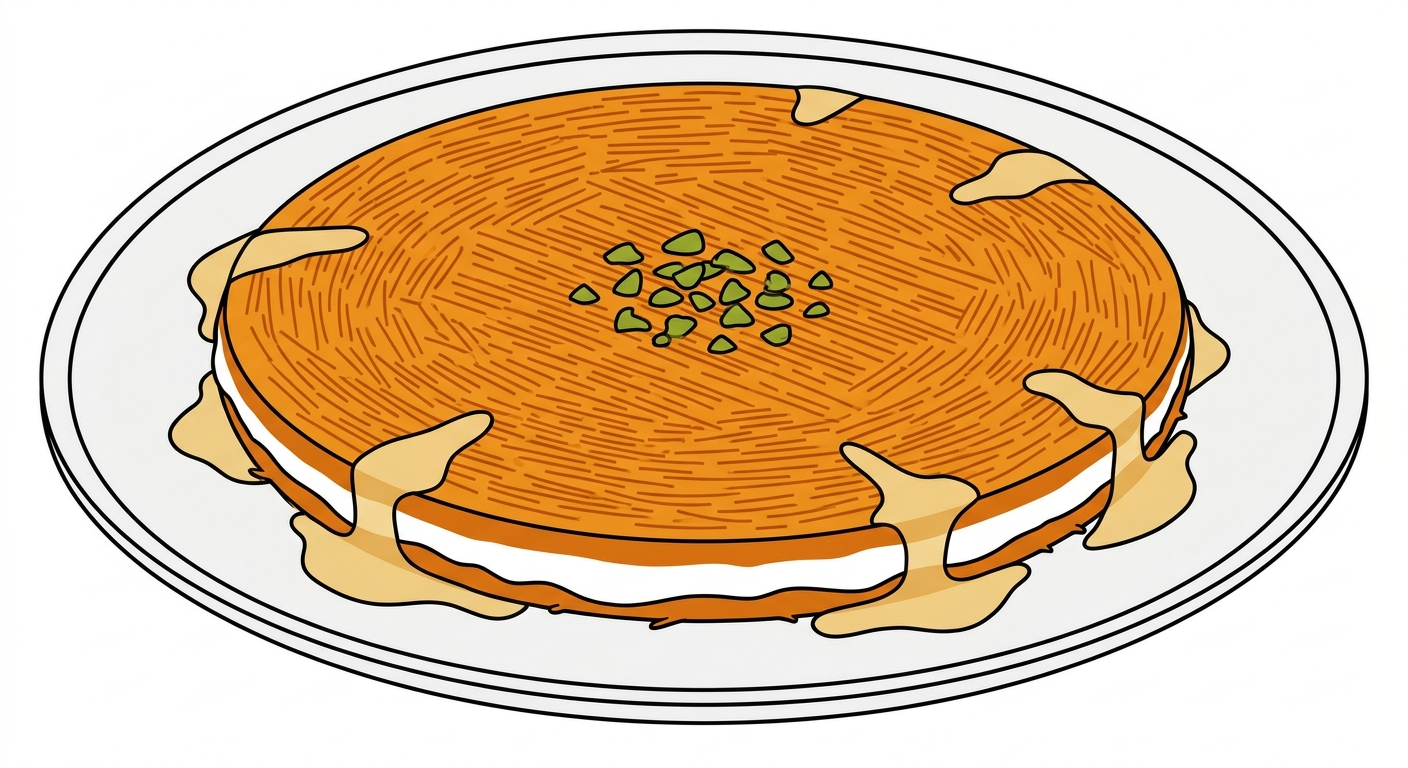
Kunāfah is made from two components assembled in layers and baked: a base of either shredded kataifi pastry — fine, vermicelli-like strands of dough — or ground semolina dough called farkeh, and a filling of soft white cheese, traditionally Nabulsi cheese, which is brined, firm, and becomes stretchy and mild when heated. The assembled tray goes into a hot oven or onto a flame until the pastry turns golden and the cheese melts. It is then flipped onto a serving dish, flooded immediately with cold sugar syrup scented with rose water or orange blossom, and finished with crushed pistachios. The contrast of temperatures — the hot pastry and cheese against the cold syrup — is intentional and essential. It is eaten immediately, in squares cut from the tray, while the cheese is still molten. The surface is traditionally tinted orange with food coloring, a purely aesthetic choice that has become a visual marker of the dish.
The two main forms carry different names depending on region. Khishneh — meaning rough — uses the shredded kataifi pastry and produces a crunchier, more textured exterior. Na’ameh — meaning smooth — uses ground semolina dough and has a softer, more uniform crust. The cheese filling varies too: Nabulsi cheese is the Nablus standard, akkawi is common across the Levant, and Egyptian versions use qishta, a clotted cream, rather than cheese entirely. Turkish künefe uses a local string cheese called dil peyniri and is typically made in individual portions rather than large trays.
The earliest written references to kunāfah-like preparations appear in tenth-century Arabic sources, describing cheese-filled pastries eaten during Ramadan suhoor — the pre-dawn meal before fasting. The dish is most consistently attributed to Nablus, a Palestinian city in the northern West Bank, where it was made with local Nabulsi cheese and has been produced continuously for centuries. The name derives from the Arabic root kanaf, meaning to shelter or protect — a reference to the pastry layers enclosing the cheese. From Nablus it spread across the Levant and through the Ottoman Empire into Turkey, Egypt, and the Gulf states, each adapting the form to local cheese and local convention. Nablus holds the Guinness World Record for the largest kunāfah ever made: seventy-four meters long, assembled in the city’s old market in 2009.
This content was created with the assistance of AI. Sources are currently being reviewed.