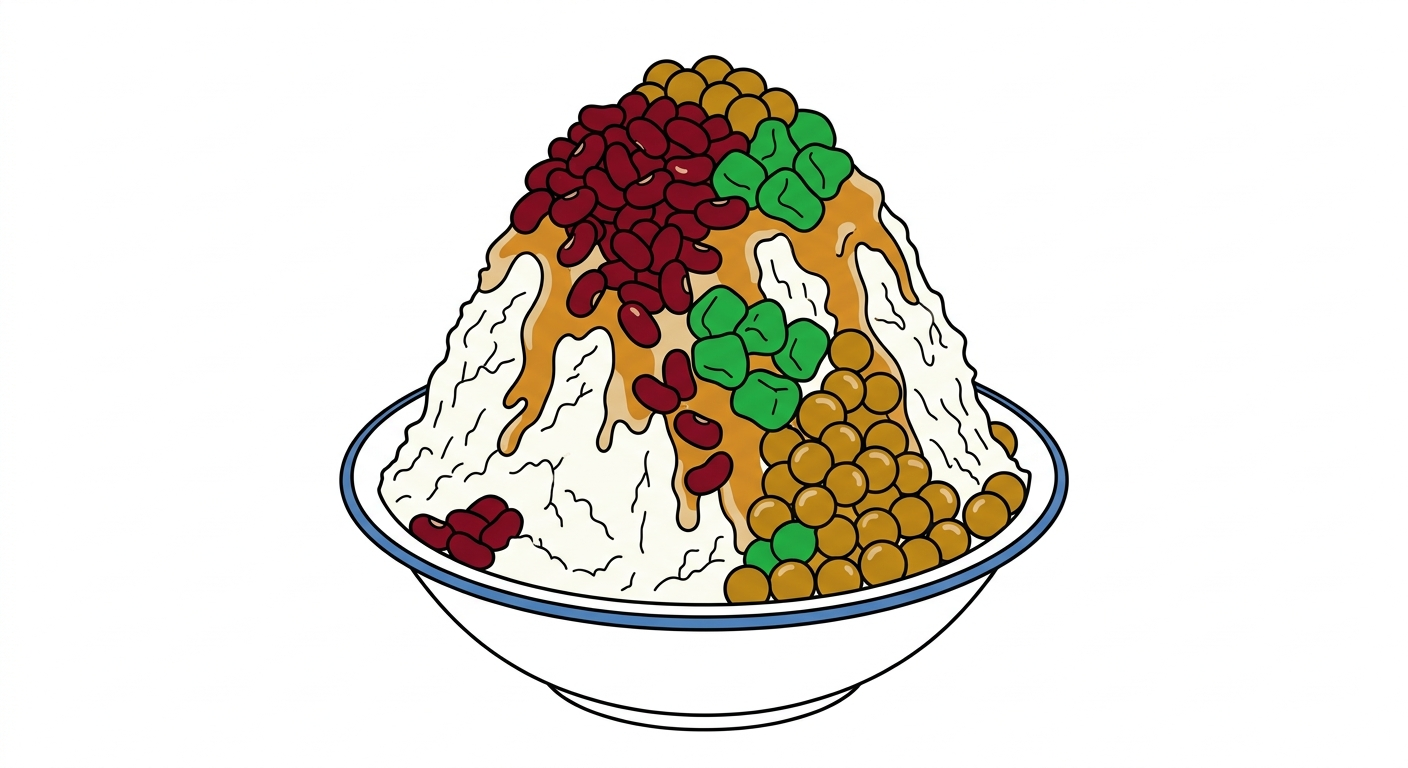
Tshuah-ping is a mound of shaved ice — finely shaved into soft, almost powdery layers that pile high above the rim of a bowl, then covered with toppings that vary by season, by vendor, and by the preferences of whoever is eating it. The foundation is cold and neutral. The toppings are the argument. Red adzuki beans cooked with sugar, mung beans, tapioca balls, fresh mango, strawberry, grass jelly, condensed milk drizzled over everything — the combinations are seasonal and personal, and the correct version is whatever the person eating it grew up with. What remains consistent is the ice itself: shaved fine enough that it dissolves on the tongue rather than requiring chewing, cold but not abrasive, a texture that the Taiwanese call snow-like and that most people have no other frame of reference for until they have eaten it.
The name in Taiwanese Hokkien means shaved ice — tshuah being the act of shaving or grating, ping being ice. In Mandarin it is bàobīng, which means the same thing. Neither name is particularly poetic, which is consistent with a food that needs no embellishment to justify itself on a hot summer afternoon in Taipei.
Tshuah-ping as it exists today — the machine-shaved ice, the specific texture, the format of a mountain of toppings on a bowl of fine ice — was introduced to Taiwan during the Japanese colonial period, which ran from 1895 to 1945. The kakigōri tradition, Japan’s own shaved ice dessert that dates to the Heian period, came with the colonial administration, and with it came the technology to shave ice finely enough to produce the particular texture that defines tshuah-ping. Taiwan’s tropical climate and abundant fruit — mango, strawberry, lychee, passion fruit — gave the island ingredients that Japan’s climate couldn’t replicate, and Taiwanese vendors adapted the kakigōri format to what was available and what worked in the local food culture. The result was something distinct enough from the Japanese original that it became its own thing.
The direction of travel after 1945 is significant. When Japanese colonial rule ended, tshuah-ping did not disappear — it spread. It moved from Taiwan to mainland China and to Chinese diaspora communities across Southeast Asia, arriving in Malaysia and Singapore as ais kacang in its regional adaptations, influencing the broader East Asian shaved ice tradition. A dessert introduced by an occupying power became, through the work of Taiwanese vendors and night market culture, an export from Taiwan rather than an import.
The mango version — fresh mango piled over shaved ice with mango syrup and condensed milk — is the version that traveled most effectively and the one that most people outside Taiwan encounter first. It became a symbol of Taiwanese food culture in the same way that the pastel de nata became a symbol of Portuguese food culture — specific enough to identify a place, accessible enough to travel widely, good enough that the reason for its association with its origin is self-evident. In Taiwan, mango tshuah-ping is summer — available from the first Irwin mangoes of June through the end of the season, made from fruit specific to the southern counties around Tainan where the best mangoes grow, and eaten sitting at a plastic table in a night market with the ice melting faster than it can be eaten.
The xuehua bing variation — snow flower ice — takes the format further. Instead of water ice, frozen milk is shaved, producing something even finer and creamier than the standard version, closer to fresh snow than to ice, melting on contact. It is the current direction of tshuah-ping’s evolution, a refinement of the texture that has been defining the dessert since a Japanese ice-shaving machine arrived in Taiwan over a century ago.
This content was created with the assistance of AI. Sources are currently being reviewed.