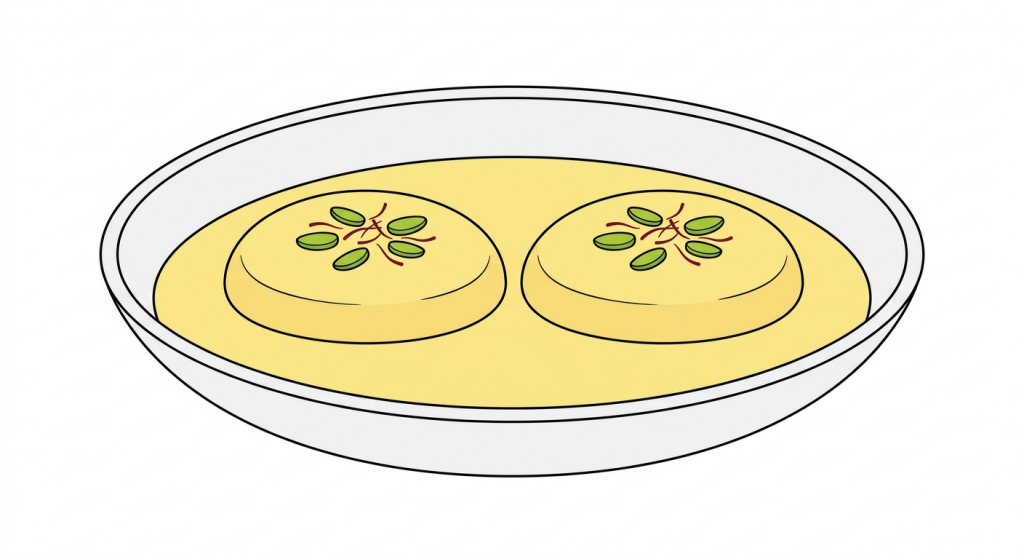
Bengali sweets represent one of the most technically distinct dessert traditions in India, built almost entirely around fresh chenna — a soft, crumbly fresh cheese made by curdling milk with lemon juice or vinegar and draining the whey. The technique of working chenna into smooth, moldable dough and then cooking it in sugar syrup or shaping it into confections is unique to Bengal and Odisha and distinguishes Bengali mithai from the khoya-based sweets of North India.
Rasgulla are soft chenna spheres cooked in light sugar syrup until they absorb liquid and become spongy. The preparation was documented in Bengal in the 19th century, though Odisha contests its origin, claiming a version called kheer mohana was offered at the Jagannath Temple in Puri centuries earlier. The geographical indication dispute between West Bengal and Odisha over rasgulla was formally resolved in 2017 when West Bengal received a GI tag for Banglar Rasgulla as a distinct preparation. Sandesh is an uncooked or lightly cooked chenna sweet, shaped in molds and flavored with cardamom, saffron, or fruit — it is more delicate than rasgulla and considered the more refined of the two. Mishti doi is yogurt set with date palm jaggery or caramelized sugar, giving it a darker color and deeper flavor than standard sweetened yogurt.
Date palm jaggery — nolen gur — is harvested from date palms during winter months in Bengal and is one of the most prized sweeteners in Indian cooking. It has a complex, slightly smoky caramel flavor distinct from sugarcane jaggery, and its season runs roughly from December through February. Sweets made with nolen gur — nolen gurer sandesh, nolen gurer rosogolla, nolen gurer ice cream — are available only during this window and are considered seasonal specialties.
The Bengali mithai shop — mishti’r dokan — is a distinct institution, often family-run for multiple generations, with each shop known for specific preparations. Kolkata’s mithai culture is concentrated in neighborhoods like Bhowanipore, Shyambazar, and around College Street, where shops have operated continuously for over a century. The Bengali tradition of gifting sweets at Durga Puja, Diwali, and Eid reflects the way mithai functions as social currency across religious communities in Bengal.
This content was created with the assistance of AI. Sources are currently being reviewed.