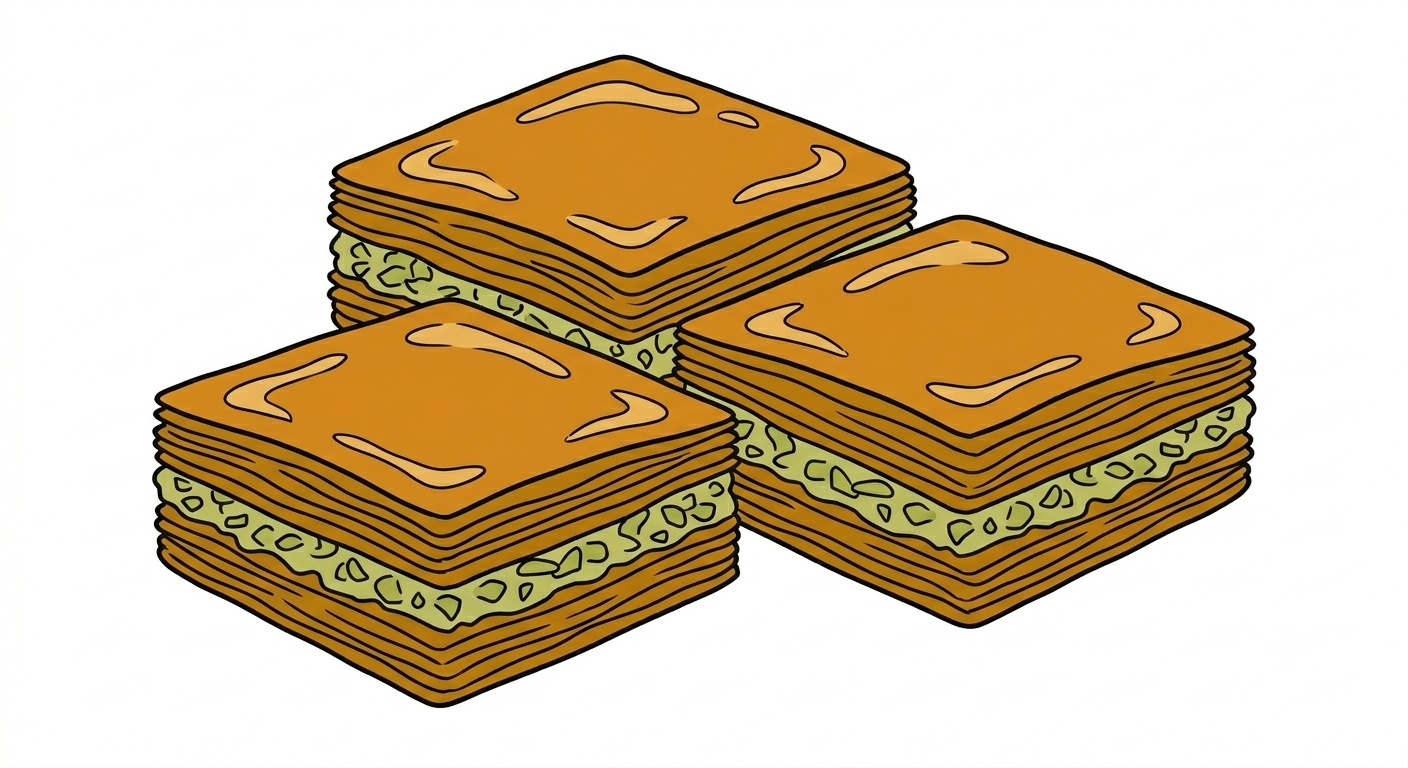
Tunisian baklawa is phyllo — dozens of paper-thin sheets of dough layered with a filling of finely ground almonds and pistachios, cut into diamond shapes, baked until the pastry is golden and shatteringly crisp, then drenched in pure honey while still hot from the oven. The honey soaks into the layers immediately, pooling in the cuts and saturating the pastry from the inside out. The result is sticky, crunchy, and intensely sweet — a combination of textures and flavors that is the same basic logic as baklava everywhere and yet distinctly its own. The honey is the tell. Where Turkish baklava uses a cooled sugar syrup, Tunisian baklawa uses honey, and that difference changes the flavor entirely — darker, more complex, with the particular floral bitterness of North African honey cutting through the richness of the nut filling and the butter-soaked phyllo.
The filling distinguishes it further. Tunisian baklawa uses a blend of almonds and pistachios rather than the pistachio-dominant Turkish version or the walnut-dominant Greek one. The nuts are ground finely, sometimes with a little orange blossom water worked in, producing a paste that is fragrant and dense rather than chunky. Cardamom and orange blossom water flavor the preparation in place of the cinnamon and cloves common in other regional versions.
Baklawa arrived in Tunisia through the Ottoman Empire, which exerted control over the region from the 16th century until the French protectorate of 1881. The Ottoman culinary tradition — centered on layered pastry, nut fillings, and sweet syrup — traveled with the empire’s administrative and military presence, and North African cooks absorbed the technique and rebuilt it with local ingredients. Algeria and Morocco received the same influence through the same route, and the broader Maghrebi baklawa tradition reflects that shared Ottoman inheritance filtered through distinct local pantries.
Tunisia adapted what it received with complete confidence. The pure honey finish, the almond-pistachio blend, the orange blossom water — none of these are Ottoman defaults. They are Tunisian choices made over generations of production, each one reflecting what was available and what tasted right in a North African kitchen. The result sits in the same family as baklava across the Mediterranean and Middle East while being immediately identifiable as its own thing to anyone who has eaten both.
Tunisian baklawa is Ramadan food, Eid food, wedding food — present at every occasion significant enough to require the most labor-intensive and most celebrated pastry in the repertoire. It is made in large trays, cut in the tray, and distributed among guests and family. Bakeries produce it year-round but in greatest quantities in the weeks approaching Eid al-Fitr, when it functions as the primary celebration sweet and as a gift exchanged between households. The stickiness of the honey glaze means it travels well in closed boxes and arrives at its destination in the same condition it left — which is practical for a gift and part of why it became one.
This content was created with the assistance of AI. Sources are currently being reviewed.