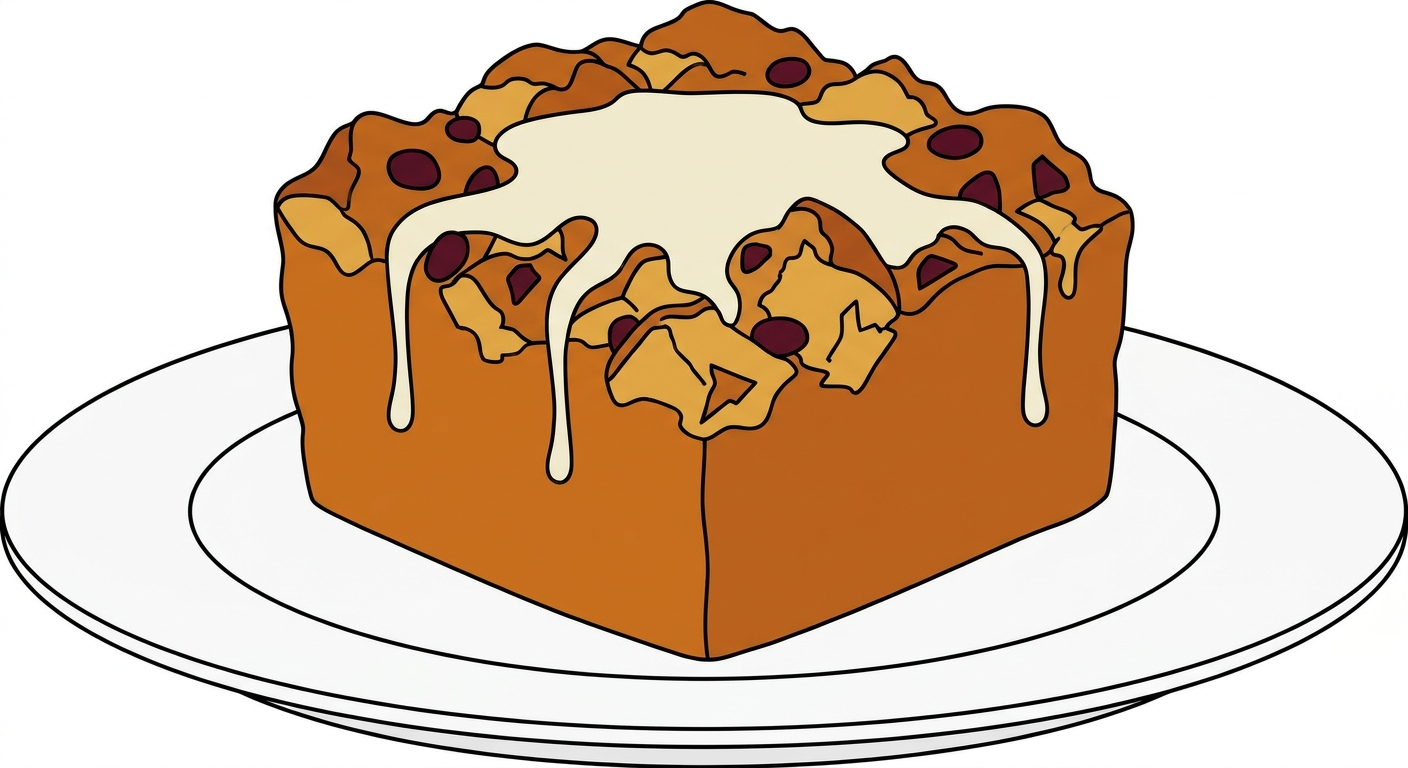
New Orleans bread pudding is made from day-old French bread — the light, airy loaves specific to New Orleans bakeries — soaked in a custard of eggs, milk, cream, sugar, vanilla, and cinnamon until fully saturated, then baked until set and golden on top. The interior stays soft and custardy, the top develops a slight crust, and the whole thing is served warm, flooded with whiskey sauce: butter, powdered sugar, egg, and bourbon or Irish whiskey cooked together into a thin, rich, boozy glaze that soaks into the pudding on contact. Raisins are traditional; pecans and seasonal fruit appear by restaurant and household. The whiskey sauce is not optional — it is the defining element that separates the New Orleans version from generic bread pudding and the reason the dessert is as much about the sauce as the pudding itself.
The logic of bread pudding is universal and old: stale bread, sweetened liquid, baked until edible again. Sweet custard-based versions appear in English cookbooks by the mid-eighteenth century, and the British form traveled to New Orleans with the city’s complex colonial history. What New Orleans added was the whiskey sauce and the specific bread. New Orleans French bread has a different crumb than standard French baguette — lighter and more porous — which absorbs the custard more completely and produces a softer finished texture. Bread pudding recipes appear in New Orleans cookbooks from at least 1885, when Lafcadio Hearn’s La Cuisine Creole included a version. By the mid-twentieth century it was on menus across the city, made differently at every restaurant — some soufflé it, some add chocolate, some finish with rum sauce instead of whiskey — but always warm, always sauced.
The dessert is now so embedded in New Orleans restaurant culture that it functions as a benchmark: ordering bread pudding at a new restaurant is a calibration exercise, a way of reading the kitchen. The best-known versions — Commander’s Palace, Mr. B’s Bistro, Dooky Chase’s — are distinct from each other in proportion and sauce, and regulars have opinions. It appears on menus across the city from neighborhood lunch counters to white-tablecloth dining rooms without contradiction, which is a thing very few desserts manage.
This content was created with the assistance of AI. Sources are currently being reviewed.