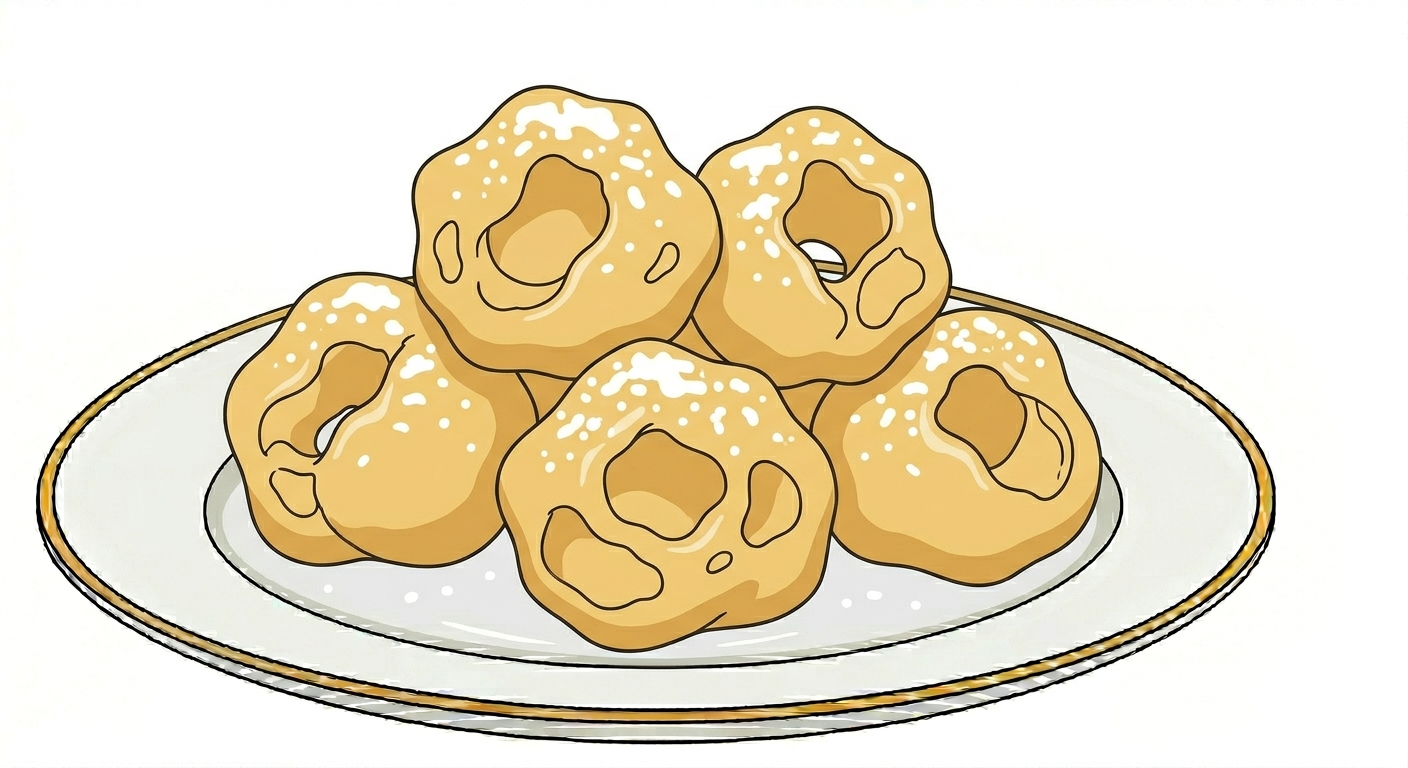
Buñuelos de viento are small, round fried puffs made from a choux-style dough — flour, butter, eggs, milk, and a pinch of salt, flavored with cinnamon and star anise — piped or spooned directly into hot oil, where they puff up into hollow, irregular spheres. The name means wind fritters, a reference to how light and airy they are — the interior is almost entirely empty, the wall of fried dough thin enough to collapse on the first bite. They are dusted with sugar, filled with pastry cream, whipped cream, chocolate ganache, or jam depending on the bakery, and eaten warm. Unfilled, they are simple and austere. Filled with cold cream against the warm dough, they are considerably more interesting.
The origin is genuinely layered. The broadest family of fried dough balls traces to Roman globos — flour and cheese fried in oil, described by Cato the Elder in the second century BC — and to Sephardic bimuelos, honey-soaked fried fritters made since at least the tenth century for Hanukkah, which fell close enough to All Saints Day on the calendar that the Christian adoption of the form was a natural borrowing. Moorish fritters fried in oil and dipped in honey represent a parallel and overlapping tradition. The modern choux-based form — lighter and more hollow than any of these predecessors — is associated with old Madrid, where buñuelos de viento were sold alongside churros at street stalls and cafés and appear in Francisco Martínez Montiño’s 1611 cookbook Arte de Cozina explicitly linked to All Saints Day observance. Convents and monasteries adopted and spread the recipe, as they did with most Spanish festive sweets, firmly fixing it to the religious calendar.
The folk belief attached to buñuelos de viento is specific: for each one eaten, a soul is released from purgatory. The lightness of the fritter — its near-weightlessness — made it a fitting symbol for that particular theological transaction. They are eaten across Spain from Andalusia to Catalonia on November 1st and 2nd alongside huesos de santo, and reappear during Lent and Carnival in some regions. The version that traveled to Latin America with Spanish colonizers was a simpler, flatter disc — the ancestor of the Mexican and Colombian forms — while the hollow choux puff remained the Iberian standard.
This content was created with the assistance of AI. Sources are currently being reviewed.