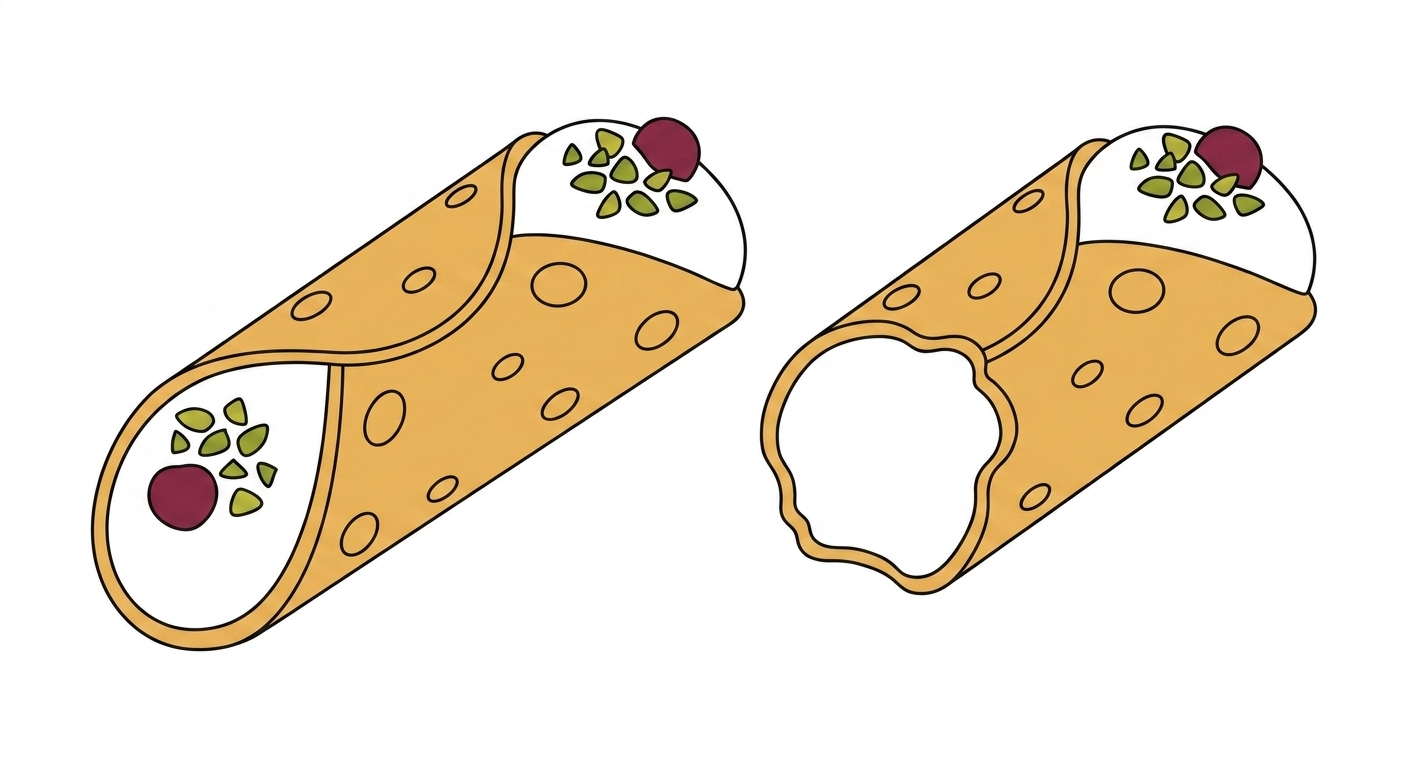
Cannoli are fried pastry shells — thin, blistered, and crisp — rolled into tubes around a metal form, deep fried in lard until golden, then filled to order with sweetened sheep’s milk ricotta. The shell is made from flour, lard, sugar, Marsala, and sometimes cocoa or cinnamon, rolled thin and wrapped tightly around the mold before frying. The filling is ricotta beaten with sugar until smooth, studded with chocolate chips, candied orange peel, or chopped pistachios depending on the region and the maker. Cannoli are filled at the moment of serving — a filled cannoli left to sit becomes a soggy one, and any Sicilian baker will tell you this unprompted. The ends are finished with a pistachio or a piece of candied fruit. The plural is cannoli; the singular, cannolo, is rarely used outside of Sicily.
The origin is placed in Caltanissetta during the Arab rule of Sicily between the ninth and eleventh centuries. The city’s name derives from the Arabic Qalʿat an-nisāʾ, meaning castle of the women, and the origin story — that the dessert was made by women in an emir’s harem, the tube shape a deliberate symbol of fertility — is repeated across food histories without being fully verifiable. What is documented is that Arab rule introduced sugarcane, almonds, and confectionery techniques to Sicily that permanently shaped the island’s pastry culture. Cannoli, cassata, marzipan, and torrone all belong to that inheritance. After the Norman conquest converted Sicily to Christianity in the eleventh century, convent kitchens absorbed the recipes. Nuns in Palermo kept and developed the cannoli tradition through the medieval period, preparing them for Carnival — the pre-Lenten celebration — and for feast days.
By the nineteenth century cannoli had spread from Sicily to mainland Italy, and with the large Sicilian migration of the 1880s and 1890s they arrived in the United States, where Italian-American bakeries in New York, Boston, and other cities with large Sicilian immigrant populations made them a fixture. American versions substituted cow’s milk ricotta for sheep’s milk ricotta, which is harder to source outside of Sicily, producing a milder, less tangy filling. The Godfather’s 1972 instruction to leave the gun and take the cannoli embedded the pastry permanently in American cultural memory. In Sicily the standard remains sheep’s milk ricotta from Palermo, filled to order, eaten immediately.
This content was created with the assistance of AI. Sources are currently being reviewed.