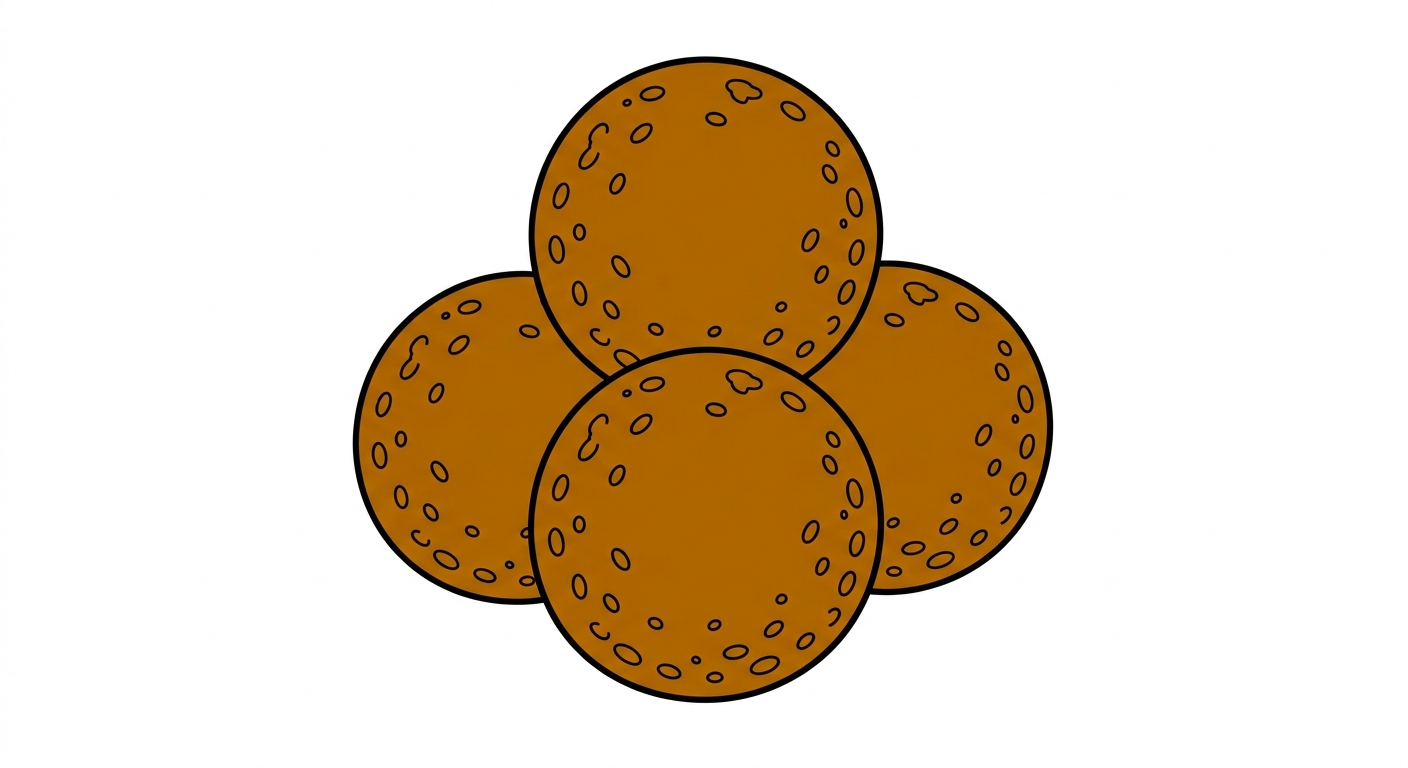
Cascaron are small, round, deep-fried rice balls — glutinous rice flour mixed with grated coconut, coconut milk, and sugar, rolled into golf ball-sized spheres and fried until the outside is crunchy and caramelized, while the interior stays dense and chewy in the way that glutinous rice always does when heat gets to it. They are sold on skewers, four to a stick, glazed with a syrup of brown sugar and coconut milk that sets into a sticky, dark lacquer. They are street food — bought from vendors at markets, festivals, and roadside stalls, eaten standing up or walking, finished before they cool.
The name is Spanish. Cascarón means eggshell, a reference to the rounded shape and the thin, crunchy exterior that gives way when you bite through it. The Spanish colonial period, which ran from 1565 to 1898, left a deep imprint on Philippine food culture — introducing wheat, deep-frying techniques, and a vocabulary for food that layered over the existing indigenous traditions without erasing them. Cascaron is a product of that layering: the core ingredients, glutinous rice and coconut, are entirely indigenous to the Philippine archipelago and fundamental to kakanin, the broad category of Filipino rice-based sweets that predates Spanish contact by centuries. What the Spanish period contributed was the deep-frying method and the name.
The Ilocos region in northwestern Luzon is most closely associated with cascaron, and Vigan — Ilocos Sur’s well-preserved colonial city and a UNESCO World Heritage site — is where the Spanish colonial influence on local food culture is most visible and most documented. Families in Vigan have been making cascaron for generations, passing the recipe through grandmothers and mothers in the same way that most Filipino sweets travel — by demonstration, by memory, and by the particular ratio of rice flour to coconut milk that each family considers correct.
The regional name variation is significant and worth noting. In the Tagalog-speaking regions, the same sweet is called carioca or karioka. In parts of the Visayas it is bitsu-bitsu. In some areas it is tinudok, referring to the skewer it is sold on. The Philippines is a archipelago of over 7,000 islands and over 180 languages, and food names shift across regions the way dialects do — the same object carrying different names depending on where you are standing when you eat it. All of these are cascaron. None of the names belongs to the others.
The syrup glaze distinguishes the finished cascaron from its uncoated form. The brown sugar and coconut milk reduce together into something dark, thick, and faintly smoky from the caramelization, and the balls are tumbled through it while still hot so the glaze clings and sets. Without the glaze the rice balls are good. With it they are the thing people remember.
This content was created with the assistance of AI. Sources are currently being reviewed.