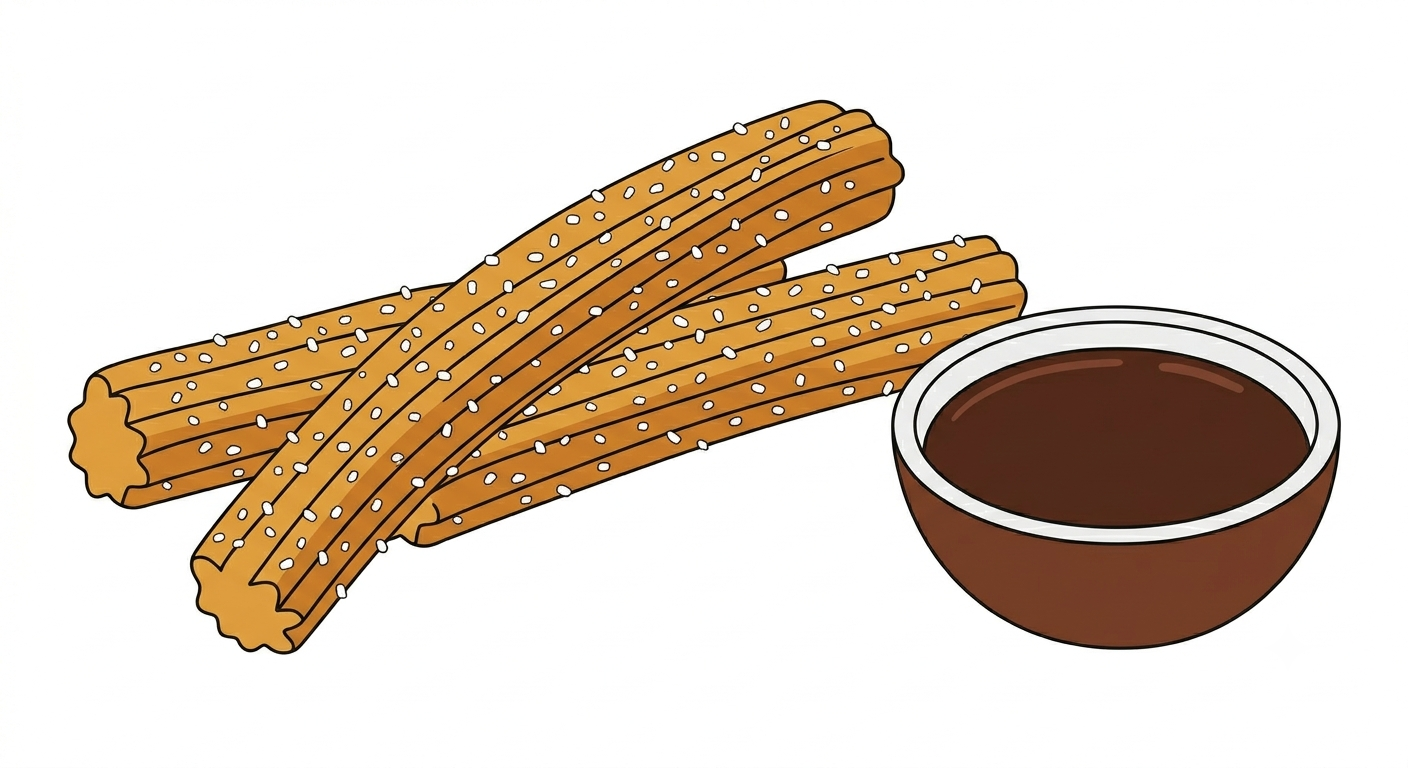
Churros are fried dough pastries made from a simple paste of flour, water, and salt, piped through a star-shaped tip and dropped into hot oil until the outside is crisp and golden and the inside stays soft and slightly doughy. They are eaten hot, rolled in cinnamon sugar, and served alongside a cup of thick hot chocolate for dipping — a combination so elemental that it has remained essentially unchanged for centuries. The star-shaped ridges are not decorative; they increase the surface area, which means more crunch per bite and more texture to hold the sugar.
The origins of churros are genuinely contested and the competing theories are all plausible enough to keep the argument alive. One attributes them to Spanish shepherds who developed a simple fried dough they could make over open fires in the mountains — the star tip mimicking the horns of the Churra sheep they herded, which is either the source of the name or a convenient post-hoc explanation. Another theory credits Portuguese sailors who encountered a similar fried dough in China and brought the technique back to the Iberian Peninsula, where it was adapted into what became the churro. There is also the straightforward possibility that frying dough in oil is an ancient and widespread technique that developed in multiple places independently.
What is well established is that churros became deeply embedded in Spanish daily life, particularly as a breakfast food. The combination of churros and chocolate is not a dessert in Spain — it is a morning ritual, available at dedicated churrerías that open early and close when the dough runs out. The Chocolatería San Ginés in Madrid, open since 1894, is the most famous of these and remains perpetually crowded at any hour.
From Spain and Portugal, churros traveled to Latin America with colonization and took on regional identities of their own. Mexican churros tend to be longer and thinner, often filled with cajeta or chocolate. Argentine churros are typically filled with dulce de leche. In the United States, the theme park and street fair version — cinnamon sugar, no dipping sauce — has become its own distinct cultural object, related to the original but operating in a different register entirely.
This content was created with the assistance of AI. Sources are currently being reviewed.