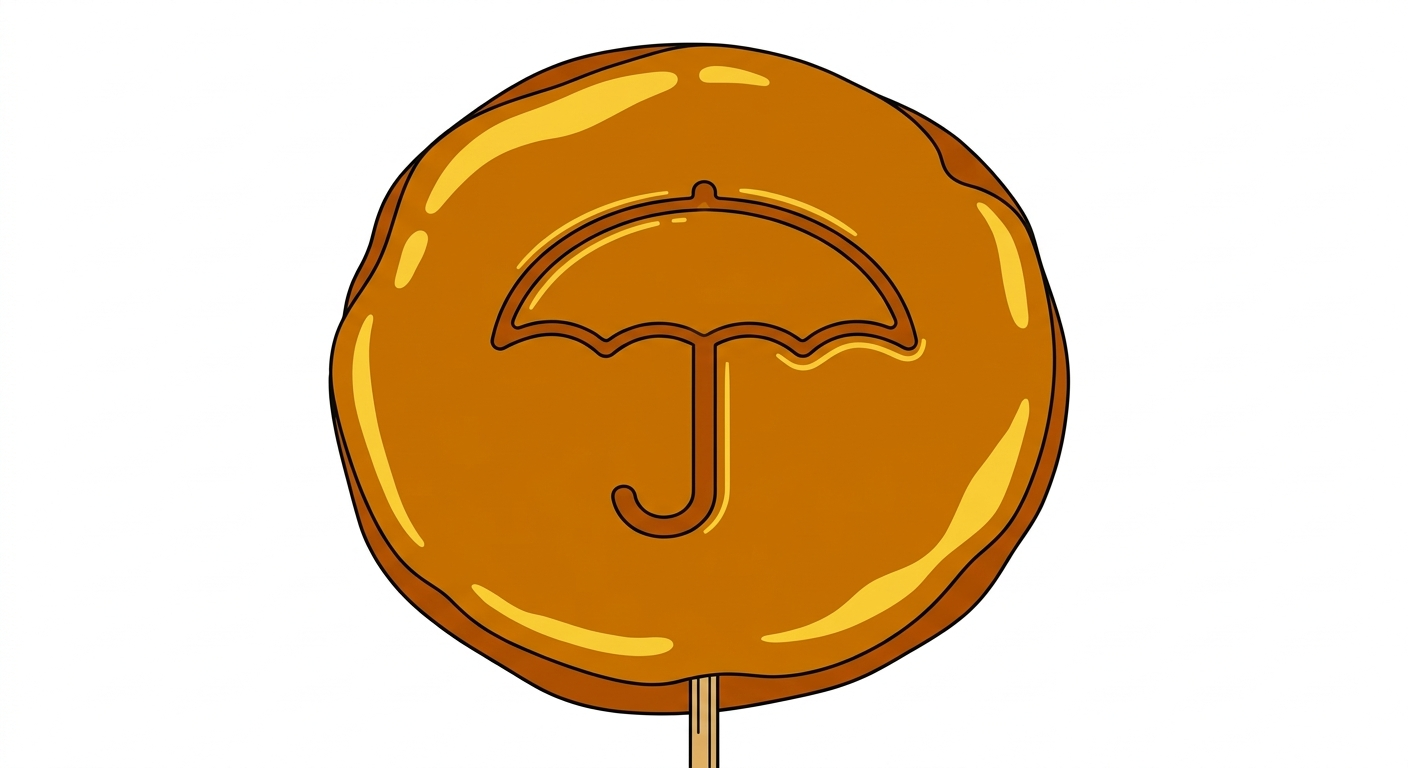
Dalgona is a flat disc of honeycomb toffee — sugar melted in a ladle over low heat until liquid, a pinch of baking soda stirred in quickly, the mixture foaming and expanding as the baking soda releases carbon dioxide and aerates the caramel, then poured onto a flat surface and pressed thin with a mould stamp that embosses a shape into the center — a star, a circle, a triangle, an umbrella — before the candy hardens. The result is a pale amber disc, crunchy and slightly bitter at the edges from the caramelization, sweet and airy within. The game attached to it is the point: you were supposed to extract the stamped shape from the disc without breaking it, using a needle or a pin, working carefully around the outline. If you succeeded, you got another one for free. If you broke it, you ate it anyway, which was always the plan regardless.
The name comes from the Korean word dalguna, meaning it is sweet — an observation so straightforward that it functions as a name. The candy itself is straightforward in the same way: two ingredients, one technique, no equipment beyond a ladle and a heat source. That simplicity was the reason it existed and the reason it spread.
Dalgona emerged in South Korea in the 1950s, in the years immediately following the Korean War. The war had left the country impoverished and its infrastructure in ruins, and the sweet treats that American soldiers had distributed during the occupation — chocolates, candies — had created a taste for sweetness among Korean children that their parents could not afford to regularly satisfy. Dalgona was the answer to that gap. Sugar and baking soda were cheap and available. A ladle over a gas flame required nothing beyond what a street vendor already had. The finished candy cost almost nothing to produce and could be sold for a few won outside elementary schools and in markets across the country.
The game element — the shape in the center that had to be extracted intact — turned a piece of candy into an interaction. Children took the dare seriously, working at the edge of the stamped shape with pins and needles, blowing gently on the candy to cool it, angling the light to see where the outline ran thinnest. Vendors charged for the game and gave free candy as the reward for winning, which meant the business model worked regardless of outcome. Everyone ate the dalgona eventually.
The candy declined through the 1980s and 1990s as South Korea’s economy grew and more sophisticated snacks became available and affordable. It became a nostalgia item — something associated with a specific era of Korean childhood, sold at retro-themed markets and occasionally by elderly vendors who had been making it the same way for decades. Then in 2021, Squid Game made dalgona globally recognizable in a single episode. The honeycomb disc with the stamped shape at its center, the needle, the desperate precision of the extraction game — all of it translated immediately to international audiences who had never seen it before, because the logic of the game is universal. The candy went from regional nostalgia to global reference point in the span of a streaming season, which is not the kind of trajectory any street snack is designed to handle.
The candy is the same as it ever was. Sugar, baking soda, heat, a ladle, a flat surface, a mould. Everything else that happened to it is external.
This content was created with the assistance of AI. Sources are currently being reviewed.