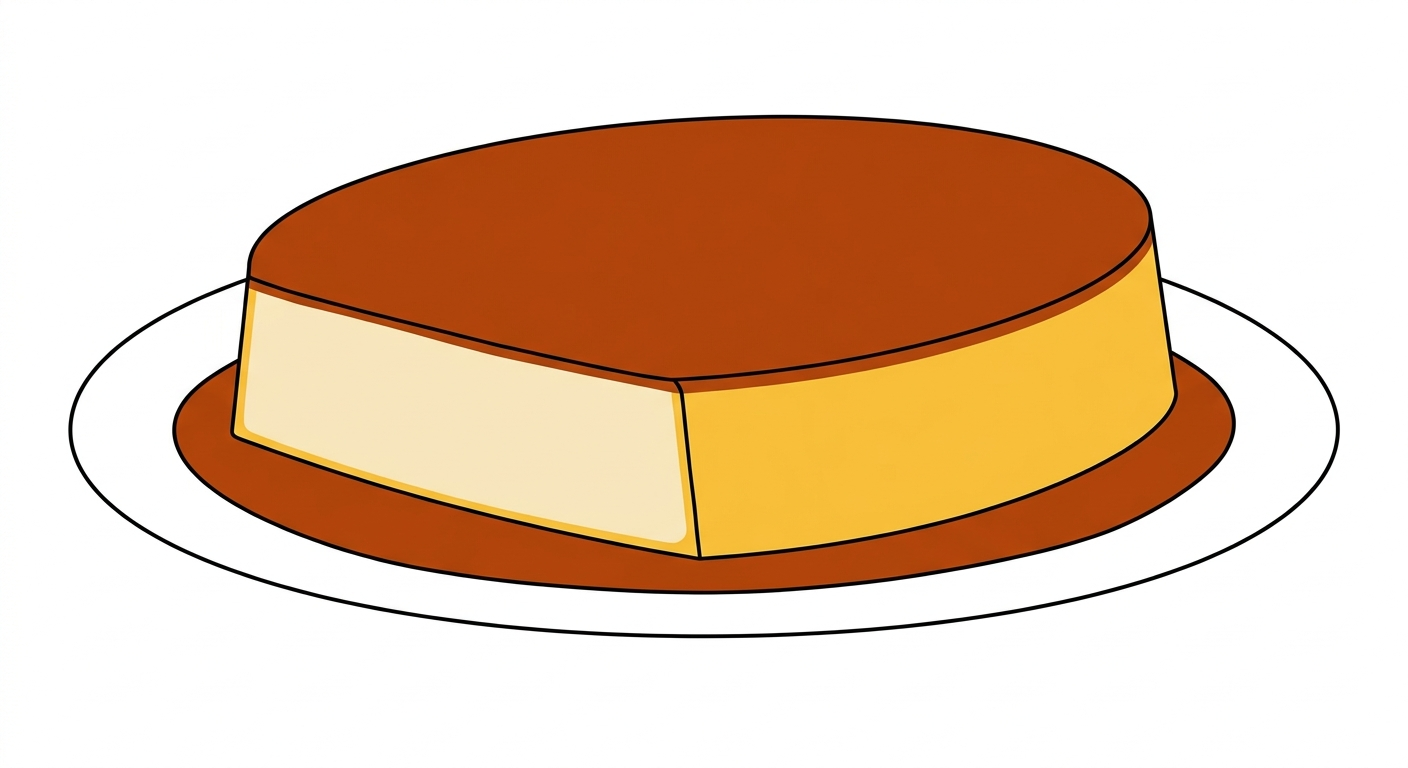
Leche flan is a steamed custard — egg yolks, condensed milk, evaporated milk, and sugar poured into an oval metal mold called a llanera lined with dark caramel, then covered and steamed until the custard sets firm and silky. When unmolded, the caramel runs down over the pale yellow custard in dark amber rivulets. The texture is denser and richer than a French crème caramel — the extra yolks and the condensed milk give it a weight and sweetness that is specific to the Filipino version and that most people who grew up eating it consider definitive. It is served cold, sliced at the table, and eaten at every celebration that matters — fiestas, birthdays, Christmas, New Year, and any gathering significant enough to warrant dessert.
The name is Spanish. Leche means milk and flan is flan — the caramel custard that Spain brought with it when it colonized the Philippines in the 16th century, a dessert whose own roots trace back through Medieval Europe to the Roman crustade. Spanish flan traveled to the Philippines the same way Spanish food traditions traveled everywhere Spain colonized — through the households of colonial administrators, through the kitchens of Catholic missionaries, and through the Catholic feast culture that structured Filipino social and religious life for over three hundred years.
The egg yolk origin story is among the most specific and most repeated in Philippine food history. Spanish missionaries building churches across the archipelago used egg whites as a structural adhesive, mixed with quicklime to bind stone. The practice was widespread enough that the dome of the Manila Cathedral, sealed in 1780, is documented to contain a layer of duck eggs as structural reinforcement. This left enormous quantities of egg yolks with nowhere to go. Filipinos who found them — floating in rivers near construction sites, disposed of in quantities no household kitchen could absorb — began cooking them into custards. The leche flan that emerged from this improvisation became one of the most beloved desserts in the country.
What changed the recipe from its Spanish origin into something specifically Filipino was time, local ingredients, and one outside addition. The Spanish flan de leche used fresh milk. Filipino leche flan shifted to carabao milk — water buffalo milk, richer and higher in fat than cow’s milk, which gave the custard a particular depth available nowhere else. When the American colonial period arrived after 1898, it brought canned condensed and evaporated milk, which proved more consistent and more practical for large-batch production than fresh carabao milk. The modern recipe uses both, and the result is denser and sweeter than the Spanish original.
The llanera is the other distinctly Filipino element — the oval, lidded metal mold that replaced the Spanish round ceramic ramekin and became the standard vessel for making and serving leche flan across the country. A household with a llanera is a household that makes leche flan. The mold is passed down alongside the recipe, the specific oval shape as recognizable in the Philippines as the fluted edge of a tart pan in France.
Leche flan sits on top of halo-halo as its most celebratory component, appears in bakeries as an individual portion dessert, and is made at home in batches large enough to feed a fiesta. It is the dessert that most immediately communicates Filipino hospitality — made in advance, served cold, requiring enough eggs and enough time to signal that the occasion mattered. A plate of leche flan on a table is a statement that someone worked for this, which in Filipino food culture is the clearest possible expression of welcome.
This content was created with the assistance of AI. Sources are currently being reviewed.