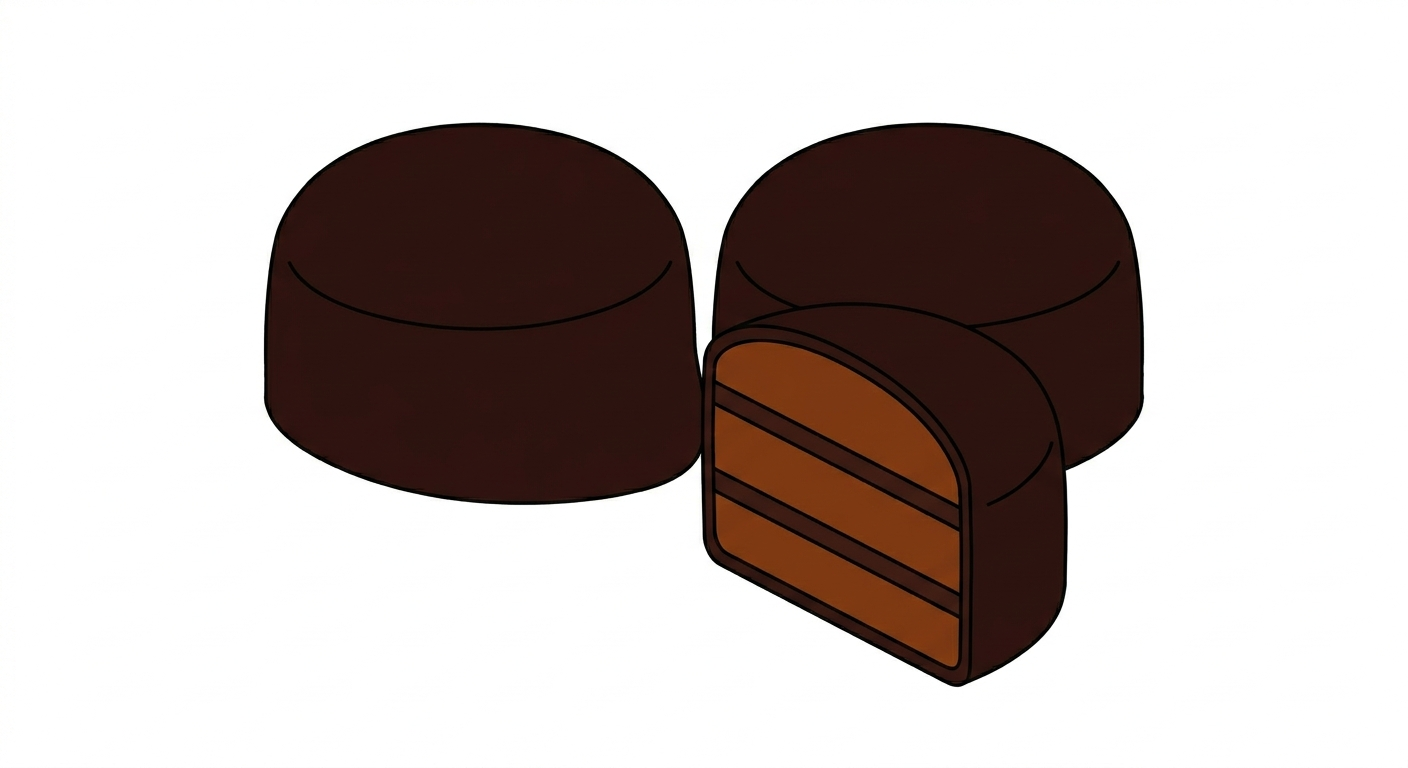
Pão de mel — honey bread — is a small, individually portioned cake made from a spiced honey batter, cut in half, filled with doce de leite, and coated entirely in chocolate. The base is dense and moist, flavored with cinnamon, cloves, and nutmeg, and despite the name, the honey is more structural than dominant — the chocolate coating and spices take the front. The chocolate shell serves a practical purpose beyond flavor: it seals in moisture and extends shelf life, which makes pão de mel well-suited to gifting. It appears at weddings, birthday parties, and holiday tables, often packaged individually and handed out as favors. The doce de leite filling is standard, though brigadeiro and guava paste also appear by region and preference.
The origin is genuinely contested and falls into two theories that food writers tend to present without resolution. The first traces pão de mel to Russian pryaniki — honey and spice cookies coated in sugar glaze, brought to Brazil by Eastern European immigrants, particularly from the Russian Empire and later from Eastern Europe more broadly during the late nineteenth and early twentieth centuries. The second and more commonly cited theory connects it to the broader European tradition of spiced honey cakes — German Lebkuchen, French pain d’épices, Portuguese broa de mel — carried to Brazil through Portuguese colonization and later German and central European immigration. The chocolate coating is the Brazilian innovation in either case, likely adopted because it solved the preservation problem that the original sugar or fondant glazes on European equivalents addressed less effectively in a tropical climate.
What is consistent across accounts is that pão de mel is a product of Brazil’s layered immigration history rather than a single point of origin. It circulates today primarily as a gift food — the kind of thing made in batches, wrapped individually, and given rather than served at a table. Bakeries and home confectioners both produce it, and the quality range is wide: the best versions have a thin, snapping chocolate shell and a filling that hasn’t been oversweetened into paste.
This content was created with the assistance of AI. Sources are currently being reviewed.